
By Caribbean News Global 
DOMINICA / DUBAI – MMC Development Ltd has initiated formal arbitration proceedings against the government of Dominica, as noted in the article ‘Rebuilding a Nation: MMCD’s Expanding Footprint in Dominica’ published March 30, 2026.
Of consequence, many are unable to get answers to the question: ‘Could this arbitration result in the suspension of the airport project?
Inherent risks
CNG’s exclusive interview with Cal Murad, project director of MMC Development Ltd., underlined:
“ That is the gravest possible outcome, and it is emphatically not the outcome we desire. We are fully conscious of what suspension would mean for everyone, including MMCD, as well as the country. I hope that it does not come to that. I am hopeful that we will see an amicable resolution to the current dispute,” project director MMC Development Ltd., Murad, continued. “The interview ends, but the uncertainty does not,” Murad emphasised: “Somewhere on a hillside in Dominica, earthmovers are still turning soil for an airport that will transform the lives of Dominicans for generations to come.”
Confidentiality proceedings that are more private than the court of law is keeping matters under wraps, as regulated by statute. As required, a neutral third party/arbitrator is duty-bound to review evidence and arguments towards a legally enforceable decision.
Meanwhile, there are obligation concerns surrounding approximately 1600-plus Chinese and other construction workers and various equipment. And the carrying cost of approximately USD10 -15 million construction payables per month.
In tandem with the formal arbitration outcome, the interconnectedness of different expertise necessitates flexibility, capable of taking many forms, which can influence speed, technical issues, including contract claims, that may involve breach of contract, nonpayment, vendor disputes, tort disagreements, construction issues, indemnity disputes, licensing conflicts, and business transgressions linked to construction and financing agreements.
In furtherance of the arbitration proceedings, what may have given rise to the Dominica Airport Project, ‘distinction’ is a valid point of reflection and understudy.
There is likewise the politics vs development concerns and the current mystery, that have many wondering “ if backpeddling and clever politicians overplayed their hands.”
On the revenue side, there are alleged “anxieties about Dominica’s CBI and related revenue streams, contracts, and guardianship.”
Dominica’s size and population, approximately 65,500 people, and its economy of scale, factor into the cost of the Airport Project [XCD $1.4 billion] operational cost, and to achieve targeted investment returns and profitability.
Will there be construction demobilisation at the Airport Project?
Applying pressure points and leverage to recover ongoing construction liability in situations that exceed USD 250 million is not unforeseen in high-stakes manoeuvring, that calls for ‘ The Art of the Deal.’ Historically, when construction liability is unresolved, construction demobilisation becomes practical. (Re-mobilisation comes at an extra cost, paid upfront.)
Other emerging risks and vulnerabilities, in law, speak to an interlocutory injunction (prohibitive or mandatory), a temporary court order, ‘protects a party from irreparable harm.’ The relevance of this is to preserve time, worries about exposures to business vulnerabilities, and to allow for a final decision to be made, ensuring effective relief.
In any circumstance, irreparable harm must be protected, and a balance must be struck to avoid irreparable loss and injury.
A better understanding of the risks associated should appropriately calibrate the exposures that support economic growth and development.
The challenge that emerges demands financial and political influences to step in and maintain soundness by ensuring well-capitalised and structured agreements are not comprehensively assessed and deploy external assets.
Dominica – MMCE signs agreement to construct international airport
The government of Dominica, on June 9, 2021, in an elaborate ceremony, officially signed an agreement with Montreal Management Company (MMCE) to construct the airport funded entirely by the country’s Citizenship by Investment (CBI) Programme.
China Railway No.5 Engineering Group Co., Ltd., “CR5”, won the contract for the Dominica International Airport project [XCD $1.4 billion].
Chinese firm chosen as Dominica International Airport contractor
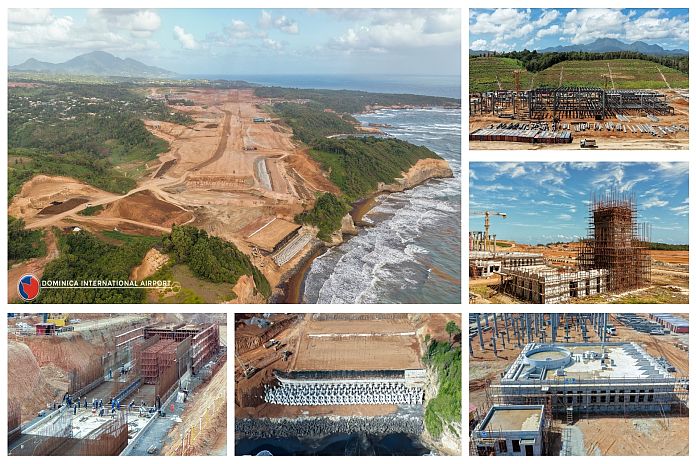
Set to be completed in 2027, the Dominica International Airport will be the game changer for the “nature island” – opening up a world of opportunities for socio-economic growth, the Dominica International Airport said on its website, featuring construction updates – “ the biggest contracted project not only in the history of Dominica but also in the history of the Eastern Caribbean region, to date.”
Evolving landscape
Construction of Dominica’s International Airport continues to make significant and measurable progress, prime minister Roosevelt Skerrit announced in April 2026. The project, expected to redefine Dominica’s economic future, is designed to improve global connectivity, expand opportunities for trade and investment and strengthen tourism.
Prime Minister Skerrit, in his end-of-year press conference, announced that the airport remains on schedule for completion in 2027.
“We are building an airport to unlock opportunities for trade, investment, education and direct global access. We are building it so that our young people can dream bigger. We are building it so that Dominica can stand confidently among developing nations with first-class, modern infrastructure,” prime minister Skerrit advised.
Preserve corresponding roles
In light of these redemptions, an approach that recognises the need to address inappropriate risk means eliminating punitive capital market conditions.
Recognising these challenges, there should be no mystery about strengthened government capital and liquidity, to promote infrastructure development, address legitimate financial gaps, and mitigate excessive and underlying risk to contractual obligations.

About the Author