



ITC News
GENEVA, Switzerland – From Ethiopia to Honduras, a new training partnership shows coffee producers and cooperatives how to understand specialty markets, gain skills to connect with the right buyers, and tell their story with confidence. The goal is to evolve from simply delivering their coffee to actively selling it.
Knowing you produce exceptional coffee is one thing. Knowing how to position it, price it, and present it to specialty buyers is another. And for many smallholder producers and cooperatives at origin, that second step remains out of reach.
To help close that gap, the International Trade Centre (ITC) has partnered with the Specialty Coffee Association (SCA) and the International Coffee Organization (ICO) to deliver a series of practical workshops under the banner ‘Introduction to Specialty Coffee Markets.’
Rolled out through ITC’s ACP Business-Friendly and CLEAR Supply Chains projects, the programme is designed to strengthen market readiness and commercial positioning for coffee producers across origin countries.
The first edition took place on 3 February 2026 in Addis Ababa, Ethiopia, gathering 21 participants – including cooperative representatives from Uganda – for a full-day, hands-on session delivered by Sara Yirga, a certified specialty coffee trainer and ITC consultant based in Ethiopia.
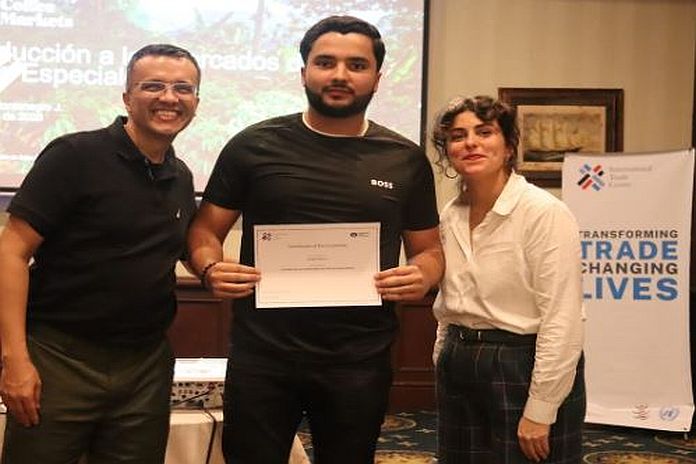
This session followed on 19 March in San Pedro Sula, Honduras, with 32 participants – 17 men and 15 women – drawn from cooperatives and producer organizations across the country. It was led by Andrés Montenegro, SCA’s Sustainability Director. A third edition is planned ahead of World of Coffee Brussels which takes place on 24 June this year, with further editions planned across producing countries before year’s end.
This pilot workshop is one that partners have committed to expanding with the aim of building further knowledge and skills in coffee-producing countries. Each workshop follows the same three-part structure: understanding what makes a coffee ‘specialty’ and how farm-level decisions shape quality; identifying the right market segment for a given coffee profile; and learning how to communicate effectively with buyers: telling the cooperative’s story in a way that resonates across cultures and commercial contexts.
The Honduran edition brought together voices from across the value chain, including cooperatives, roasters, and exporters. Participants described the training as a turning point in how they think about their place in the global specialty market.
Feedback from the Ethiopia workshop pointed to immediate, practical shifts: participants reported plans to approach different markets with greater specificity, tailor their farm stories to different buyer profiles, and engage more proactively in the wider coffee world through events and social media.
With editions spanning two continents and more coffee-growing countries targeted on the horizon, the partnership signals a shared commitment: that the knowledge needed to compete in specialty markets should be as accessible at origin as it is anywhere else in the chain.
The ACP Business-Friendly Programme is funded by the European Union and the Organisation of African, Caribbean and Pacific States (OACPS) and jointly implemented by ITC’s Alliances for Action, the World Bank and UNIDO. It seeks to improve the ability of agribusiness firms in ACP countries to compete, grow and prosper in domestic, regional, and international markets. Through the Alliances for Action approach, it promotes inclusive and sustainable agricultural value chains that value all stakeholders from farm to shelf.
PilotingiInnovative alliances to address root causes of child labour in supply chains
The “Ending child labour in supply chains: Addressing the root causes of child labour in supply chains through an area-based approach” (CLEAR Supply Chains) project, funded by the European Union, brings together the International Trade Centre (ITC), the International Labour Organization (ILO) as the leading UN agency, the Food and Agricultural Organization (FAO), the International Trade Centre (ITC) and the United Nations Children’s Fund (UNICEF) to address jointly the root causes of child labour, with a primarily focus on the coffee supply chain.
ITC provide technical assistance and support farmer organizations and micro, small and medium enterprises (MSMEs) and value chain actors in the implementation of strategy options for increasing commercial value, sustainability, Human Rights and Environmental Due Diligence (HREDD) alignment and incomes for smallholder farmers in the coffee supply chain and associated crops in project countries (Uganda, Honduras, DRC and Vietnam).