



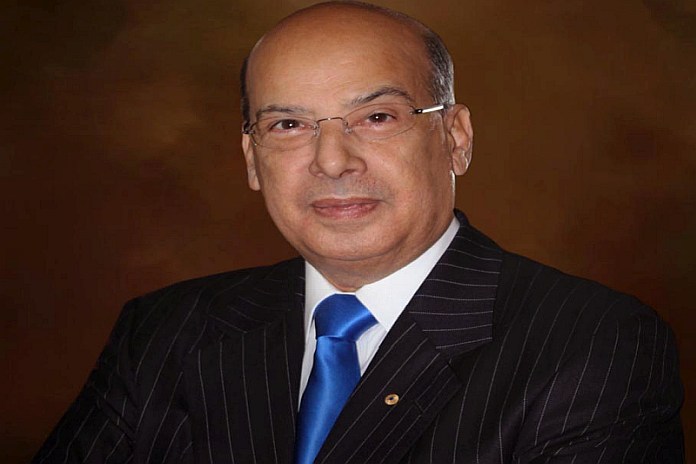
By Sir Ronald Sanders
An attempt is now being made by a few member states of the Organization of American States (OAS), using procedural manoeuvres, to prevent a proposed “Declaration on the Rights of Persons and Peoples of African Descent” from proceeding to the OAS General Assembly scheduled to be held in Panama next month.
Debate on this fundamentally important declaration should have been near its end by now, leaving the way clear for consideration and adoption by the General Assembly, the highest decision-making body of the OAS.
Normally, the positions expressed in my weekly commentary reflect my own views. I am pleased to say that this commentary has the full support of the Government of Antigua and Barbuda, whose Prime Minister, Gaston Browne, instructed that “We stand on the principles of justice, truth and right… We should never cower in defending these principles”.
The proposed Declaration is the product of a negotiating process of a Working Group of the Committee on Juridical and Political Affairs (CAJP) of the OAS, led principally by Brazil and Colombia, and involving numerous member states across the hemisphere, including Antigua and Barbuda.
Yet, some countries are now seeking to block the Declaration from proceeding, advancing arguments that ring hollow. Among them is the claim that “more time” is needed. But the evidence of history is not obscure. The denial of rights to peoples of African descent in the Americas is not a recent discovery. It is written into centuries of slavery, colonial exploitation, racial discrimination, exclusion, and dispossession. To say now that more time is required risks appearing less as a procedural concern than as an effort to avoid acknowledging truths that have long been plain.
The countries of CARICOM, with majority or significant populations of African descent, are among the few places in the hemisphere where those systems have been most consciously challenged. They have done the most to dismantle the structures built on that history.
The draft Declaration seeks to affirm, within the Inter-American system, principles relating to equality before the law, protection against racial discrimination, access to justice, political participation, education, development, cultural identity, economic and social inclusion, and recognition of the continuing effects of slavery and colonialism upon peoples of African descent in the hemisphere.
The draft also addresses matters such as the preservation of cultural heritage, the pursuit of reparatory justice, the collection of disaggregated data to expose racial inequality, fair access to education and employment, protection against racial profiling and discrimination in the administration of justice, and measures aimed at improving participation and representation in public life.
In several respects, the Declaration seeks to encourage member states to confront enduring structural inequalities affecting peoples of African descent and to adopt public policies directed toward equality, inclusion, dignity, and opportunity.
Antigua and Barbuda has long played a constructive leadership role within the Inter-American system in confronting racism and discrimination. Our country served as Chair of the OAS Working Group to draft Legally Binding Instruments Against Racism, Discrimination and All Forms of Intolerance, a process that helped to usher in the adoption of two important Inter-American instruments addressing racism and all forms of discrimination in the hemisphere.
CARICOM countries were significantly shaped by the forced labour, suffering, endurance, and resilience of their ancestors. The prosperity of colonial powers was built in significant measure upon that exploitation. The freedom and dignity that the peoples of CARICOM countries now enjoy were won through generations of resistance, sacrifice, and struggle by those who came before us, including the indentured labourers from India and Madeira. Their descendants, too, joined the wider struggle for African liberation everywhere.
The names of those struggles, from slavery to the end of colonial rule, still echo across the Caribbean: Toussaint Louverture and Dessalines of Haiti; Nanny and Marcus Garvey of Jamaica; Bussa and Barrow of Barbados; Cuffy, Jagan and Burnham of Guyana; Prince Klaas, V.C. Bird and Tim Hector of Antigua.
These men and women were asserting the humanity, equality, and dignity of African peoples in societies designed to deny all three.
Therefore, CARICOM nations would be untrue to their own history, untrue to the memory of their ancestors, and untrue to all those who fought against racism and colonial domination if they do not support a serious hemispheric declaration affirming the rights, dignity, equality, and historical experience of peoples of African descent.
That support does not mean that every word of the current draft is settled or agreed; like many multilateral texts, it contains provisions still under discussion and consultation among states. That is the normal process of multilateral negotiation.
However, what must not happen is the prevention of the Declaration from proceeding at all to the OAS General Assembly in Panama. The General Assembly is precisely the forum where governments should demonstrate their individual dedication and the commitment of the OAS, as an institution, to more rights for more people, as former Secretary General, Luis Almagro, so often proclaimed. To prevent consideration altogether would be contrary to the spirit of dialogue and multilateral engagement that the OAS is intended to uphold.
There is no justifiable reason for this issue to become a source of unnecessary confrontation within the hemisphere. The rights and dignity of peoples of African descent should not be viewed as a partisan or ideological matter. They are matters of history, justice, equality, inclusion, and human rights.
We would like all OAS member states to join Colombia, Brazil and the 14 CARICOM members in support of this Declaration, which is entirely consistent with the history, values, and constitutional democracies that fashioned the OAS and its many declarations, resolutions and statements of commitment to human dignity and equality for all peoples.
OAS member states should also remember that the General Assembly is being held in Panama, where the Canal that enriched world commerce and transformed global shipping was built largely by the labour, sacrifice, suffering, and deaths of thousands of African descendants from the Caribbean. The moral question could not be clearer.