



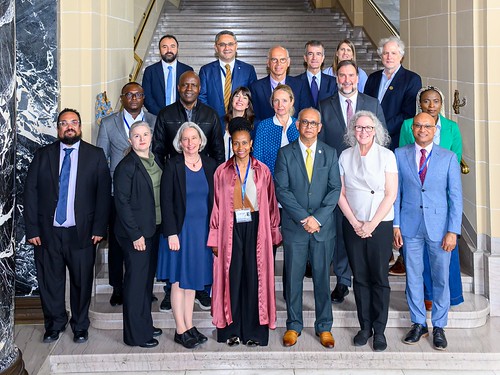
WASHINGTON, USA – The Organization of American States (OAS) hosted, on May 12–13, a meeting of the Convening Committee for the Implementation Meeting of the Declaration of Principles for International Election Observation (DoP), an instrument that establishes global standards for independent, impartial, and credible election observation.
The meeting brought together representatives from organizations including the United Nations, the European Union, the European Parliament, the Organization for Security and Co-operation in Europe’s Office for Democratic Institutions and Human Rights (OSCE/ODIHR), the Commonwealth Secretariat, as well as The Carter Center and the National Democratic Institute, in preparation for the next DoP Implementation Meeting to be held in December 2026 in Antigua, Guatemala, organized by the OAS.
In this context, OAS secretary-general, Albert Ramdin, underscored the importance of strengthening cooperation among organisations that face similar challenges in election observation at the global level: “In a context of increasing polarization and growing pressure on electoral institutions, it is essential to strengthen institutional cooperation among organizations confronting common challenges in observing electoral processes worldwide. The OAS General Secretariat remains committed to contributing to that collaboration.”
OAS secretary for strengthening democracy, Sebastián Kraljevich, emphasised that the Organisation particularly welcomes the fact that the next DoP implementation mMeeting will be held for the first time in Latin America this year, noted:
“Hosting this meeting is especially meaningful for the OAS, as it coincides with the 25th anniversary of the Inter-American Democratic Charter, a fundamental instrument for promoting and defending democracy in our hemisphere and a key framework guiding the electoral observation work carried out by our Organisation in the region.”
Director of the department of Electoral Cooperation and Observation (DECO), Gerardo de Icaza, stated:
“The development of methodologies based on international standards, shared experiences, and best practices is essential for the continuous professionalisation of election observation, particularly in a global context in which an increasing number of actors are engaging in commentary on electoral processes.”
The Declaration, signed at the United Nations in 2005 and currently endorsed by more than 50 organisations, constitutes a key reference framework for election observation worldwide.
In this context, the meeting at OAS Headquarters provided an opportunity to exchange experiences on current challenges —such as disinformation, political polarisation, and the impact of new technologies— advance working sessions on the organisation and content of the upcoming meeting in Guatemala, and strengthen coordination among institutions operating across different continents.