



By Kadasi Ceres
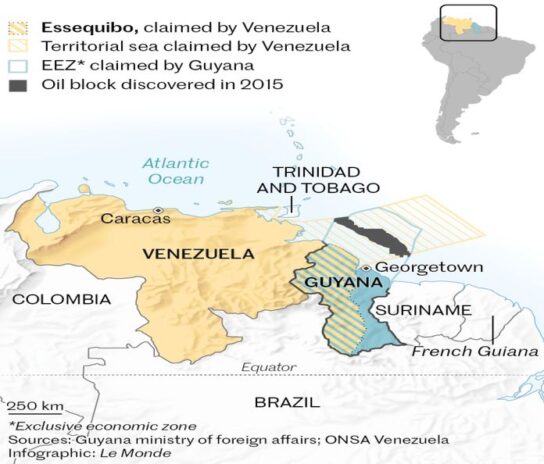
Venezuela’s heightened aggression towards Guyana over its Essequibo claims also corresponds to the substantial discovery of oil in the Stabroek Block, a 26,000 km2 area adjacent to the Essequibo coastline, in 2015. Oil and gas exploration in this ‘super-basin’ was led by the US-based Exxon Mobil, whose assets in Venezuela had been nationalised in 2007 as the Chavez government implemented its nationalist anti-imperialist political agenda. Resultant sanctions imposed by the USA, and the contraction of the Venezuelan oil and gas sector, precipitated the economic decline of the country. Since 2019, the economic and political crisis in Venezuela has resulted in significant outward migration. It is estimated that almost eight million Venezuelans have left the country since 2015, and there are now thought to be 100,000 Venezuelans in Guyana.
As the Essequibo case meandered through the International Court of Justice system, Venezuela’s aggressive posture towards Guyana continued with a ‘consultative referendum’ on the future of the disputed region in December 2023 (International Crisis Group, Citation2025); in May 2025, the Maduro government also announced a Venezuelan Governor of the Essequibo region. Guyana raised these matters at the ICJ, requesting immediate provisional measures.
The ICJ responded, indicating binding measures on both parties. Meanwhile, the regional organisation, CARICOM, took up the issue and along with Brazil convened a meeting between Presidential delegations from both Guyana and Venezuela. This resulted in the Argyle Declaration in December 2023, an 11-point agreement between the two countries that pledged both sides’ willingness to refrain from actions that might escalate the controversy. This agreement was overseen by three regional prime ministers as well as the President of Brazil.
The massive US military build-up in the Caribbean in the latter part of 2025, as well as strikes on alleged drug boats, increased American pressure on president Maduro, culminating in his seizure by US forces on 6 January 2026. While the Trump Administration’s action has set alarm bells ringing among developing countries as it directly violated international law and the United Nations Charter, the prime minister of fellow CARICOM member Trinidad and Tobago endorsed this action on the pretext of combating transnational crime. This is in sharp contrast to the rest of the CARICOM grouping, which has argued for the region to remain a zone of peace.
While Guyana has always been wary of a potential Venezuelan invasion – Venezuelan military capability grossly exceeds the Guyanese security forces – the Georgetown government has conducted its foreign policy in accordance with international law. Notwithstanding Venezuela’s occupation of Ankoko Island and its continued aggression towards the country, it is hoped that Guyana’s move towards a full and final settlement of its land borders with its neighbour may finally remove this obstacle towards full realisation of the country’s development potential.
While the possibility of an imminent invasion may have receded at the moment, subsequent economic and political developments, especially related to the unfolding political response by the Venezuelan regime, will influence Venezuela’s position on the territorial controversy. At present, the USA’s deep engagement in Guyana and Washington’s influence in Venezuela, which is particularly focused on the oil and gas sector, will ensure that even after the ICJ announces its decision in 2026/2027, the possibility for Venezuelan aggression towards Guyana seems slim. Nevertheless, the Essequibo region issue is of considerable popular and political significance in Venezuela and transcends any political administration; hence, the USA’s political landscape and resulting focus will play a massive role in any long-term solution to the territorial controversy.
Kadasi Ceres is with the Department of Government and International Affairs, Faculty of Social Sciences, University of Guyana, Greater Georgetown, Guyana.