



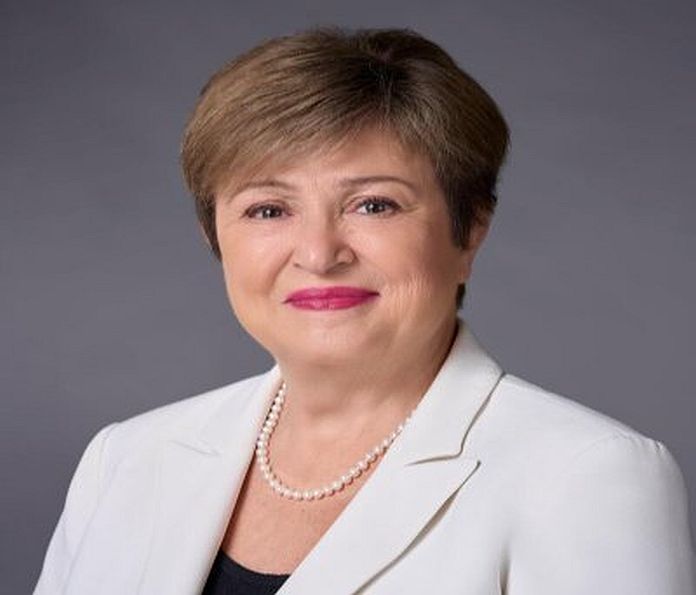
- Each time I come to Poland, I recall my first visit, in 1980. The Cold War was still on, store shelves were empty, and life was a struggle for many. I was a young professor visiting the Wroclaw University of Economics. Our hosts were gracious, but these were times of scarcity and they could not offer to treat us to a nice meal. Fortunately, you can count on the people of Poland to be creative: to show their hospitality, they offered us driving lessons. That is how I learned to drive—in a little Fiat, made in Poland.
- On my way here today, it was amazing to see how far the country has come. This is testimony to the Polish miracle—the transformation of an economy that was languishing behind the Iron Curtain into the largest in central Europe and one of Europe’s most dynamic. These days, you are producing exciting startups like Polish-founded ElevenLabs, whose software creates incredibly realistic AI-generated voices—though I promise, this is really me speaking right now!
IMF managing director’s keynote speech at the 2026 Impact Conference, Poznan, Poland
Today I would like to reflect on Poland’s remarkable journey—and on the lessons it holds for Europe.
First, a little-known fact. Poland was one of the original signatories at the historic Bretton Woods conference in 1944 that led to the creation of the IMF and World Bank.
Unfortunately, history took a different turn, and Poland was not able to join the Fund until four decades later, in 1986. As many of you will recall, the Polish economy was then in a bad state. Incomes per person were about 40 percent of Western European levels. And shortages of goods and housing were severe.
What happened next is one of the best success stories of our times. Over four decades, Poland raised incomes to roughly 80 percent of the EU average. It is now competing to be the 20th largest economy in the World, projected to surpass Japan and Spain in per‑capita terms and may soon approach South Korea.
Let me put this success story in a more global perspective: excluding financial hubs and oil exporters, Poland has had the second fastest rate of income convergence in the world over the past 20 years.
In many countries, such rapid growth comes with social and environmental imbalances. Not in Poland.
Income inequality has declined over the past decade. And over the past 30 years, Poland’s greenhouse gas emissions dropped by 18 percent and its emissions intensity per unit of output declined by much more than in advanced Europe.
Bottom line: Poland has shown that fast, sustainable, and inclusive growth is possible. How did Poland do this—and what lessons can we take from it?
First lesson: the importance of strong institutions and macroeconomic stability.
In the 1990s, Poland dismantled decisively with a big bang the extractive incompetent institutions of communism and built the institutions of an inclusive market economy.
Next, driven by its EU accession path, Poland deepened those reforms. It restructured the steel and coal sectors, adapted farming to the common agricultural policy, and strengthened the rule of law.
The strength of Poland’s institutions laid the foundations for its excellent economic performance and its ability to respond to shocks. Benefitting from a strong, independent central bank, Poland saw inflation average just 2 percent between 2000 and 2020, even as it maintained a floating exchange rate. And prior to the pandemic, public debt was only 45 percent of GDP, giving Poland space to respond forcefully to COVID and, when circumstances demanded, to invest heavily in national security.
Second lesson, openness. Poland steadily reduced trade barriers, with average tariffs falling 90 percent over three decades. This has given Polish firms low‑cost access to global inputs.
Poland also opened up to foreign investors, attracting foreign direct investment equal to around 50 percent of today’s GDP—more than any other Central and Eastern European country.
That investment brought technology and knowhow. In the past 20 years, Poland’s productivity has grown at an average annual rate of three percent. By comparison, other Central, Eastern and Southeastern European countries saw 2 percent growth, and the euro area only 1 percent.
These are important lessons for the rest of the region and beyond: Stronger institutions, increased openness, more integrated labor markets and capital accumulation increase productivity and accelerate income convergence.
This brings me to my final point: what does Poland need to do to sustain its success?
Here, let us acknowledge that all countries face a daunting global environment: EU countries are exposed to higher trade barriers, increasingly fragile supply chains, and rising competition for rare materials.
And Europe is facing yet another energy-supply shock, this time from the conflict in the Middle East. And while the shock so far is smaller than in 2022, this time European countries have even less policy space to respond.
At home, Poland also faces challenges. It ran Europe’s second largest fiscal deficit last year, partly due to higher defense spending. Its working‑age population is declining. And despite strong technology adoption, home‑grown innovation needs a boost.
Part of the solution lies in reaffirming Poland’s hard‑won reputation for prudent macroeconomic policy. Against the latest energy supply shock, the National Bank of Poland needs to maintain a clear focus on price stability. Fiscal support should be well-targeted to vulnerable households.
More broadly, macroeconomic stability requires reducing the fiscal deficit. How that is achieved—whether through higher taxes or lower spending, or some mix of the two—is for Poland to decide. But adjustment should not be postponed for too long.
On defense spending, let me say a few words. As Poland knows well, strengthening national security is costly. Our research also shows that defense buildups tend to deliver little growth in the short term, especially when equipment must be imported. Accumulating debt to finance defense, with a limited boost to growth, is not a sustainable mix.
To make sure national security does not come at the expense of economic stability, two priorities stand out. First, spend better: coordinate across Europe to avoid duplication and capture scale. And second, build Europe’s own ecosystem for startups—including in Poland, so defense spending strengthens R&D and innovation at home.
Indeed, continued strong productivity growth will be key to sustaining Poland’s momentum—and that will require more progress on structural reforms. Bringing more women into the labor market, including through providing additional childcare, and boosting digital skills through training programs would certainly help.
More can also be done to strengthen Poland’s investment climate. For example, reducing tax incentives for real estate while strengthening support for venture capital and private-equity funds can help innovative firms to emerge and grow.
In addition to taking action at home, Poland should also be a strong voice and driving force for reforming Europe. Polish firms are competitive and ambitious—but fragmentation in Europe’s laws, regulations, and infrastructure limits their scale. Poland’s economy would benefit from a renewed push to deepen the European single market.
The agenda is clear. Firms incorporated in one European country should be able to operate seamlessly across all. National entry barriers and regulatory gold‑plating should be rolled back, and labor mobility improved. Let’s make the 28th regime a reality!
EU capital markets should also be deepened and integrated. A larger, unified market for capital would expand risk financing for startups and scale‑ups, lower funding costs, and provide more stable financing when shocks hit.
And please, help integrate the European energy market. Europe needs an integrated electricity system to reduce price volatility, strengthen resilience, and unlock the benefits of renewables for energy security, affordability and the green transition.
The payoff for these European reforms could be substantial. We estimate that completing the EU single market alongside strong structural reforms at the national level could lift European productivity by around 20 percent. It could mobilise hundreds of billions of euros in private investment over the coming decade. What a prize!
And an outward-facing and ambitious Poland can help make this a reality. Today, Poland’s voice is increasingly heard on the global stage. Poland’s invitation to this year’s G20 meetings is proof of its growing influence.
As an old friend and longstanding admirer of Poland, I urge you to use your hard-won clout to drive progress at the European level. Harness the force of Poland’s strong economic example. Make the case for the economic ideas that underpinned the Polish miracle. Build coalitions with like-minded countries on issues of pan-European importance.
Let me end by congratulating you on Poland’s tremendous growth story. Truly, it has been inspiring to witness. For the Fund—and for me personally. I look forward to continued progress as you move forward with the next phase of reforms.
You can rely on the IMF as your partner! Dziekuje!