



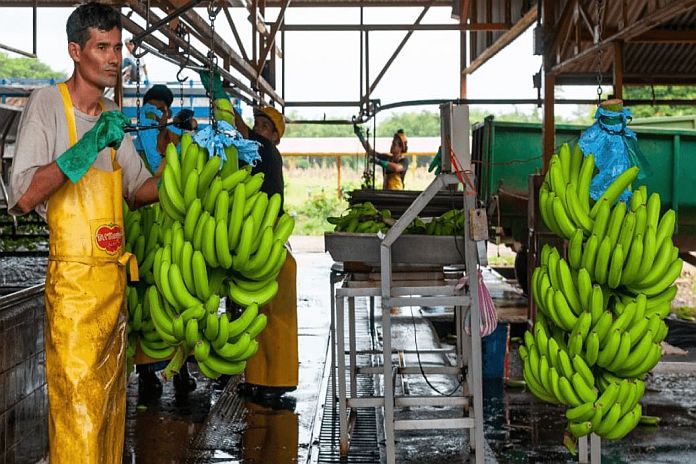
- A regional effort in Latin America and the Caribbean is helping protect banana crops from one of the world’s most destructive plant diseases.
Highlights
- Bananas and plantains are essential for the food security and livelihoods of around 12 million people in Latin America and the Caribbean and 400 million people worldwide.
- Fusarium R4T disease poses an “invisible” threat capable of devastating entire plantations and rural economies.
- With IDB backing, the VigiMusa project has brought together seven countries in the region through a digital and scientific surveillance network to strengthen prevention and response efforts against this pest.
By Carlos Ramón Urías, Xavier Euceda, Lina Piedad Salazar
Every time we enjoy a banana at breakfast or fried plantains at dinner, we rarely think about the complex protection network that allows this fruit to reach our table. Nor do we think about the threats this food faces, such as Fusarium R4T, the so-called “COVID of plants,” a highly aggressive soil-borne fungus that causes plants to wilt, spreads rapidly, and cannot be controlled with chemical products.
Regional experience shows that getting ahead of Fusarium R4T through investment in surveillance, innovation, and cooperation is key to protecting food security and rural livelihoods.
That is why, to commemorate International Day of Plant Health, we are highlighting the impact that the VigiMusa project has had in improving the detection, prevention, and response to this pest in Latin America and the Caribbean. while creating a regional digital and scientific surveillance network. Launched in 2021, this project is led by the Inter-American Development Bank (IDB) and the International Regional Organization for Agricultural Health (OIRSA).
Strengthening Phytosanitary Surveillance in Latin America and the Caribbean
In Latin America and the Caribbean, musaceae (the technical term that includes bananas and plantains) are essential to the food security and livelihoods of around 12 million people.
Bananas are the world’s fourth most important food crop after rice, wheat, and maize in terms of gross production value. According to the Food and Agriculture Organization (FAO), our region produces 26 percent of the world’s bananas and plantains and accounts for 69% of global exports of these crops.
VigiMusa’s goal is to prevent pests such as Fusarium R4T —which has already been detected in neighbouring countries such as Colombia, Peru, and Ecuador— from crossing borders and destroying Central America’s agricultural heritage.
The project supports seven beneficiary countries: Belize, Costa Rica, El Salvador, Guatemala, Honduras, Panama, and the Dominican Republic, through three key technologies designed to detect and contain this pest:
Cutting-edge technology in technicians’ hands: An electronic platform and mobile application were developed to allow technicians to report any suspicious plant in real time, using GPS and photographs so experts can immediately assess the risk.
Laboratories with “Eagle Eyes”: Through the project, official laboratories received molecular diagnostic kits. These make it possible to conduct advanced tests (such as the LAMP technique, a highly accurate detection method) to identify the disease reliably.
Virtual reality for emergencies: A virtual simulation room was implemented where technical teams can “train” using fictional outbreak scenarios to learn exactly how to respond without putting a single real plant at risk.
Drones, sensors, and rapid diagnostics: Innovation to protect Banana Crops
One of the innovations the project has introduced in the field works like a rapid pregnancy test, but designed for plant tissue. The device is known as a lateral flow immunostrip. By extracting a small amount of tissue from the stem of a suspicious plant and mixing it with a special solution, technicians can obtain a preliminary result in just five to 10 minutes directly in the plantation. This greatly accelerates decision-making, making it possible to prioritise the isolation of an affected area without waiting for long periods.
But surveillance is not limited to what the human eye can detect at ground level. VigiMusa has incorporated “eyes in the sky” through the transfer of remote sensing technologies. Using drones and satellite imagery analysis, the project enables the monitoring of “sentinel farms” from the air. This technology helps detect anomalies on a large scale, identifying possible infection hotspots long before wilting becomes visible to the naked eye.
To make sense of all this information, the project has developed a “phytosanitary intelligence” system by creating epidemiological risk maps. Using mathematical models and geographic information systems, experts combine climate, topography, and trade route data to predict how and where the fungus could enter and spread. Based on this information, countries have divided their territories into “sanitary quadrants,” allowing them to strategically focus inspection efforts on the most vulnerable areas.
Beyond satellites and applications, the heart of this strategy remains the human factor. To ensure technical teams were truly prepared, VigiMusa organised “field schools” in territories where the disease is already present, such as Colombia. There, Central American and Caribbean specialists were able to observe the disease firsthand, learning in a real-world environment the strict biosecurity measures required to disinfect footwear, tools, and vehicles, thereby avoiding becoming vectors of the pest themselves.
All this acquired knowledge is continuously tested through emergency simulations, much like cities conduct earthquake preparedness drills. During these exercises, authorities deploy the “actionability kits” —tools, protective suits, and biosecurity equipment provided by the project—to establish sanitary cordons and practice the safe eradication of infected plants in controlled scenarios.
Training, simulations, and regional surveillance
The project strengthened the surveillance and diagnostic capacities of national and regional phytosanitary protection organisations and also trained producers on the impact of the fungus and biosecurity practices. The following figures illustrate the project’s reach:
- Nearly 8,000 people have participated in more than 40 training, risk communication, and technology dissemination events.
- Nine emergency simulations were carried out across the region (surpassing the original target of seven) to ensure that protocols function effectively under pressure.
- More than 1,200 students from 19 countries enrolled in the advanced virtual course on epidemic outbreak prevention and management.
Investing before the emergency: Key actions to strengthen plant health
Plant health may seem like an issue relevant only to farmers or scientists, but it is a pillar of the region’s social and economic stability. If bananas and plantains are affected by disease, it could create pressure on local market prices, affect jobs linked to these value chains, weaken export capacity, and increase food security risks for the most vulnerable populations. The scale of these impacts may vary depending on the country, the severity of the outbreak, the importance of the crop to the local economy, and the institutional capacity to prevent, contain, and respond to phytosanitary emergencies.
Projects such as VigiMusa demonstrate that protecting strategic crops such as bananas and plantains requires early investments to prevent phytosanitary emergencies. Strengthening technical capacities, modernising surveillance systems, preparing institutions through protocols, simulations, and diagnostic tools, and promoting regional cooperation are all essential to anticipating, detecting, and responding promptly to phytosanitary risks.