



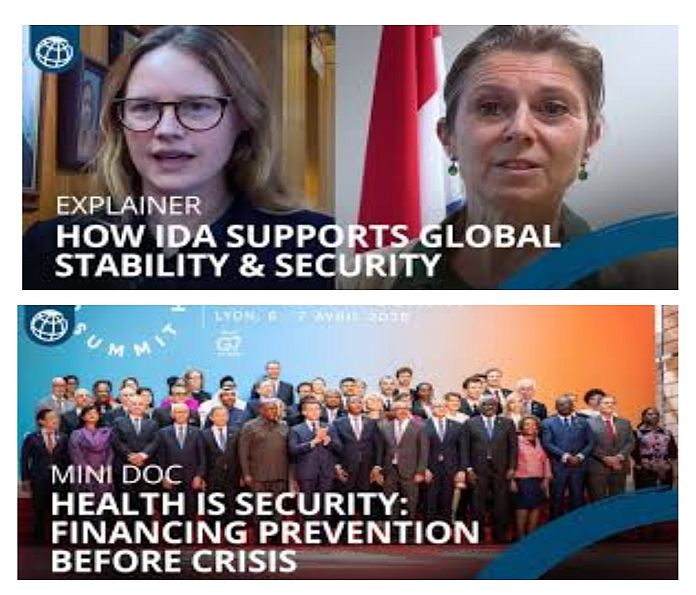
Last month, I sat in a room in Lyon, France, alongside President Macron, health ministers, and global leaders for the G7 One Health Summit. One thing kept coming up in the room and across the two-day summit, panel after panel, in the corridors, and over dinner in Lyon and beyond: the link between development and security.
It is a link that I have been thinking about for years, and one that I believe is becoming the defining argument of our time for why development finance matters.
Security has changed. Our thinking needs to catch up.
When most people think about security, they think about armies and deterrence. These things matter. But they are no longer the whole picture. As Stephan Exo-Kreischer of the ONE Campaign in Europe put it recently, “development and diplomacy are integral parts of long-term human security.”
He is right.
National security today is built beyond borders, and it needs to be rooted in the stability and growth of the most vulnerable countries. Overlapping economic, social, and environmental crises in low-income countries are accelerating state fragility, driving irregular migration, and increasing the likelihood of regional instability. These are not abstract threats. They are the conditions that can produce crises that end up on the front pages around the world.
And yet, at precisely the moment when these dynamics are intensifying, official development assistance is shrinking. ODA is projected to fall back to 2020 levels by 2027. Defense budgets are rising (across OECD countries, defense spending has increased 30 percent over the last decade), while investment in the conditions that help prevent conflict is declining.
How IDA works: Building the foundations of stability
Increasingly, we are recognizing that development spending and security spending are not alternatives. They are complements.
The World Bank’s International Development Association, or IDA, works in 78 of the world’s poorest countries, where risks are often highest and the capacity to manage them is lowest. Between 2022 and 2025, IDA helped nearly 200 million people in fragile countries access services for health, education, and improved livelihoods, including about 70 million who received employment and economic opportunities. Those are 70 million people with a stake in stability. With jobs. With reasons to stay, build, and invest in their communities rather than flee.
For those less familiar with how IDA works: it is not a traditional aid program. IDA is a fund that pools contributions from donor governments, then leverages them through its triple-A credit rating to borrow from capital markets and deploy far greater resources than donors could achieve on their own.
Those resources go to the 78 poorest countries in the world as long-term, low-cost loans and grants, tied to results and reform. IDA finances the fundamentals like health systems, education, infrastructure, agriculture, climate resilience, working directly with governments to build the institutions and capabilities that make development stick. It is on the ground in these countries, with the technical expertise and country relationships to turn financing into outcomes. And crucially, IDA keeps showing up: not just in a crisis, but between crises, building the systems that mean the next shock does not become a catastrophe.
Prevention is cheaper than crisis…by a wide margin.
An analysis by the ONE Campaign shows it can be up to 103 times more expensive to deal with a crisis than to prevent it from arising in the first place. That is not a rounding error. That is a fundamental argument for where we should invest resources.
IDA operates on this logic. Every dollar of donor contribution is leveraged up to four times through IDA’s triple-A credit rating and access to capital markets. In IDA20, $93 billion was deployed. IDA21 is delivering $99 billion.
As Heleen Uijt de Haag, director of international financial affairs at the Netherlands ministry of finance, put it: “IDA pools financing and leverages donor contributions to invest at a scale that countries on a national basis never would. This is multilateralism at its best.” The director added something I hear more and more from finance ministries around the world: “In a world with decreasing budgets, it is really key to spend your money wisely. IDA represents the best deal in development.”
IDA in fragility, conflict and violence (FCV) settings: where it matters most
Forced displacement has reached record levels globally, with more than 117 million people displaced by conflict and persecution as of 2025. In regions of high migration pressure (like the Sahel, and parts of North Africa and the Middle East), IDA supports girls’ education, women’s empowerment, and climate-smart rural livelihoods. Such upstream interventions can reduce the downstream costs of migration, conflict, and humanitarian crisis.
Even in the places where private capital will not go, where the risk is too high, the infrastructure too weak, the governance too fragile, IDA goes through the Private Sector Window and through financing of basic services projects that are implemented with partners. We know through experience that if we leave those places without investment, we do not make the problem go away. We make it worse.
Health security as global security
I would be remiss not to mention one dimension of this security argument that has gained significant momentum: the link between health systems and global security.
At the G7 One Health Summit in Lyon, the message was clear: a health risk can become a global security crisis at a moment’s notice. When a pandemic emerges in a fragile state and goes unchecked, the consequences for the world as a whole can be dire.
Since 2021, the World Bank Group has committed approximately $4 billion across 34 One Health projects spanning health, agriculture, and the environment. IDA’s Regional Disease Surveillance Systems Enhancement program (REDISSE) is a poster child for this kind of proactive approach. REDISSE has built cross-border surveillance systems across 16 countries in West and Central Africa, training thousands of health workers and upgrading hundreds of laboratories. When COVID-19 hit, those systems held.
Once again, prevention is far less costly than response.
The bottom line
Perhaps what strikes me most in the conversations I have been having with donors and partners is not just the financial argument, compelling as it is, but the political and institutional one. Amid fracturing alliances and competing interests, IDA is one of the few multilateral instruments where 189 member countries — donors and borrowers alike — continue to find common ground. That consensus is itself a form of security architecture.
I believe the case for IDA has never been stronger or more urgent. We are at an inflection point. Countries deciding how to contribute to IDA are not just making a development decision. They are making a decision