
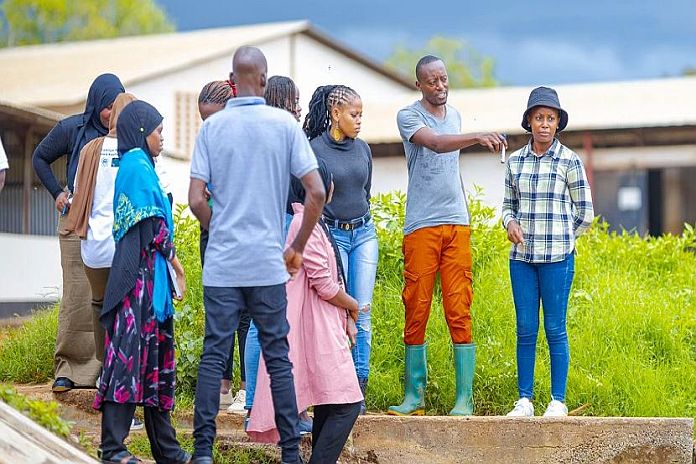
Photo: Huru Initiatives, Tanzania
By Roya Rahmani
We’ve all seen the “on paper” version of partnership: joint press releases, polished logos on reports, and carefully staged side events. But there’s a much more powerful version – the one that actually changes how a development institution operates. It changes who we listen to, what we prioritize, and, most importantly, whether our impact improves the lives of the people we serve.
Partnership, understood this way, is fundamental to how we close the gap between what is planned in headquarters or our country offices, and what matters in the communities we serve. The scale of the world’s challenges demands that we work differently – bringing together the best knowledge, the most innovative thinking, and the deepest community trust.
The One World Bank Group Partnership Charter, published in May 2024, reflects exactly this conviction: partnerships strengthen impact, mobilise resources, improve efficiency, and limit the fragmentation that too often dilutes development results. But a charter only matters if the relationships behind it are genuine – built not just on periodic consultation, but on consistent, deliberate engagement at every level, from global forums to the communities on the frontlines of development challenges. IDA21 takes this further: it does not simply track whether civic and citizen engagement happens, it tracks whether it is meaningful. What gives these commitments substance is what partners are telling us, and showing us, every day.
Investing in people and local capacity as foundation
Partners consistently emphasise the central role of strong human capacity – the people and institutions that effectively translate resources into results. Across the partnerships we are building, the evidence points in the same direction: investing in people is not a complement to development – it is the foundation.
This starts with the most fundamental needs. Huru Initiatives in Tanzania, a women-led organisation founded by Emmanuel Godliving Minja, trains young women in water resource management, conservation, sanitation, and community engagement. Clean water is not a development indicator – it is a prerequisite for everything else. And as Huru’s work demonstrates, the solutions that last are the ones built by and with the communities they serve.
The same conviction drives CoAction Global’s contribution to Mission 300, the initiative working to connect 300 million people in Sub-Saharan Africa to electricity by 2030. Nearly 600 million people across the region currently lack reliable access. Rather than deploying external expertise, CoAction designed a competitive fellowship that embeds African energy professionals inside African governments. As Fellow Sharon Matongo reflected after her first months in Liberia: “Seeing that finances are a constraint, I began to ask, ‘So how do we raise capital?’ I am learning now that our mandate is to create an enabling environment for energy investments and businesses to thrive.” That kind of learning – embedded, contextual, locally led – is what accelerating impact actually looks like.
Ukraine offers a parallel lesson. Writing from her experience with recovery efforts, Iryna Mykulych of the Agency for Recovery and Development argues that job creation cannot wait for stability – it is a critical part of building it. Recovery, she argues, depends on the skilled professionals and functioning institutions needed to put financing to work.
Skills and jobs require deliberate, long-term partnership
A second message from partners is equally clear: jobs and skills are not an afterthought to development, rather they are how development takes shape. And delivering on the jobs agenda requires the kind of sustained, multi-sector collaboration that does not happen through a single meeting or a periodic consultation.
Researchers from the World Resources Institute and their partners Systemiq put the scale of the opportunity plainly, noting that ocean-centric sectors alone could generate 93 million additional jobs globally by 2050. But realising that potential requires coordinated action that aligns governments, institutions, and the private sector around workforce needs, flexible training, and investment in people. The transition to a sustainable economy will reshape labor markets. Without deliberate choices about who benefits and how, those gains will not reach the workers and communities who need them most.
Our partners are calling for long-term, reciprocal partnerships that ensure education is designed with jobs in mind. How Historically Black Colleges and Universities (HBCUs)-Africa Partnerships can advance jobs and economic mobility is a strong example of what that looks like – partnership built around shared purpose rather than periodic exchange.
What partnership makes possible
What connects these stories – water in Tanzania, energy across Sub-Saharan Africa, recovery in Ukraine, ocean economy jobs, education-to-employment pathways between HBCUs and African institutions – is not a common sector or geography. It is a common understanding: that the most powerful development happens when people are at the center, when local knowledge is built and valued, and when partnerships are designed to last.
This is the kind of partnership the World Bank Group is committed to- not the polished-logo version, but the kind that connects communities to clean water, connects young Africans to careers in the energy sector, connects workers to the skills a changing economy demands, and connects institutions across borders and generations around mutual understanding.
This means not only opening channels of engagement, but using them with intention – listening carefully, engaging seriously, and ensuring that the perspectives of our partners shape how we think, how we design, and how we deliver. The next step is ensuring that what we hear in dialogues and partnerships like these visibly shapes how we design and deliver. That is the standard our partners are holding us to – and the right one.
About the Author