


By Divinna Boyd
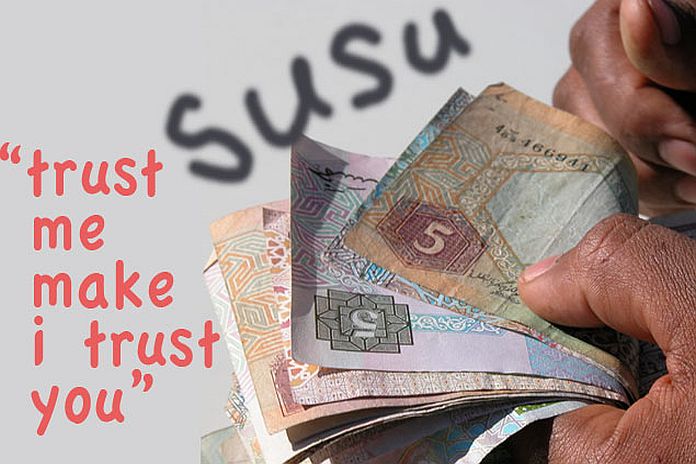
Before I understood what a poverty trap was, I was already living its logic. Growing up in a Liberian household, my sisters and I ran our own susu, pooling pocket money and taking turns receiving the lump sum each week. We thought we were just being clever. We did not know we were copying the main savings system our mothers trusted. That normal childhood routine was a small version of the thin financial thread holding our families together
What we call susu is part of a much larger family of informal savings groups that economists call Rotating Savings and Credit Associations, or ROSCAs. These groups exist in many low- and middle-income countries under different names: susu or esusu in Ghana and Nigeria, tontines in Francophone West Africa, stokvels in South Africa, ekub in Ethiopia, and others. They work as community-based financial systems for people who cannot, or do not, use formal banks.
The World Bank defines the “poverty trap” as a set of self-reinforcing mechanisms where poverty begets poverty, leaving countries and vulnerable populations unable to break the cycle without external, systemic interventions. It is characterized by persistently low productivity, a lack of access to finance, and severely limited opportunities for savings and investment.
My mother is a nurse. By most measures, she was not poor. But every school term, our family held its breath, not because the money did not exist, but because of where some of it was. Part of her salary circulated through a susu with other women, and whose turn it was that month shaped whether school fees were paid on time or a medical bill could be covered without new debt. Studies from urban Sub-Saharan Africa show that women’s ROSCA savings usually go toward the family, food, school, health rather than personal spending.
Susu continues not because people lack options, but because it solves problems formal finance still does not. It encourages saving when incomes are small, irregular, and hard to document, and when bank fees, paperwork, and distrust make formal accounts less. Even as financial inclusion has grown, gaps remain. In 2021, about 68% of women in developing economies had an account, compared with 74% of men. My mother’s use of susu is not unusual; it is a practical answer to an incomplete financial system.
The poverty trap is not in the susu itself. It appears when a family has no other backup. A badly timed illness, funeral, or job loss can force a woman to break the susu, miss contributions, or borrow at very high interest, wiping out months of saving. Evidence from Benin shows that more rigid ROSCAs are the least sustainable when households face health shocks, because members cannot easily change their payments when income suddenly drops. That pattern of small gains and repeated setbacks is what a poverty trap feels like from inside a household.
My mother sat just above the poverty line, but very close to the edge. A simple headcount ratio at a national poverty line would never label her as poor. Yet the poverty gap and poverty severity capture how far people fall below that line and how strongly they are hit when shocks arrive.
When we pay attention to who can save safely, who can borrow without being trapped, and who is exposed to shocks, we see how close families like mine are to falling back into poverty. When children inherit a savings system before they inherit an explanation, that system deserves a place in how we think about poverty.
Susu is not just a cultural habit; it is information about how families survive close to the edge. If our poverty measures ignore those fragile threads, they will keep missing people who look stable on paper but live one shock away from the trap.