
-
- Caracas will reportedly present macroeconomic and debt sustainability plans to international financial actors next month.
- ExxonMobil and ConocoPhillips are reportedly weighing a return to the country almost two decades after their assets were nationalised.
By Ricardo Vaz
CARACAS, (venezuelanalysis.com) – The Venezuelan acting government announced the formal launch of a restructuring process of the country’s sizable foreign debt. In a statement published on Wednesday, Caracas promised “comprehensive and orderly” proceedings to renegotiate liabilities owed by the country and state oil company PDVSA.
“This decision has the goal of putting the economy at the service of the Venezuelan people and freeing the country of the burden of accumulated debt,” the communique read. “This is a responsible, nationalist, and social decision.”
Venezuelan authorities added that the country’s resources should prioritise the people’s well-being over “unsustainable financial obligations” and that they seek a “substantial reduction” of the total debt.
Venezuela defaulted on a range of bonds and loans beginning in 2017 as US sanctions severely exacerbated the country’s economic crisis and shut it out of financial markets, making payments impossible. The Nicolás Maduro government had prioritised debt service in previous years as the country’s economy entered a tailspin in hopes of retaining access to international credit.
The sum total of defaulted debts and loans, on top of international arbitration awards, is estimated to be as high as US $170 billion with accrued interest. Liabilities likewise include unpaid loans to China. The restructuring process may be one of the largest in history, surpassing Russia (1998) and Argentina (2001).
According to Business Wire, the government led by acting president Delcy Rodríguez plans to present its “macroeconomic framework and public debt sustainability analysis” to the international financial community in June. Caracas has reportedly hired Centerview Partners as a financial advisor.
On May 5, the US Treasury Department issued a license allowing the provision of financial and advisory services related to Venezuelan debt restructuring. The sanctions waiver does not allow creditors to transfer or settle debt, nor directly engage with Venezuelan authorities.
Market analyst S&P Global argued that Venezuela’s debt renegotiation process could face obstacles if some creditors hold out and reject restructuring proposals.
Financial analyst Elías Ferrer Breda called Wednesday’s announcement an expected “formality” and added that the next step will be assessing the actual size of Venezuela’s foreign debt. For his part, political commentator Luis Vicente León argued that the restructuring process will be drawn out but may “restore credibility” before financial markets.
Pramol Dhawan, head of Pacific Investment Management Company LLC (PIMCO) emerging markets team, welcomed Caracas’ “willingness to engage with bondholders.”
“Any durable resolution will need to be comprehensive and anchored by a credible macroeconomic framework to give creditors confidence in Venezuela’s capacity to service restructured obligations,” he told Reuters.
Venezuelan bonds rose again following the latest announcement, continuing a recent upward trend as investors eye windfall returns. Creditors have also met with Trump officials in recent weeks.
Since the January 3, US military strikes and kidnapping of President Nicolás Maduro, the acting authorities led by Delcy Rodríguez have fast-tracked a rapprochement with Washington. The Venezuelan National Assembly has approved pro-business reforms to its energy and mining sectors while the government has struck agreements with multiple Western multinational corporations.
Following the White House’s recognition of Rodríguez as the South American country’s “sole leader,” Caracas reestablished ties with the World Bank and the International Monetary Fund. Venezuelan officials have expressed hopes of accessing around $5 billion in Special Drawing Rights and stated that there are “no plans” to contract IMF loans.
For her part, IMF Managing Director Kristalina Georgieva stated that the Washington-based institution is willing to support a loan program for Venezuela but requires clarity on economic data and external debt.
In April, Rodríguez established a commission tasked with assessing the “strategic” value of Venezuelan state assets and their possible privatisation, with private sector conglomerates already raising funds ahead of potential sell-offs.
Meanwhile, oil output surpasses 1M BPD as Western Corporations Crowd in. ExxonMobil and ConocoPhillips are reportedly weighing a return to the country almost two decades after their assets were nationalised.
Venezuelan oil production has moved past 1 million barrels per day (bpd) for the first time in over seven years.
The latest OPEC monthly report placed the Caribbean nation’s April output at 1.031 million bpd, as measured by secondary sources. The figure increased by 46,000 bpd compared to the previous month.
For its part, state oil company PDVSA reported April’s production at 1.136 million bpd, up from 1.095 million bpd in March. Direct and secondary measurements have differed over time due to disagreements over the inclusion of natural gas liquids and condensates.
With the oil industry under crushing US coercive measures, crude production plummeted from around 1.9 million bpd when the first sanctions were levied against PDVSA. Following the US imposition of an export embargo in January 2019, output fell under 1 million bpd, hitting decades-lows around 350,000 bpd in 2020 before a steady recovery in recent years.
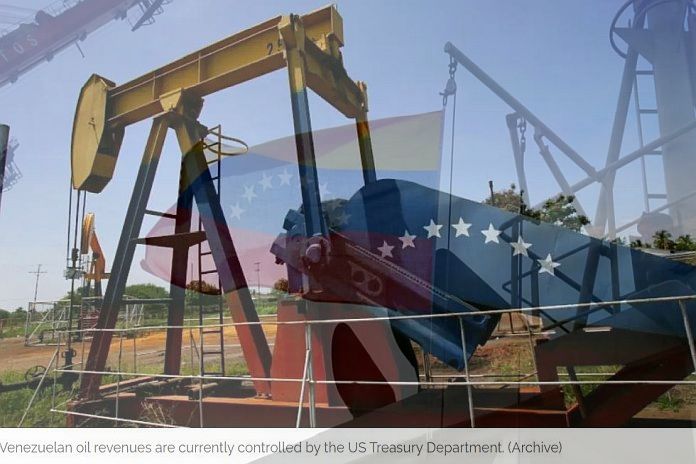
Since the January 3 US military strikes against Venezuela and kidnapping of President Nicolás Maduro, the Trump administration has imposed control over the nation’s energy sector, with revenues deposited in US Treasury-run accounts before being partially returned to Caracas at US officials’ discretion.
US secretary of state Marco Rubio stated on Thursday that “for the first time in over a decade the wealth of Venezuela is benefitting the people of Venezuela,” though he did not mention the impact of US sanctions first imposed in late 2014.
While US coercive measures remain in place, the White House has issued a series of licenses allowing Western corporations to return to the Venezuelan energy sector.
BP, Chevron, Eni, Repsol, and Shell are among the companies to have struck oil and natural gas contracts with the Venezuelan government led by Acting President Delcy Rodríguez in past weeks, taking advantage of a recent pro-business legislative overhaul that slashed royalties and taxes, granted private partners increased control over operations and sales, and opened the way for disputes to be settled in international arbitration bodies.
Lesser-known companies Overseas Oil and Crossover Energy have likewise inked agreements for energy projects in the South American country.
ExxonMobil and ConocoPhillips are also evaluating prospects for a return to Venezuela, according to the Wall Street Journal. The two oil giants saw their assets nationalised by the former Hugo Chávez government in the 2000s after refusing to accept the country’s reforms, asserting sovereignty over the industry. Both corporations would go on to secure compensation via international arbitration, with an award of over US $10 billion to ConocoPhillips still outstanding.
The recent rebound in oil production coincided with an increase in US-sourced diluent imports. Exports also surged in April to 1.23 million bpd, the highest figure in over seven years. Apart from a growing number of cargoes to US refineries, Indian refiner Reliance is receiving increased shipments after securing US Treasury approval.
In contrast, two tankers reportedly headed to China and Cuba, respectively, will return their cargoes to Venezuelan ports after being intercepted by US naval forces. Prior to the January 3, operation and US control over oil exports, China had been the primary destination for Venezuelan crude. Caracas had likewise been the main supplier of oil to Cuba in the last two decades.
Venezuelan and US authorities have offered no clarity on the return of export proceeds to the South American country, with US Secretary of State Marco Rubio stating that Caracas needs to submit a “budget request” before accessing its funds. The Venezuelan Central Bank’s handling of US-disbursed resources will be subjected to outside auditing, with Pentagon and CIA contractor Deloitte reportedly among the companies hired.
Despite the absence of official data on Venezuelan export revenues and the portion being returned to the country, the Rodríguez administration’s injection of foreign currency into exchange tables run by public and private banks increased in April and May. US authorities reportedly mandated that PDVSA revenues be funnelled directly to private sector importers via forex auctions as opposed to having the Venezuelan Central Bank run foreign currency assignments.
About the Author