



-
- Connecting the Atlantic and Pacific oceans, bringing markets closer together, and reducing distances: the goal behind South America’s most ambitious regional integration initiative.
Highlights
- Located at the heart of the new corridor, Paraguay is poised to play a key role in linking South America’s main production hubs with regional markets and Pacific trade routes.
- To turn that potential into reality, Argentina, Brazil, Chile, and Paraguay are advancing a shared agenda that combines infrastructure, institutional coordination, and trade facilitation.
- But infrastructure alone will not be enough. Border coordination, information sharing, and customs cooperation will be critical to turning the Bioceanic Corridor into a true driver of regional integration.
By Alonso J. Chaverri-Suarez, Eduardo Augusto Café
South America has spent decades debating how best to connect its Atlantic and Pacific coasts. The Capricorn Bioceanic Corridor is arguably the most tangible outcome of that effort so far: a 3,800-kilometer highway corridor linking the port of Santos in Brazil with the Chilean ports of Antofagasta and Tarapacá.
Along its route, it crosses four countries and connects some of the continent’s most dynamic regions: the states of São Paulo and Mato Grosso do Sul in Brazil; the departments of Boquerón, Alto Paraguay, and Presidente Hayes in Paraguay; the provinces of Salta and Jujuy in Argentina; and the regions of Antofagasta and Tarapacá in Chile.
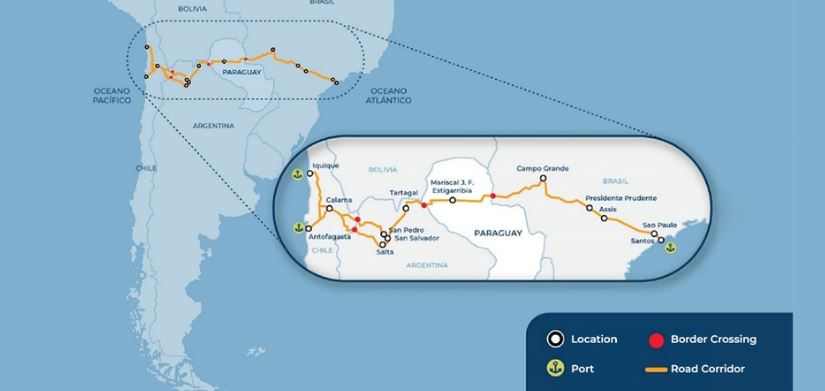
One corridor, four countries, one shared vision
The Capricorn Bioceanic Corridor’s potential extends far beyond road infrastructure. Once fully operational, it will connect historically isolated territories to new markets, boost productive development, strengthen value chains in agribusiness, mining, tourism, and logistics, and bring inland regions closer to Pacific ports and markets.
To achieve this, the governments of Argentina, Brazil, Chile, and Paraguay have established a coordination mechanism among their foreign ministries, bringing together efforts in areas as diverse as customs, agriculture, transport, and security. This institutional dimension is just as important as the physical infrastructure. A corridor of this scale cannot be built with roads and bridges alone; it also requires coordinated rules, procedures, and institutions.
The Inter-American Development Bank (IDB) has played a key role in this process. Since 2023, it has supported the creation of the Subnational Entities Forum and the development of the Corridor Master Plan, which identifies trade facilitation measures and a pipeline of infrastructure projects in transport, logistics, energy, and digital connectivity. The bank is also supporting value chain studies and a strategic environmental and social assessment of the corridor.
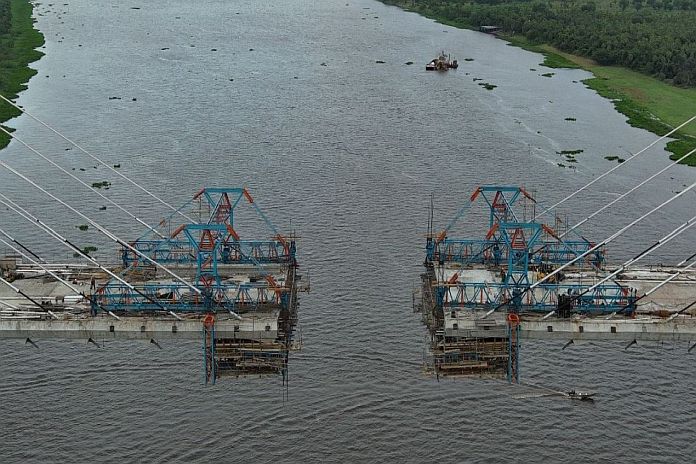
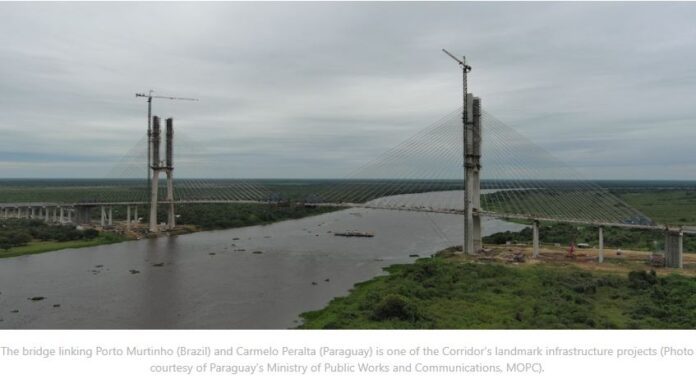
The corridor currently faces two critical infrastructure challenges. The first is the Porto Murtinho (Brazil)–Carmelo Peralta (Paraguay) crossing, where the bridge is nearing completion.
The second is the Pozo Hondo (Paraguay)–Misión La Paz (Argentina) crossing, which remains at the feasibility study stage. Paraguay occupies a central position at both crossings, reinforcing its strategic role in ensuring the Corridor’s physical continuity and unlocking its full potential.
Paraguay: The strategic advantage of being at the center
As a landlocked country, Paraguay depends on efficient transport corridors to move its exports and imports. Today, 75 percent of its cargo moves through the Paraguay-Paraná Waterway, while the remainder travels overland to Brazil or to Chilean ports on the Pacific. This dependence comes at a tangible cost: road infrastructure and border crossing conditions can account for up to 12 percent of the final cost of goods entering and leaving the country, compared with 6–8 percent in neighbouring countries such as Argentina and Brazil.
The economic context makes this agenda more urgent than ever. In 2025, Paraguay’s economy grew by 6.6 percent, above the average of the past decade, while gross fixed capital formation expanded by 12.2 percent, reflecting strong investment momentum. At the same time, sectors with significant export potential continued to gain ground: pharmaceutical exports increased by 18.9 percent year-on-year, and the maquila industry surpassed $1 billion in industrial exports.
The entry into force of the MERCOSUR–European Union Agreement in May 2026 adds further momentum to this trend, giving Paraguay access to a market of more than 700 million consumers. Given that Paraguayan exports to the European Union currently amount to only about $350 million per year, the room for growth is substantial. But for this economic dynamism and these new trade opportunities to translate into greater competitiveness, Paraguay needs corridors that work.
Concrete Progress: Infrastructure, institutions, and trade facilitation
Paraguay has responded with a comprehensive agenda built around the National Logistics Plan 2030, with support from the IDB, advancing simultaneously in three areas: infrastructure, institutional strengthening, and trade facilitation.
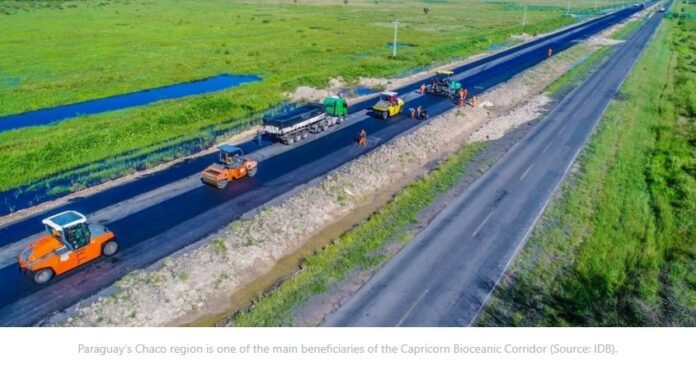
On the infrastructure front, the flagship project is National Route PY15, a 532-kilometer highway connecting Carmelo Peralta and Pozo Hondo. Currently under construction with financing from the IDB and FONPLATA, the road will link two of the Corridor’s key crossings and facilitate approximately $220 million in annual Paraguayan exports to Brazil and Chile, primarily livestock products (65%), agricultural goods (19%), and dairy products (16%). It is complemented by the Carmelo Peralta bridge, which is nearing completion, and Paraguay’s commitment to build the Pozo Hondo–Misión La Paz bridge, which is currently at the study stage.
Progress, however, extends beyond infrastructure. The creation of the National Directorate of Tax Revenue (DNIT) strengthened customs and tax administration, with direct benefits for trade facilitation. At the same time, the IDB is supporting Paraguay through the Program to Support International Integration, Trade Promotion, and Trade Facilitation, which is advancing initiatives such as the digital modernization of REDIEX, the internationalization of exporting MSMEs, and the implementation of a coordinated border management model in Presidente Franco.
Once operational, the corridor’s potential benefits will be substantial. IDB estimates suggest that the required investment, close to $600 million, could generate annual economic benefits of around $60 million for historically isolated territories, including Paraguay’s Chaco region. Overall, the investment would yield an estimated rate of return of approximately 6.6 percent for the participating economies.
The Bioceanic Corridor: A cooperative endeavor
Paving roads and building bridges are necessary, but not sufficient. For the corridor to function as a seamless logistics chain, the four countries must also put in place the institutional and digital framework needed to ensure the smooth movement of goods. This requires a shared approach to border management and, in particular, authorities capable of exchanging information in real time, coordinating risk management, and avoiding duplicate controls.
For Paraguay, this means moving forward simultaneously with Brazil at the Carmelo Peralta–Porto Murtinho crossing and with Argentina at the Pozo Hondo–Misión La Paz crossing, while also strengthening coordination and information sharing among the respective border authorities.
Chile also has a critical role to play. The Jama and Sico crossings are the main gateway to the Pacific for cargo originating in Paraguay, Brazil, and Argentina. For the Corridor to operate smoothly from end to end, all four countries will need to exchange information efficiently and coordinate their border controls.
Customs and trade facilitation
Authorised Economic Operators (AEOs) offer a practical opportunity to improve the Corridor’s performance. These are companies certified by their national customs authorities that, by meeting specific security and compliance standards, benefit from streamlined procedures and simplified controls. If the four countries move toward mutual recognition of their AEO programs, they will be able to facilitate the movement of trusted operators without compromising risk management. This would be a decisive step toward a more efficient and integrated network of border crossings, capable of functioning as a truly smart gateway for regional trade.
In short, the Capricorn Bioceanic Corridor is not an infrastructure project with a fixed endpoint, but an ongoing process of integration that combines physical works, institutions, and trade facilitation. As the central node in that process, Paraguay has both the opportunity and the urgency to help lead the transition from a corridor under construction to a corridor that works.