



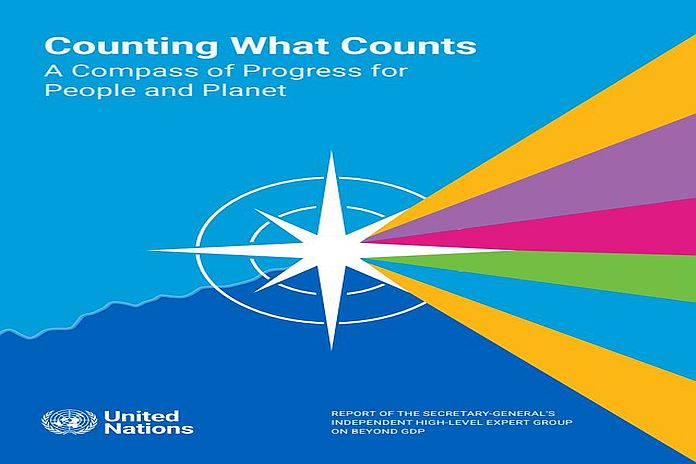
- Gross Domestic Product, or GDP, remains essential but cannot measure whether lives are improving.
- A new United Nations report proposes 31 indicators to track progress beyond output.
- It is the first UN blueprint of this kind requested by member states.
- The framework includes cross-border spillovers, from emissions to supply chains.
- UNCTAD, UNDP and partners will support countries that choose to test it.
 GENEVA, Switzerland – Gross domestic product, or GDP, measures the value of goods and services produced in an economy. It has long been treated as the world’s scoreboard for progress. But a growing economy can still leave people poorer in security, trust, opportunity and hope. The report argues that governments need a broader way to judge whether development is working. It does not call for replacing GDP. It calls for complementing it with a practical dashboard that captures what GDP misses: well-being, equity, sustainability and resilience.
Meanwhile, UNCTAD acting secretary-general Pedro Manuel Moreno warned geopolitical tensions, rising debt burdens and economic fragmentation are straining development cooperation and called for urgent reforms to the international financial architecture.
Growth is not the whole story
Between 1980 and 2025, global economic activity contracted only twice: During the 2009 financial crisis and the COVID-19 pandemic in 2020. By GDP’s measure, the world has rarely been richer.
Yet trust in institutions has eroded, inequality has widened in many places and environmental pressures have intensified. In some wealthy countries, young people report high levels of anxiety and isolation. The gap between economic output and lived experience is becoming harder to ignore.
“What we measure shapes what we value,” said Pedro Manuel Moreno, deputy secretary-general and acting secretary-general of UN Trade and Development (UNCTAD). “That is the question this work now places squarely on the international agenda.”
A dashboard for the real economy
The report proposes 31 indicators built around four areas: Peace, human rights and respect for the planet; current well-being; equity and inclusion; and sustainability and resilience.
The dashboard would track material conditions, health, education, social cohesion, institutional quality, environmental conditions, poverty, inequality and the assets societies pass to future generations – including produced, human, social, institutional and natural capital.
It is designed to be country-owned, so governments can adapt it to national priorities and capacities. Close to half of the indicators are drawn from the Sustainable Development Goals, meaning many countries already have data systems in place.
Why it matters now
Unlike earlier Beyond GDP efforts, this report comes with a political track. It was produced in response to a direct request from Member States under the Pact for the Future and will now move into an intergovernmental process at the General Assembly, led by Spain and Guyana.
It also recognises that progress does not stop at borders. One country’s well-being can be shaped by decisions made elsewhere — through emissions, trade, finance, technology and supply chains.
UNCTAD, together with the UN Development Programme and partners across the UN system, will support countries that choose to begin testing the framework.
“GDP tells us how fast an economy is growing,” Moreno said. “It does not tell us where we are headed, what we pass on the way, or what we leave behind for the next generation.”

Attending the Yerevan Dialogue 2026, UNCTAD acting secretary-general Pedro Manuel Moreno spoke at a session on development cooperation challenges. He warned that development cooperation is under growing strain as geopolitical tensions, economic fragmentation and rising protectionism deepen global vulnerabilities.
A cascade of global shocks drive up cost and debt
Moreno said the world is facing not a single crisis but a “cascade” of interconnected shocks. Conflict-related disruptions to energy markets, including the tension in the Strait of Hormuz, are driving up energy and fertiliser prices, which in turn impact food costs and debt burdens for developing countries. He noted that 3.4 billion people now live in countries spending more on debt service than on health or education, while 42 countries devote over 20 percent of their export earnings to servicing debt.
A call to complete international finance reforms
Against this backdrop, he stressed the need to complete reforms to the international financial architecture, including faster crisis liquidity, more counter-cyclical financing and stronger multilateral development banks to mobilize private investment. He highlighted the Sevilla Commitment as a key roadmap for action.
The acting secretary-general also emphasised that official development assistance remains indispensable for vulnerable countries and cannot be replaced by private capital alone. Trade, he added, remains a critical source of development finance for many economies.