



-
- According to the United Nations Development Programme (UNDP), in the region, the future will depend on its ability to transform pressures into momentum for democratic renewal and progress in well-being.
MONTEVIDEO, Uruguay — Latin America and the Caribbean is today the most democratic developing region and the third most democratic worldwide. More than four out of five citizens in the region live under governments elected through electoral processes.
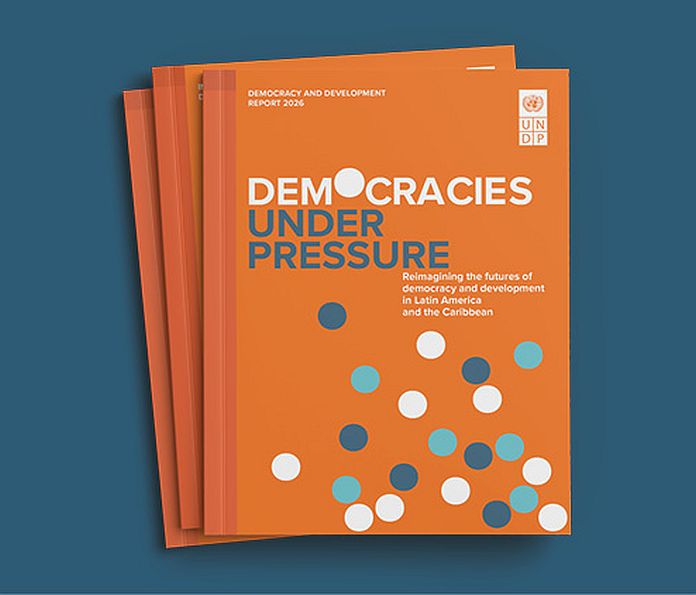
Yet this strength coexists with growing tension: democracies that endure, but face pressures that distort and threaten their ability to represent citizens, manage conflict, and deliver tangible development and well-being outcomes. This is one of the central conclusions of the new regional report by the United Nations Development Programme (UNDP), Democracies Under Pressure: Reimagining the Futures of Democracy and Development in Latin America and the Caribbean, launched today in Montevideo alongside the President of Uruguay, Yamandú Orsi.
The report examines these pressures through an integrated lens linking democracy, the state, and development, and proposes strategic actions to strengthen democratic quality, advance human development, and improve state capacity.
“The future of democracy and development will depend on our collective ability to transform pressure into progress without sacrificing human agency or freedoms. In this shared challenge, UNDP will continue supporting the governments and societies of Latin America and the Caribbean,” said Michelle Muschett, UNDP regional director for Latin America and the Caribbean. “The report, conceived both as a product and as a process, supports the transformation of pressures into coordinated action, tangible progress, and resilient results for citizens,” she added.
More than two decades after the first regional democracy report was published in 2004, which warned about the gap between electoral citizenship and social citizenship, the new report highlights both progress and persistent challenges in a more uncertain and complex global context. Structural inequality, political party crises, and institutional distrust are increasingly intensified by overlapping pressures, including polarisation, disinformation, organised crime, planetary crises, and the accelerating pace of technological transformation, among others.
In response, the report proposes a comprehensive understanding of democracy. Its sustainability depends not only on rules and institutions, but also on its ability to expand freedoms, maintain a credible social contract, and deliver concrete results for citizens in contexts of mounting pressure. Within this framework, the report identifies three defining characteristics of the region:
- Enduring democracies with deficits in quality and performance;
- Progress in human development alongside structural inequalities and vulnerabilities; and
- States with uneven capacities and limited territorial presence.
The report argues that the main strategic priority is not an exhaustive list of reforms but rather preserving political competition and preventing the erosion of electoral integrity. To achieve this, it is essential to act in the spaces where political influence is concentrated or distorted, generating systemic effects and gradually rebuilding democratic legitimacy across five fronts:
- Rebuild the foundations of political representation;
- Restrain the influence of economic power;
- Recover state control;
- Revitalise deliberation and the information ecosystem
- Reinforce institutional checks and balances.
This requires moving beyond reactive responses toward building resilient governance models and state capacities capable of anticipating risks, adapting to changing contexts, and delivering sustained human development outcomes.
Advancing this agenda will not depend solely on institutional reforms. Democratic renewal is not a one-time event, but rather a sustained process of collective action capable of bringing actors together, maintaining agreements, and driving concrete changes in contexts of high uncertainty and complexity.
This makes it essential to strengthen states capable of upholding the democratic rules of the game, political parties that can rebuild trust with citizens, civil society organisations that reinforce public deliberation, and economic actors that contribute to limiting distortions in political influence.
With more than six decades of experience promoting human development and democratic governance in the region, UNDP is presenting this report together with a renewed offer to support countries in anticipating risks, managing uncertainty, and responding more effectively to future challenges. The proposal combines dialogue platforms, foresight analysis, and anticipatory governance tools to strengthen more resilient, future-ready institutions capable of delivering well-being for all people, especially those in vulnerable situations.
Given the strong interest generated by the report and the relevance of its findings, it will be presented in several countries across the region in the coming weeks, including Bolivia alongside president Rodrigo Paz Pereira, the Dominican Republic alongside president Luis Abinader, and Guatemala alongside president Bernardo Arévalo de León.