



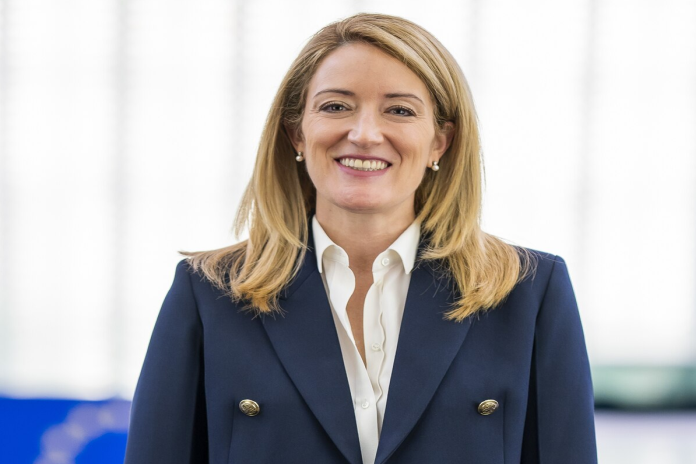
- At the European Council, Parliament President Roberta Metsola addressed three main topics: competitiveness, energy and geopolitical developments. March 19, 2026.
On competitiveness, president Metsola said:
“We need to resist the temptation to fall back on what is comfortable simply because the next steps seem too difficult.” She added that this applies to simplification at all levels, including in fields such as financial services. She also underlined that “we need to be ready to think differently and come up with out-of-the-box solutions, while respecting the European Parliament’s prerogatives.” Metsola called for urgent action on Europe’s Savings and Investments Union and “revising regulatory requirements that are no longer driving investment the way they should”. She stressed that for members of the European Parliament, “competitiveness today is as much about security as it is about growth”, and that “Europe needs the economic force that commands the role we must play”.
Referring to the ‘One Europe, One Market’, president Metsola called for “the full involvement of the European Parliament” and stressed that what was needed are “actions with fixed timelines and targets for deliver.” She stressed, however, that Parliament “will not and never be a rubber-stamp.”
On energy, she highlighted that Europe is diversifying its energy mix, and this is already beginning to pay off. However, she argued that “this does not mean we are immune to price shocks” and reminded that instability elsewhere can still affect us at home, adding that “this is why our focus on storage, grids, and reducing external demand is precisely the right approach.”
Finally, on geopolitical developments, president Metsola said:
“We should never lose sight of the people suffering – including the more than 90 million Iranians who have been fighting for freedom from an oppressive regime for decades,” while also stressing that “the attacks against the Gulf countries are condemnable and must immediately stop”, and reiterating once more her unwavering solidarity with the people of Cyprus, which she said “stand on Europe’s frontline.” She added that, in this context, “we will not lose sight of Russia’s continued illegal war of aggression in Ukraine.”
President of the European Parliament’s speech at the European Council, 19 March 2026
Traditionally, the March European Council is our economic summit, so I will start with that. Too often, we let events dictate our agenda. It is understandable, but it cannot be our default. Of course, geopolitical challenges require a response – but if Europe wants to speak the language of power, we must be established and seen as an economic force.
Next week, parliament will adopt its position on simplifying AI rules. In April, we will adopt our position on the simplification packages for chemicals and mid-caps, and shortly after, on the digital omnibus. We are playing our part, we are moving – but expectations remain, understandably, high. We need to resist the temptation to fall back on what is comfortable simply because the next steps seem too difficult. This goes for simplification on all levels. But we also need to do more, much more, to reduce fragmentation in the Single Market. I will reiterate what I said the last time we met: we have a narrow window of opportunity to push Europe forward. It was not here two years ago, and it certainly won’t be here in two years’ time.
There is a lot of anticipation and expectation around the ‘One Europe, One Market’ Roadmap. I have two asks here. My first is that it includes the full involvement of the European Parliament. We will not and never be a rubber-stamp. And my second is that this is more than a simple declaration. We need it to include actions – with fixed timelines and targets for delivery. We know from experience that we can’t manage what we don’t measure.
That is also why the Joint Declaration between the European Parliament, Commission and Council matters. And on those ten priority files, parliament is moving on every single front. Just yesterday, the European Commission presented its proposal on ‘EU Inc.,’ – something the European Parliament has long called for. There is real excitement around this. Now we need to build on that momentum and actively promote it.
I’ve already spoken about the simplification files, but since we last met, we also voted on the Return Regulation and will soon be able to start negotiations with member states. We have adopted our report on Affordable Housing, and the file on Securitisation is expected to go to plenary in May. All this reflects the European Parliament’s determination to act with seriousness and urgency. This is especially true for the success of Europe’s Savings and Investments Union project. We need courage, clarity and pragmatism. And we need to be ready to think differently and come up with out-of-the-box solutions while respecting the European Parliament’s prerogatives. That also means revising regulatory requirements that are no longer driving investment the way they should.
Another idea worth exploring is how we support disruptive innovation – something along the lines of a European version of Germany’s SPRIND, which identifies and funds transformative technologies. People no longer accept politics that merely describes the challenges. They expect solutions and results. And if Europe wants to lead, we need to be ready – and able – to take risks. The most urgent matter, from both a competitiveness and a geopolitical perspective is energy, particularly gas and oil.
We all remember how in the last legislature, Europe received a wakeup call about our energy dependence, stability and affordability. In the weeks and months to follow, the European Council set the direction – and the co-legislators followed through with far-reaching reforms. A lot of this legislation still needs to be fully implemented, but the first indications are already there. Diversifying our energy mix is already starting to pay off, but we must remain open-eyed. And that does not mean we are immune to price shocks. What is happening in the Strait of Hormuz is another reminder of how quickly instability elsewhere can affect us here at home.
I understand people’s concerns about rising energy bills and spikes at the pump. Since the start of the conflict, Europe has already paid an extra 6 billion Euros for fossil fuel imports, and if disruptions continue, that price will only grow. That is why our focus on storage, grids and reducing external demand is precisely the right approach. This is not about emergency measures or short-term relief here. I am also not implying that we cannot be more realistic in how we implement our laws. But any attempt to return to the situation before the war in Ukraine would be a mistake. We need to stay the course.
This brings me back to where I began. For the members of the European Parliament, competitiveness today is as much about security as it is about growth. Europe needs the weight of an economic force that commands the role we must play – especially in a world where geopolitical tensions only seem to be growing. What we are seeing with Iran sowing instability across the region – using Hezbollah, Hamas, and other proxies to pull countries deeper into chaos – shows just how far a desperate regime is willing to go to cling to power. The attacks against the Gulf countries are condemnable and must immediately stop. And here, in all of this, the European Parliament will keep playing its part to find solutions rooted in international law.
Let me also take a moment to express my and the European Parliament’s unwavering solidarity with the people of Cyprus. Cyprus stands as Europe’s lighthouse in the Eastern Mediterranean – your security is our security. And to the member states that moved quickly to offer tangible support: you have shown Europe at its best.
We need to discuss how Article 42 (7) would work in practice and be prepared. Looking ahead, the parliament’s appeal is to keep the people in Iran central to our actions – some 92 million people who have waited through decades of darkness for the freedom they deserve. And in doing so, we will never lose sight of Russia’s continued illegal war of aggression in Ukraine, and what that means for people there and for all of Europe. Now is the time to deliver on what was agreed last December, and what members of the European Parliament voted on.
This is not charity. It is a collective security issue, and it needs to get done. With a little more compromise and a lot more political will, I am confident we can find a solution.
Finally, allow me one final thank you for your efforts, and the Cyprus Presidency in particular, on amending the electoral law to allow proxy voting for pregnant and young mothers members of the European Parliament. It means a lot for MEPs and for women looking at getting into politics.