



By Dardo Justino Rodríguez
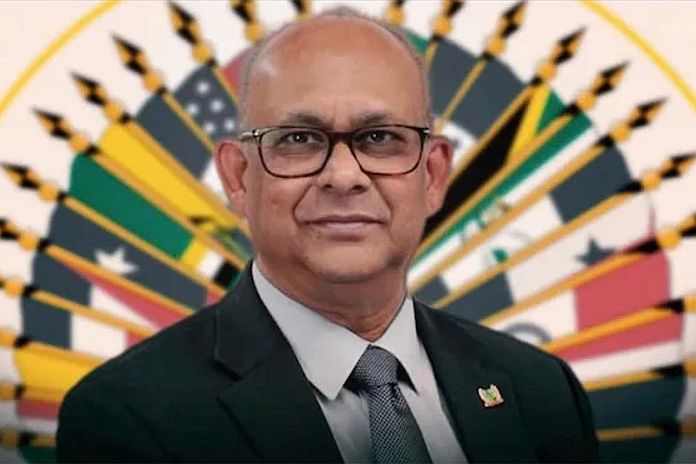
OAS Secretary General Albert Ramdin is currently facing an unprecedented offensive whose terms and objectives play out in a swirl of secret gatherings echoing through the corridors of the Organization of American States, amplified by a small group of Latin American digital media outlets. Nothing is happening in the official meeting rooms, where member states speak through their ambassadors. Various sources consulted indicate that the campaign’s objective is to remove Ramdin from his position during the General Assembly, to be held at the end of this month in Panama.
Having served as foreign minister of Suriname, Ramdin was elected in March 2025, defeating by acclamation his rival, Paraguayan foreign minister Ramírez Lezcano, who claimed to have Washington’s backing and circulated a photo of himself with president Donald Trump at Mar-a-Lago. Lezcano ultimately withdrew his candidacy due to lack of support. Ramdin thus became the first secretary general in OAS history to come from a Caribbean Community (CARICOM) country. The attacks against Ramdin, however, began even before his election.
It was precisely during the campaign for the secretary generalship that the first attacks emerged. Argentine and Central American outlets circulated claims that then-foreign minister Ramdin was a candidate controlled and backed by the People’s Republic of China, which would allegedly use him to gain control of a key regional body and advance its expansionist interests in Latin America.
Just days before the election, in March 2025, Mauricio Claver-Carone — then US Special Envoy for Latin America — declared that both Albert Ramdin and the Paraguayan candidate Rubén Ramírez Lezcano were equally qualified to lead the OAS. By refraining from offering explicit US support to the Paraguayan candidate, Claver-Carone’s remarks helped clear the path for Ramdin’s historic election by acclamation. Openly exposing the falsity of the media campaign’s allegations, Claver-Carone praised the Surinamese government, describing it as a “success story” in the face of Chinese financial influence in the Americas.
No sooner had Ramdin taken office than internal criticism began from certain missions — not through formal channels, but circulated and amplified by the same digital outlets, which are consumed with great appetite within the OAS ecosystem. It amounted to challenges to the new Secretary General’s exercise of his functions on minor or administrative matters: his travel and stays in expensive hotels, alleged lavish spending on his offices, or his plans to restructure the Secretariat. This leaderless process took on a scandalous dimension when it became known that Ramdin’s chief of staff was the subject of a judicial investigation in Suriname for alleged public corruption stemming from her time as an official of the country’s national airline.
Today, one year into his tenure, the accusations against Ramdin have escalated to the disproportionate categories of nepotism, corruption, lack of managerial judgment, and disrespect toward member states. Most notably, none of these accusations have been formally or officially raised within the OAS institutional structure — such as before the Permanent Council. In recent weeks, however, the US representative to the OAS has become the open critic of Ramdin and the primary source for the outlets constructing a narrative built on half-truths.
That representative is Ambassador Leandro Rizzuto Jr., an American businessman and Trump campaign donor who made his fortune with a hair dryer manufacturing company. Rizzuto’s limited diplomatic experience has led him to commit errors reflecting not only ignorance and arrogance in his conduct within multilateral bodies such as the OAS, but something worse: his actions suggest he is operating autonomously, without instructions from either the state department or the US presidency.
Only this can explain how, in his personal campaign against Ramdin, Rizzuto shared with OAS ambassadors via a WhatsApp group chat his detailed criticisms of Ramdin, expressed during a controversial private meeting between the two on May 21. The full content of that message to ambassadors was published verbatim three days later by the same digital outlet that has been attacking Ramdin since before his election.
Well-placed sources from several OAS missions indicate that Rizzuto’s animosity toward Ramdin stems from demands without precedent at the OAS that the Secretary General declined to meet — such as requesting an office for the US ambassador at the Organization’s headquarters, or seeking to be present at the secretary general’s meetings with the highest authorities of member states. The ambassador and businessman Rizzuto likely takes careful note of the fact that U.S. quotas and contributions fund 50 percent of the OAS budget.
It is nonetheless notable that none of this months-long controversy has been mentioned by State Department or US presidential authorities. No official expression from Washington in support of ambassador Rizzuto’s positions has come to light.
One is therefore left with an unavoidable question: what lies behind this sustained offensive against Ramdin? Is it a matter of state policy in the new era the continent is living through? Or is it simply the chronicle of a conflict driven by a misguided businessman-ambassador who mistakenly believes that at the OAS, the rule is “he who pays, commands”?
- Originally Published in Spanish: Tiempo Argentino.