



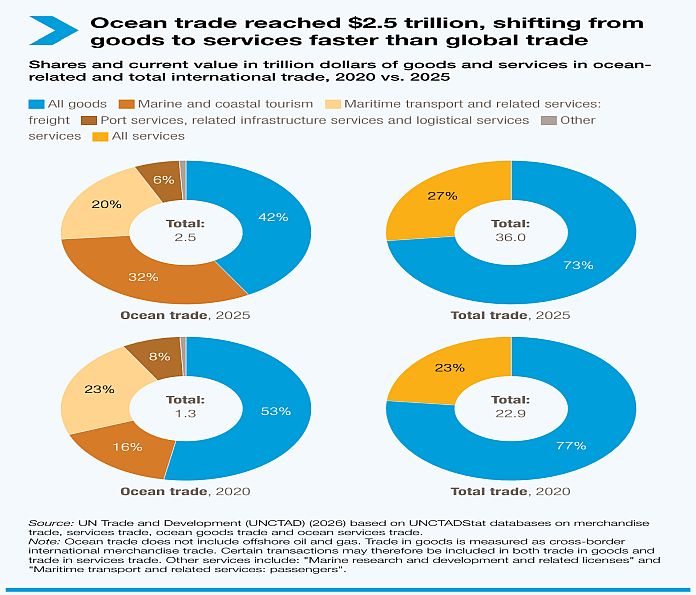
- Ocean-related services now account for 58% of total ocean trade.
- Tourism, maritime transport and ports services are driving the shift.
- Small island developing states and coastal developing countries can capture more value through sustainable ocean and blue economy strategies.
GENEVA, Switzerland – As the world marks World Oceans Day, new UNCTAD data show that services now account for most of the world’s $2.5 trillion ocean-related trade, overtaking goods and opening new opportunities for developing countries to create value from the ocean while protecting it.
Trade in ocean-related services reached $1.44 trillion in 2025, representing 58 percent of total ocean trade, up from 47 percent in 2020. The shift is being driven mainly by marine and coastal tourism, maritime freight transport and port services.
Services reshaping ocean trade
Marine and coastal tourism remained the largest ocean service export in 2025, reaching $785 billion, more than half of total ocean services trade. Maritime freight transport followed, at $487 billion.
This marks a sharp turnaround from 2020, when the COVID-19 pandemic cut international marine and coastal tourism by 70 percent. It also shows how exposed the ocean economy remains to shocks, including geopolitical tensions, conflicts and disruptions along key maritime routes.
Ocean-related services trade grew by 3vpercent in 2025, down from 12vpercent in 2024, pointing to a slower but still expanding sector.
Goods still matter, but value is shifting
The rise of services does not make ocean goods less important. Ocean-related goods trade surpassed $1 trillion in 2025, growing by 8 percent. It was led by ships and port equipment ($414 billion), high-tech manufactures ($402 billion), fisheries and aquaculture ($209 billion) and sea minerals ($2 billion).
But most value from ocean products is captured beyond primary commodities, especially in manufacturing, processing and services. For developing economies, this means the opportunity is not only to export more from the ocean, but to build stronger links between ocean resources, services (such as tourism), industry and local suppliers.
This is particularly important for small island developing states (SIDS), where building large-scale manufacturing capacity can be costly and connectivity is among the lowest. Integrated ocean and blue economy strategies can help countries diversify exports, add value and create jobs while protecting the marine ecosystems on which their economies depend.
Innovation and conservation must advance together
Marine research and development remains a small part of ocean services trade, but it was the fastest-growing segment in 2025, rising by 9 percent.
This points to growing interest in ocean-based innovation, from marine data and ecosystem monitoring to technologies that support sustainable use of ocean resources and the implementation of the agreement on marine biodiversity of areas beyond national jurisdiction, which sets binding rules on sharing the benefits of marine genetic resources fairly and transferring marine technology to developing countries.
“The ocean is Earth’s least explored frontier, yet it may hold answers to this century’s defining challenges,” said Ashok Adicéam, Executive Director of Mission Neptune, France. “Our challenge is no longer only to generate knowledge, but to ensure that knowledge, technology and exploration become truly shared global public goods.”
Healthy marine ecosystems are central to the future of the ocean economy.
As of June 2026, around 10 percent of marine areas and 17 percent of territorial waters were protected worldwide, still below the global biodiversity target to conserve and effectively manage 30 percent of ocean areas by 2030.
For SIDS and coastal developing countries, sustainable ocean services can offer a practical development pathway. When well managed, they can generate foreign exchange, support local businesses, create jobs and strengthen incentives to conserve the ecosystems that make ocean-based growth possible.