



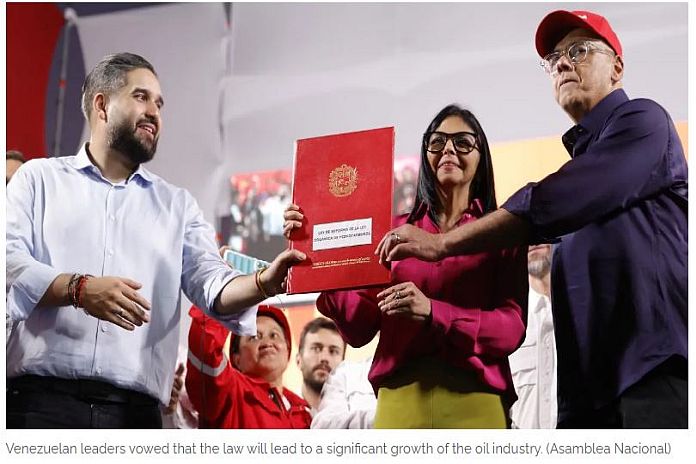
- Under the new law, the Venezuelan government can discretionally reduce taxes and royalties to ensure that projects are “internationally competitive.”
By Ricardo Vaz
CARACAS, (venezuelanalysis.com) – The Venezuelan National Assembly has approved a sweeping reform of the country’s 2001 Hydrocarbon Law that rolls back the state’s role in the energy sector in favour of private capital.
Legislators unanimously endorsed the bill at its second discussion on Thursday, with only opposition deputy Henrique Capriles abstaining. The legislative overhaul follows years of US sanctions against the Venezuelan oil industry and a naval blockade imposed in December.
National Assembly president Jorge Rodríguez hailed the vote a “historic day” and claimed the new bill will lead oil production to “skyrocket.”
“The reform will make the oil sector much more competitive for national and foreign corporations to extract crude,” he told reporters. “We are implementing mechanisms that have proven very successful.”
Venezuelan acting president Delcy Rodríguez signed and enacted the law after the parliamentary session, claiming that the industry will be guided by “the best international practices” and undertake a “historic leap forward.”
Former president Hugo Chávez revamped the country’s oil legislation in 2001 and introduced further reforms in 2006 and 2007 to assert the Venezuelan state’s primacy over the industry. Policies included a mandatory stakeholding majority for state oil company PDVSA in joint ventures, PDVSA control over operations and sales, and increased royalties and income tax to 30 and 50 percent, respectively. Increased oil revenues bankrolled the Venezuelan government’s expanded social programs in the 2000s.
The text approved during Thursday’s legislative session, following meetings between Venezuelan authorities and oil executives, went further than the draft preliminarily endorsed one week earlier.
The final version of the legislation establishes 30 percent as an upper bound for royalties, with the Venezuelan government given the discretionary power to determine the rate for each project. A 33 percent extraction tax in the present law was scrapped in favor of an “integrated hydrocarbon tax” to be set by the executive with a 15 percent limit.
Similarly, the Venezuelan government can reduce income taxes for companies involved in oil activities while also granting several other fiscal exemptions. The bill cites the “need to ensure international competitiveness” as a factor to be considered when decreasing royalty and tax demands for private corporations.
The reform additionally grants operational and sales control to minority partners and private contractors. PDVSA can furthermore lease out oilfields and projects in exchange for a fixed portion of extracted crude. The new legislation likewise allows disputes to be settled by outside arbitration instances.
Thursday’s legislative reform was immediately followed by a US Treasury general license allowing US corporations to re-engage with the Venezuelan oil sector.
General License 46 (GL46) authorises US firms to purchase and market Venezuelan crude while demanding that contracts be subjected to US jurisdiction so potential disputes are referred to US courts. The license bars transactions with companies from Russia, Iran, North Korea, or Cuba. Concerning China, it only blocks dealings with Venezuelan joint ventures with Chinese involvement.
Economist Francisco Rodríguez pointed out that the sanctions waiver does not explicitly allow for production or investment and that companies would require an additional license before signing contracts with Venezuelan authorities.
GL46 also mandates that payments to blocked agents, including PDVSA, be made to the US Foreign Government Deposit Funds or another account defined by the US Treasury Department.
Following the January 3 military strikes and kidnapping of Venezuelan president Nicolás Maduro, the Trump administration has vowed to take control of the Venezuelan oil industry by administering crude transactions. Proceeds from initial sales have been deposited in US-run bank accounts in Qatar, with a portion rerouted to Caracas for forex injections run by private banks. US Secretary of State Marco Rubio vowed that the resources will begin to be channelled to US Treasury accounts in the near future.
In a press conference on Friday, Trump said his administration is “very happy” with the actions of Venezuelan authorities and would soon invite other countries to get involved in the Caribbean nation’s oil industry. Rubio had previously argued that Caracas “deserved credit” for the oil reform that “eradicates Chávez-era restrictions on private investments.”
Despite the White House’s calls for substantial investment, Western oil corporations have expressed reservations over major projects in the Venezuelan energy sector. Chevron, the largest US company operating in the country, stated that it is looking to fund increased production with revenues from oil sales as opposed to new capital commitments.
Since 2017, Venezuela’s oil industry has been under wide-reaching US unilateral coercive measures, including financial sanctions and an export embargo, in an effort to strangle the country’s most important revenue source. The US Treasury Department has also levied and threatened secondary sanctions against third-country companies to deter involvement in the Venezuelan petroleum sector.