



BRIDGETOWN, Barbados, (GIS) – Barbados has reaffirmed its unwavering commitment to energy resilience as a Small Island Developing State while navigating an increasingly complex and volatile global risk environment.
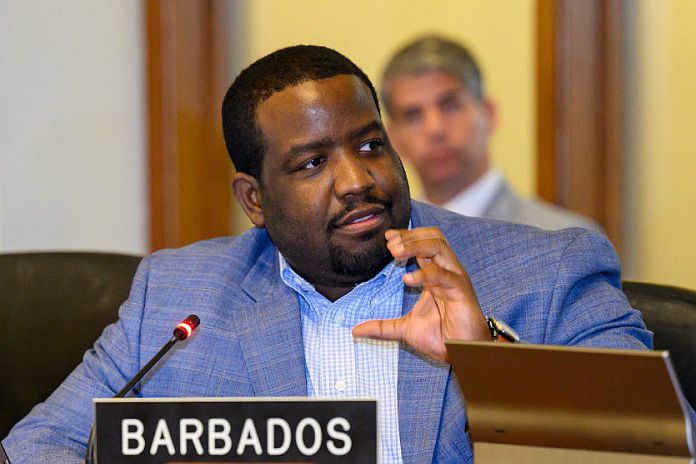
Alternate Representative of the Permanent Mission of Barbados to the Organization of American States and First Secretary at the Embassy of Barbados to the United States of America, William Clarke, shared this position as he delivered Barbados’ national statement at the regular meeting of Inter-American Council for Integral Development (CIDI) in Washington, DC, on February 24.
Under the theme Energy Resilience and Critical Infrastructure: Building Resilient Energy Systems amid a Changing Risk Landscape, Clarke said that for countries such as Barbados, energy sovereignty is not abstract policy – it is an existential necessity.
“For small island developing states, energy sovereignty determines whether we command our future or remain exposed as net importers at the mercy of fragile global supply chains,” he stressed.
Additionally, he noted that structural constraints of size and limited market scale continue to restrict access to affordable capital and investment flows.
“Contradictions persist. Certain energy subsidies still eclipse support for renewables. This is the tight space in which Small Island Developing States operate. Yes, finance matters. But capacity and scale, decide,” he stated.
Clarke emphasised that Barbados is not passive in the face of these realities. He pointed out that the country continues to advance the Bridgetown Initiative 3.0 and has worked to establish a Blue-Green Investment Bank to aggregate projects, de-risk investment, and crowd-in private capital.
He explained that Barbados is executing a whole-of-economy transformation through its Energy Transition and Investment Plan, shifting from a petroleum-based model to renewable energy across power generation, transport, buildings, industry, and agriculture, with the clear objective of achieving net-zero emissions and energy independence by 2035.
“Energy has powered every wave of human progress,” Clarke affirmed. “It will power Barbados’ growth and resilience — but we shall harness it responsibly, through sustainable and strategic partnerships.”
Barbados’ intervention at CIDI reinforced its position that resilience, sovereignty, and sustainability must define the hemisphere’s collective energy future, and that small states, though constrained by scale, are not constrained in ambition.