

-
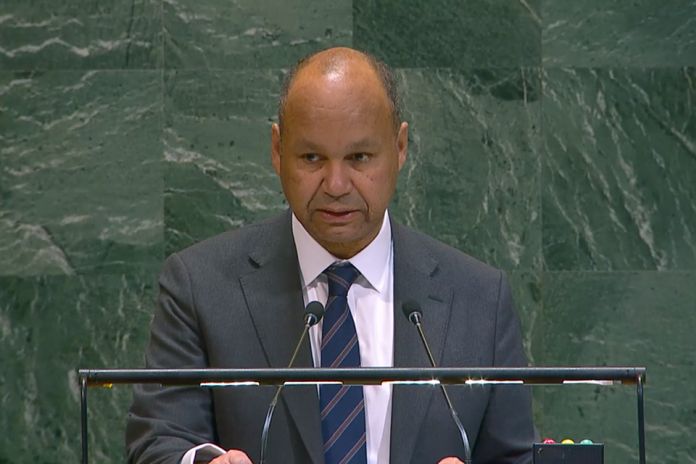
- Ambassador James Kariuki, UK Chargé d’Affaires to the UN, at the UN General Assembly meeting on strengthening the coordination of emergency humanitarian assistance of the United Nations.
By James Kariuki
Humanitarian needs have reached historic levels: conflict, climate shocks and displacement have left 305 million people in need of life-saving support.
The United Kingdom is on course to provide over $1 billion in humanitarian assistance this financial year. Yet, as global needs escalate, overall funding falls short, and protection risks continue to rise. Meeting these challenges demands bold and principled action.
First, we need a humanitarian system fit for the future.
The UK strongly supports the Humanitarian Reset and the UN80 initiative. Reform must deliver a measurable impact for those most in need.
We are championing prioritised and localised action, supporting UN humanitarian pooled funds, scaling up cash assistance, and empowering local actors.
This includes funding, capacity building and protection; for example, our support to Sudan’s Mutual Aid Movement, including locally led Emergency Response Rooms – a model for the future of locally driven humanitarian response.
Second, international humanitarian law must be upheld.
This is essential in protecting civilians, ensuring humanitarian access and safeguarding those delivering life-saving assistance.
Last year saw the highest number of humanitarian personnel deaths, the majority of whom were local staff. This is unacceptable.
The United Kingdom was proud to co-launch the Political Declaration on the Protection of Humanitarian Personnel alongside Australia and other partners.
We also joined the Global IHL Initiative, spearheaded by ICRC, and are co-leading a Workstream on National IHL Committees.
In April, we launched a Conflict, Hunger and IHL Handbook. Yet we must all go further. It is appalling that two famines – in Gaza and Sudan – are raging in the 21st century.
Third, we must invest in prevention and resilience.
Well over 90 percent of global humanitarian resources go to protracted crises. We can and must work across the humanitarian, climate, peace and development systems to build long-term resilience and reduce humanitarian need. We must also prepare for foreseeable shocks. The UK continues to champion pre-arranged finance.
Following hurricane Melissa, Jamaica accessed $242 million from insurance and catastrophe bonds, as well as anticipatory funding from global mechanisms like CERF and the Disaster Response Emergency Fund.
Demonstrating our support for this approach, this year the UK committed $77 million to pre-arranged finance.
[President,] we cannot just recommend change, we need to deliver it.
We must work together to make sure we have the information and data needed to hold us to account and make sure we are delivering to those most in need.
In this regard, we would like to thank Sweden for their facilitation and tireless efforts to maintain consensus on the Humanitarian Omnibus resolution.
This resolution is the cornerstone humanitarian text, encapsulating Member States expectations for the UN and partners’ humanitarian operations.
We regret actions have been taken to undermine the text, and we support Sweden’s difficult decision to maintain its integrity.
The UK remains committed to working across the membership to ensure we continue to send a strong, unified message to the humanitarian system at this critical time.