



This blog post is part of a special series based on the April 2026 Commodity Markets Outlook, a flagship report published by the World Bank. This series features concise summaries of commodity-specific sections extracted from the report.
Oil prices surged sharply after the outbreak of conflict in the Middle East and the near-total disruption of shipping through the Strait of Hormuz. By the end of March, the Brent price had increased by about 65 percent ($46/bbl) to record its highest monthly rise ever, amid pronounced volatility. Prices eased somewhat in early April after the announcement of a temporary ceasefire. Since then, the movement of oil prices have reflected uncertainty about the outcome of negotiations between the Islamic Republic of Iran and United States to end the conflict and restore regional oil flows. This uncertainty has persisted amid a blockade of vessels entering or leaving Iranian ports and coastal areas.
By Paolo Agnolucci, Nikita Makarenko, and Kaltrina Temaj
The closure of the Strait of Hormuz has led to the largest oil market disruption in history. Global oil supply crashed by 10.1 mb/d in March, due to attacks on energy infrastructure and restrictions on tanker traffic in the Middle East. Global oil output is expected to fall by 6.9 mb/d (6.6 percent) year-on-year in 2026Q2, recording its largest quarterly decline since the COVID-19 pandemic. Supply reductions are anticipated to be concentrated among producers exporting through the Strait of Hormuz, while production growth elsewhere is expected to remain limited. The United States is projected to account for most non-OPEC+ supply growth, with output increasing by about 0.5 mb/d, partly offsetting disruptions in the region.
Oil demand destruction is emerging. Global oil consumption is estimated to have fallen by 0.8 mb/d year-on-year in March due to increased disruptions in the Middle East and a consequent rise in oil prices. Demand is forecast to fall by another 1.5 mb/d in 2026Q2, with advanced economies, Asia, and the Middle East seeing reduced demand from trade disruptions and price hikes. Demand growth in 2026 is expected to remain concentrated in major emerging markets, particularly Brazil, India, and Indonesia, supported mainly by transport fuels and petrochemicals.
A global oil shortage is impacting the market. The oil market is projected to face a 3.7 mb/d deficit in 2026Q2 due to reduced production from the Middle East. Emergency reserves and limited output increases have partly alleviated shortages, but global inventories dropped sharply in March. Even if disruptions ease later this year, oil markets are expected to stay tight in the near future amid ongoing geopolitical risks, uncertain regional flows, and dislocation of shipping assets.
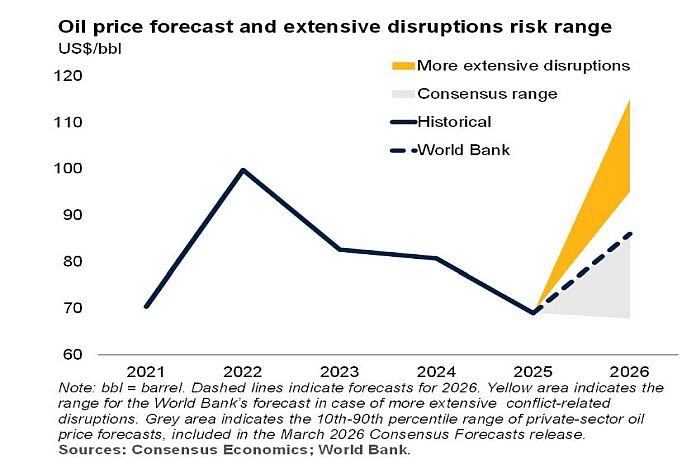
Oil price risks remain largely upward. Oil prices are expected to remain high, with Brent averaging $86/bbl in 2026 before dropping to $70/bbl in 2027 as supply stabilizes. This forecast assumes that the most acute phase of supply disruptions related to the conflict in the Middle East ends in May and that oil exports from the Middle East will recover and stabilize around pre-war levels by the final quarter of the year.
The main upside risks are re-escalating hostilities in the Middle East or lasting impediments to regional oil flows due to new constraints on exports through pipelines and more extensive damage to regional production and export capabilities. Additional risks include unanticipated logistical or operational hurdles in reversing shut-ins or resuming shipping. Under these circumstances, the average Brent oil price in 2026 could fall in a range from $95/bbl to $115/bbl, about 10 to 35 percent higher than the baseline.
On the downside, prices may drop below the baseline if supply rebounds faster than expected, supported by stronger US production growth, higher OPEC+ output, or faster normalisation of shipping flows. Faster-than-expected electric vehicle adoption and weaker global economic growth could also place downward pressure on prices.