

By Johnny Coomansingh
Early on mornings, I would sit in my favourite chair, recapitulating how I arrived at this point in my life. The flashbacks to scenes in my childhood and youth would come in almost uncontrollable torrents. Just yesterday, for whatever reason, a series of thoughts flooded my mind about my family’s nomadic lifestyle and the concomitant troubles we experienced on our journey. This uneasy way of life saw us moving from Adventist Street in Sangre Grande, Trinidad, to a more ‘spacious’ abode in the village of Boystown, Upper Sangre Grande. Like fledgling humming birds breaking out from their little nest, my great-grandmother’s adobe house couldn’t comfortably accommodate all of us; space was still the final frontier.
My mother was at sea when my father left. Confused about what to do, her efforts to make ends meet were most of the time futile; something was always moving the ends. She tried at sewing shirts for the young men who limed (hang out) with my eldest brother, but the income was never sufficient. Our situation was dire. Economically, things were past brown. The future looked gloomy. There was nowhere or no one to turn to. Nevertheless, it has been said: “Where there is hope there is life,” and “When all you have are lemons, make lemonade.” Indeed a good line but we didn’t even have lemons.
On this blessed day, my mother visited my ‘Aunty Vie’, maybe to discuss her needs, wants and worries. It was highly recognisable. Mom came back home much happier than when she left. I never saw her so excited. Aunty Vie told her to make Toolum to sell to school children and passersby. She envisaged that this was the solution to turn her problem into an opportunity. Toolum, is a confectionery created from blackstrap molasses, brown sugar, and grated coconut, flavoured with cinnamon and bay leaves.
Back then (late 60s), molasses was cheap, sugar was relatively inexpensive, and coconuts were plentiful. As far as I know, there are few people who would refuse a good Toolum. Mister Wallace, our next-door neighbour always bought a few Toolum from her. He said that the molasses was good for lowering high blood pressure. And so my mother immediately became a Toolum entrepreneur in the house on Adventist Street. One batch of Tolum would make 130 little balls, which would fetch, in those days, one Trinidad and Tobago dollar. At one cent per Toolum, the wholesale price allowed the shopkeeper to make a mere 30 cents profit on every bag. Today, Toolum, about twice the size of my mother’s, sells at six or seven dollars (TTD) for one.
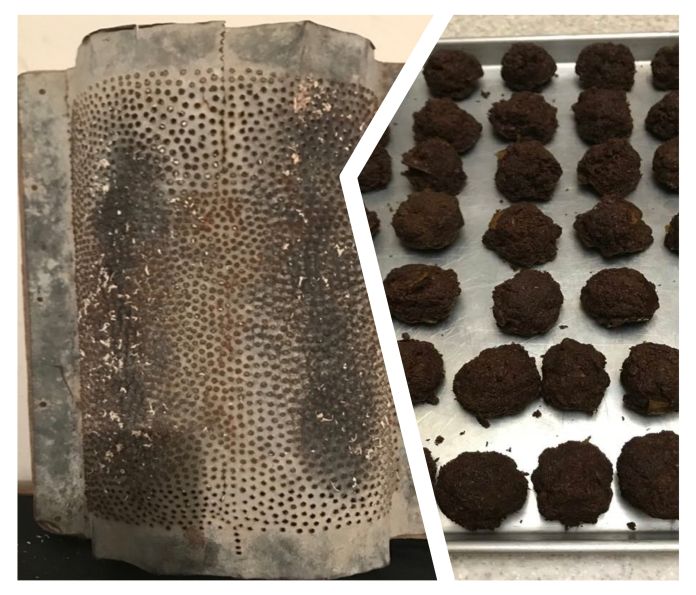
I grated coconuts to make Toolum (Photograph by author).
The earning of a paltry income while living on Adventist Street was not sufficient to meet the rent, our basic needs and electricity bills. Sometimes I had to go sell the bags of Toolum to the grocers in exchange for groceries. Although the money was hard in coming, we moved into a new house where the rent per month was double that of the sum we paid on Adventist Street.
It would seem that my mother had to work harder at making Toolum for the shops. I remember going to mister Sooklal’s grocery down on Mandillon Road to buy a supply of food in exchange for a bag of Toolum. Mister Sooklal was a very kind and good-natured man. His children were just as nice and amiable. He understood our dismal situation and was always willing to help us in whatever way he could. There are good people everywhere, and he was one of them. I also sold Toolum to mister Ayoung, the old Chinese shopkeeper on Bravo Hill, who taught me a word of wisdom. Words I kept throughout my life: “Stoop to conquer.”
As I sat there reminiscing about our constant moving of house, I was of the feeling that we should have been living in a yurt or a wigwam. Without fail, our house-moving jinx continued undisturbed. We did not stay long in Boystown. Our next stop was Sukhram Street, Sangre Grande. I am sure that this rapid moving from house to house took toll on me and my studies at Northeastern College (NEC). If I could relate the real reason for leaving the house at Boystown I would be telling a lie. I had no clue then, and I have no clue now. I surmised that the difficulty and added expense to get to Cunapo, which was about one mile away, could have been the main problem.
The difficulty with transport to and from school for my two younger sisters and younger brother was becoming more burdensome, but then I figured that the transport situation was not the real problem. I was wrong to even entertain that thought, but, as usual, I could only guess that it was a problem with the non-payment of rent. We were given marching orders. Eviction! We were already living way below the poverty line. We fell on harder times. So we moved to a house located in Sukhram Village, Sangre Grande. How my mother acquired this new ‘home’ is still a big question in my mind.
This house was a huge upgrade from the former houses that we occupied. We had the privilege of having a kitchen sink, a few roughly constructed kitchen cabinets, indoor plumbing with bathroom and toilet facilities inside; no more outhouse. Not only that, the house with its painted concrete floor had three bedrooms, a large kitchen, a huge ‘open concept’ living and dining room, accompanied by a long gallery (verandah). About six concrete steps took us from the unpaved road above the lower terrace where the two-story house stood.
It was no dream dwelling, but it was physically conducive to better living. Moreover, this location was closer to the church and schools that we attended. Everything was right at hand: shops, cafes, hospital, health office, and a standpipe. Our grandmother was located within walking distance. The place we called Marlay Oval was right up the hill, a place we frequented to play cricket and football in Sukhram Village.
Need I say that my mother continued her arduous task and trade in Toolum? Even while I was attending NEC in Sangre Grande, Trinidad, I was very instrumental in helping her with the Toolum business. During their educational experiences in Form five, most students have the opportunity of going home to study, walking down the street from school with their girlfriend or gaping and liming in Grande. Some of them checked out the county library on Brierley Street after school. I didn’t have that luxury, maybe once per week if I was lucky.
Making sure my mother had enough dried (ripe) coconuts to continue with the daily manufacture of Toolum, I was saddled with the chore of getting the coconuts to her every day. Leaving school on evenings, I came home to quickly change my clothes to find my way to Brierley Street, where I purchased the coconuts from a lady we knew as Mrs Harris. Digressing a bit, rumour has it that she had a little romantic tryst with my father. It is also rumoured that a girl child emerged from the relationship. While collecting the coconuts, I couldn’t even think about the library then, which was not too far away on Brierley Street. From the point of purchase opposite the Public Transport Service Corporation (PTSC) bus terminus, I lugged at least 25 coconuts in their husks in a ‘blue seam’ crocus bag to the backyard of one of my friends’ homes.
Mrs Harris was an extremely loquacious woman who sold the coconuts to me. She asked me a couple of times about my last name and who was my dad. I gave her the correct answers, and she just said “hmmm.” She grew anthurium lilies around her home, but did not need more coconut husks. Coconut husks were traditionally used in the cultivation of anthurium lilies because of their moisture-retaining property and their capacity to anchor roots. And so, I had to find a way to dispose of the husks. John, one of my school/church friends, realised my predicament and offered to help me get rid of the bulky husks.
John lived one house away from the corner of Brierley Street and Foster Road, a good stretch from the bus terminus. Slowly walking to John’s house in Sun or rain, especially with a bag of coconuts on my shoulder, was pure tedium. Passing the old fire station, I had to cross Ojoe Road to get to Foster Road. Without traffic lights to help, I had to wait with the bag on my back on many occasions for the vehicular traffic to clear the intersection between Brierley and Ojoe Roads. Practically all students from NEC and other schools used Ojoe Road to get to the Central Business District known as Cunapo.
The load was heavy, and I struggled with the ungainly crocus bag. Many of my schoolmates saw me as I carried the cumbersome load. With the looks on their faces, I am sure they had questions about my coconut retrieval activities. With such a bulky load on my back, I looked similar to ‘Christian’ in John Bunyan’s Pilgrim’s Progress. As we say nowadays in Trinidad, I was “toting.” Nevertheless, I carried on with my mission. My mother was waiting, and we were hungry.
With the use of a large garden hoe in an upside-down position, I husked the nuts and left the coir in a heap for John’s father, who used them for fuel. John’s father owned a huge cane syrup kettle called a copper in which he made cassava farine. The coconut coir was used to keep the fire blazing under the copper. With 25 coconuts, my mother made five batches of Toolum. My task the next morning was to make sure I grated at least ten or fifteen coconuts before I left for school. I became an expert at grating coconuts. I could grate coconuts blindfolded without bruising my fingers on the grater.
Apart from the coconuts and the grating process, a pot of Toolum takes a good while to cook. As far as I know, my mother’s Toolum became an international treat. People travelling abroad would sometimes ask for a bag of Toolum to take with them. I learnt to make Toolum the same way my mother did. The making and sale of Toolum was part of the economy in our struggle to survive. However small it was, the Toolum business was an essential part of my reality…a problem turned into an opportunity.