



By Andrés Ham, Emmanuel Jose Vazquez, Monica Yanez Pagans, Camilla Knudsen and Saher Asad
The green transition is often viewed as disruptive but in South Asia the story is more nuanced.
Our new paper, Occupational Mobility and Green Transition: A Stylized Estimation of Skill Investment Needs in South Asia, finds that many workers may not need to reinvent their careers to participate in a greener economy. In many cases, they need to adapt existing skills.
That distinction matters. South Asia has one of the world’s largest workforces—approximately 1.4 billion people of working age in 2024. An additional 512 million children aged 0–14 will enter the working-age population over the next decades.
South Asian countries face pressure to reduce emissions and manage climate risks, and also sustain growth, create better jobs, and advance development. In this context, how can workers access work in growing fields, such as clean energy, energy-efficient construction, sustainable manufacturing, climate-smart agriculture, and other sectors where greener technologies and practices are changing what workers need to know?
Green jobs are already here
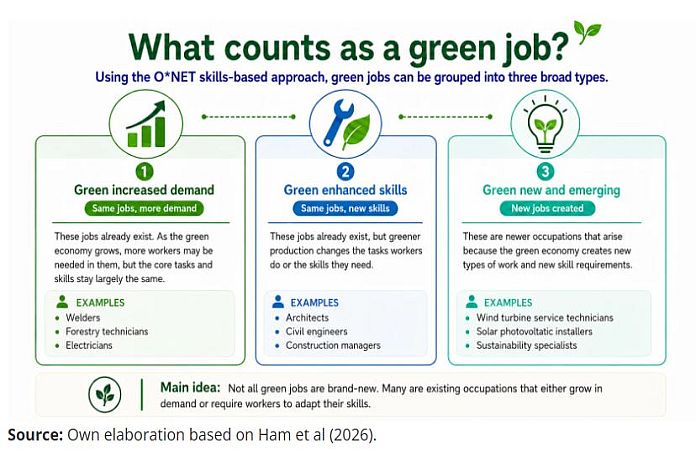
The paper examines jobs in Bangladesh, Bhutan, India, the Maldives, Nepal, Pakistan, and Sri Lanka. One in four jobs in the region is green, ranging from 17 percent in the Maldives to 29 percent in Pakistan. This does not mean one in four workers is installing solar panels. Green employment also includes occupations emerging as economies become more sustainable, jobs requiring new skills due to greener processes, and entirely new roles.
Green jobs are not just high-tech. They include construction, manufacturing, services, agriculture, and logistics jobs. The skill composition also varies by country. In Bhutan, India, and Pakistan, green employment is concentrated in lower-skill occupations. In Bangladesh and Nepal, medium-skill occupations play a larger role. In Sri Lanka and the Maldives, high-skill occupations dominate. Clearly, green skills strategies cannot be one-size-fits-all.
Occupational mobility is feasible for many
Among workers currently in non-green occupations in South Asia, 57 percent may be able to access greener work with limited reskilling, 16 percent require moderate upskilling, and 27 percent require full skills reconversion. These estimates measure skills proximity—how close workers’ current occupational skill profiles are to those required for green occupations. For some, the pathway involves adapting within the same occupation as work processes become greener; for others, it may involve moving into a different occupation.
Country differences are significant. In India, 68 percent of non-green jobs could transition with limited reskilling, while only 19 percent would require full reconversion. In the Maldives, the challenge is steeper: just 38 percent could transition with limited reskilling, while 45 percent would require full reconversion. Nepal has the highest share requiring moderate upskilling (24 percent), and Bangladesh has the lowest (12 percent).
The transition will not happen automatically. Workers still need access to information, training, certification, and job opportunities. Firms need incentives to invest in training. Governments need to coordinate education, labor, industry, and climate policies. But the key finding is that the green transition is not about replacing workers—it is mostly about helping them move.
Green jobs may offer better pay, but quality varies
Green jobs are associated with a wage premium of about 12 percent, which varies by country and gender. Higher wages can motivate workers and firms to invest in training. But many green workers are self-employed, and only a minority of paid green workers have written contracts or social security coverage.
A just transition must ensure that all workers have pathways into greener occupations. Broader efforts to support the green transition should also help expand access to stable, productive, and better-protected work—especially for women, youth, and informal workers.
A dual strategy
South Asia’s demographic transition creates both urgency and opportunity, with a large share of the future workforce still in school or about to enter training. This calls for action on two fronts.
First, countries need systems for reskilling and upskilling the current workforce. Since many workers may need only limited training to move into greener occupations, on-the-job learning should be central. Short courses, modular credentials, apprenticeships, and industry-led training can help workers adapt without long absences from employment.
Second, education and training systems must prepare future workers, while also creating pathways for women, young people, and others currently unemployed to get greener jobs. This does not require a separate green curriculum. It means embedding relevant green skills across education and training pathways, including through schools, technical and vocational systems, universities, and other systems.
Governments, firms, and education and training providers need to work together—setting occupational standards, financing priority training, improving labor market information, and supporting disadvantaged groups. Development partners can contribute through data systems, regional learning, and scalable models.
The World Bank is already supporting this agenda in South Asia. In India, we are supporting efforts to strengthen the quality, relevance, and employability outcomes of Industrial Training Institutes. The program supports demand-driven trades, stronger industry partnerships, upgraded trainers and facilities, job placement services, and integrates green skills into training. Our project in Bangladesh is developing generic training models that integrate green skills across the skills development system while supporting green and climate-related trades as part of its broader future of work agenda, using scalable training approaches that prepare workers for emerging labor market opportunities.
The green transition will depend on whether skills systems can help workers move toward future labor market opportunities. Green jobs are already in South Asia, and many workers may be closer to them than expected. A greener future requires new technologies and investments, and a pathway for workers to benefit from opportunities offered by the transition.