



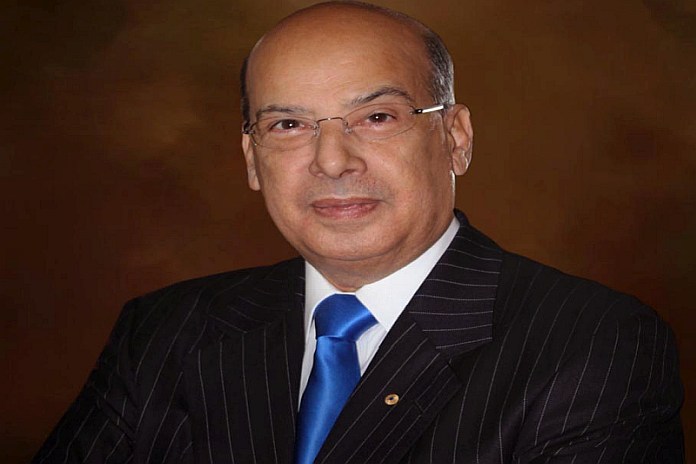
By Sir Ronald Sanders
When Marco Rubio arrived in St Kitts to address the heads of government of the Caribbean Community, CARICOM, he did so only hours after attending president Trump’s State of the Union address in Washington. The speech ended late. Before dawn, he was on his way to the Caribbean. That matters.
Secretaries of State do not lightly compress regional diplomacy into an already demanding schedule. His decision to attend signaled respect for CARICOM’s collective invitation and recognition that the Caribbean is not marginal in Washington’s hemispheric priorities. It also demonstrated continued commitment to direct engagement.
In his public remarks, Secretary Rubio spoke plainly about transnational crime, illegal migration, energy opportunity, and the stabilisation of Venezuela under interim authorities led by Delcy Rodríguez. He referenced the reopening of the US Embassy in Caracas and made clear that democratic elections remain the ultimate measure of legitimacy. His point was straightforward: a stronger, safer Caribbean strengthens the United States. There would have been no quarrel with any of that.
On security, there is also no disagreement. The criminal organisations that exploit Caribbean waters and transit routes threaten both US and CARICOM societies. Drug trafficking, arms flows, and gang networks undermine governance from Haiti to Miami. Closer intelligence cooperation and maritime coordination are shared necessities.
On migration, Secretary Rubio emphasised that the United States is conducting a global review of its migration and visa policies, expected to conclude by the end of June. For CARICOM countries, access to US visas is not a peripheral matter. It affects business travel, family connections, tourism flows, education, and longstanding people-to-people ties. Any restrictions are therefore felt quickly and widely across Caribbean societies.
Caribbean governments have consistently accepted their own nationals who are deported from the United States. The difficulty arises when small states are encouraged to accept non-nationals without defined limits or shared responsibility. For large countries, numbers may be manageable. For small island and coastal states with limited fiscal space and investigative reach, even modest numbers can carry disproportionate social and financial impact.
It is understood that some CARICOM states have already entered such arrangements. What remains essential, however, is that any framework across the region be based on clarity, reciprocity, defined limits, and respect for sovereign decision-making. Caribbean governments will follow the outcome of the US review closely and will engage constructively once its parameters are known.
Energy and regional stability formed the second major theme of the Secretary’s remarks. Developments in Venezuela were presented as a shift from immediate stabilisation to recovery. Caribbean governments will judge that progress by results. If Venezuela moves toward durable legitimacy and reduces regional instability, the entire basin benefits. If uncertainty returns, its effects will again be widely felt.
Cuba, though absent from the Secretary’s formal plenary remarks, was part of private discussions.
Subsequent reporting confirms that US officials close to the Secretary met privately in St Kitts with Raúl Guillermo Rodríguez Castro, grandson and close aide to former Cuban leader Raúl Castro. That meeting confirms that discussions between Washington and Havana are active.
Reports suggest that the United States is exploring a phased easing of sanctions in exchange for incremental economic and governance changes. Secretary Rubio has indicated publicly that the United States is prepared to listen if Cuban authorities are willing to undertake significant economic reforms that expand private enterprise and open space for broader freedoms.
This moment differs from earlier periods of strain. Cuba faces severe economic contraction, energy shortages, and humanitarian pressure. Regional energy dynamics are also shifting. In such circumstances, steady engagement may yield more than isolation alone.
It is further understood that discussions are underway regarding energy arrangements that could allow Venezuelan oil to reach Cuba through controlled channels, easing the island’s acute pressures. These negotiations remain sensitive and incomplete. But they reflect recognition that collapse in Cuba would carry consequences for the wider Caribbean, particularly in migration and regional stability.
CARICOM governments have long advocated dialogue rather than rupture in dealing with Cuba. Public statements by regional leaders emphasised de-escalation, reform, and stability. The indication that Washington is pursuing quiet engagement was therefore noted with interest and, in many quarters, with cautious welcome.
The broader significance of the meeting is clear. The Caribbean is America’s immediate neighbourhood. Trade flows in both directions. Migration binds families. Security threats move across maritime space without regard to borders.
The United States seeks secure borders, stable neighbours, and resilient economic ties. CARICOM states seek growth, climate resilience, and protection against transnational crime. These aims intersect.
If reinvigoration means deeper security cooperation, structured and lawful migration arrangements, investment that integrates Caribbean economies into resilient supply chains, and pragmatic engagement to reduce instability in Venezuela and Cuba, then the meeting in Basseterre may prove consequential.
If it becomes a series of expectations unsupported by proportional safeguards, friction will return. Small states guard sovereignty carefully because sovereignty is their shield. That instinct is not obstruction. It is prudence.
The Secretary’s overnight journey from Washington to Basseterre signalled seriousness. The discussions that followed were constructive. They did not erase every difference. But they kept dialogue open at a moment when steady engagement is essential.
In this hemisphere, instability travels quickly. Sustained diplomacy must move faster, in Washington and across CARICOM alike.