



- Canada announces $8 to scale-up food and nutrition for vulnerable Cubans
- Russia is considering a proposal to help Cuba with fuel
- CARICOM: “ We reaffirm our enduring commitment to regional solidarity …”
By Caribbean News Global 
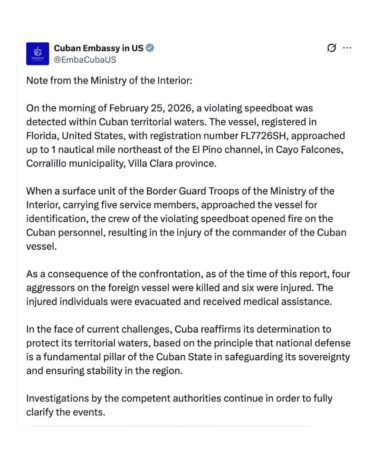
BASSETERRE, St Kitts – US Secretary of State Marco Rubio met with leaders of the Caribbean Community (CARICOM) on the margins of the 50th Regular Meeting of the Conference of Heads of Government in Basseterre, Saint Kitts and Nevis, while the Cuban crisis intensifies, killing at least four people and wounding six others in a gunfight in Cuban waters on Wednesday.
In Saint Kitts and Nevis, “The secretary underscored the United States’ enduring partnership with the Caribbean and reaffirmed our shared commitment to regional security cooperation,” according to a US Department of State readout attributable to principal deputy spokesperson Tommy Pigott.”
Participants in the meeting included prime minister Terrance Drew of Saint Kitts and Nevis, prime minister Roosevelt Skerrit of Dominica, prime minister Gaston Browne of Antigua and Barbuda, prime minister Andrew Holness of Jamaica, prime minister Mia Mottley of Barbados, president Irfaan Ali of Guyana, prime minister John Briceño of Belize, prime minister Philip J. Pierre of Saint Lucia, prime minister Philip Davis of The Bahamas, prime minister Dickon Mitchell of Grenada, prime minister Alix Didier Fils-Aimé of Haiti, prime minister Kamla Persad-Bissessar of Trinidad and Tobago, president Jennifer Geerlings-Simons of Suriname, and prime minister Godwin Friday of Saint Vincent and the Grenadines.
Secretary of State Marco Rubio also met separately with prime minister Kamla Persad-Bissessar, and commended Trinidad and Tobago as a strong US partner in the Caribbean and acknowledged Persad-Bissessar’s public support for US military operations in the South Caribbean Sea.
Secretary Rubio and prime minister Persad-Bissessar reiterated both our governments’ commitment to energy security in our region, curbing illegal narcotics and firearms trafficking, and deepening US-Trinidad and Tobago security cooperation.
Meeting with Saint Kitts and Nevis prime minister and current chairman of the Caribbean Community (CARICOM) Terrance Drew, the US secretary Rubio thanked prime minister Drew for Saint Kitts and Nevis’ leadership and hospitality.
They discussed strengthening regional security cooperation to combat transnational crime and ending illegal immigration. The secretary emphasised the United States’ dedication to working closely with Saint Kitts and Nevis as a valued partner and also discussed Saint Kitts and Nevis’ strong and enduring partnership with Taiwan.
Meanwhile, trouble erupts in Cuban waters on a US-registered speedboat, Canada continues to provide assistance to the people of Cuba.
Cuba is facing rapidly worsening conditions driven by severe fuel shortages, prolonged blackouts and growing barriers to accessing food and health care. The energy crisis, further compounded by last year’s challenges, including hurricane Melissa, has increased the vulnerability of millions of people.
On Wednesday, Anita Anand, minister of foreign affairs, and Randeep Sarai, secretary of state (International Development), announced an accelerated funding of $8 million to be released immediately to scale up food and nutrition for vulnerable Cubans. This funding is part of an international assistance program to strengthen local food security and nutrition, delivered through trusted partnerships with the World Food Programme and the United Nations Children’s Fund (UNICEF), ensuring our aid reaches the Cuban people directly.
“Canada continues to monitor the situation in Cuba and remains in close contact with its partners to assess and respond to evolving needs,” says Global Affairs Canada.
“As the people of Cuba face significant hardship, Canada stands in solidarity and is providing targeted assistance to help address urgent needs. Through trusted humanitarian partners, we are delivering timely support to vulnerable communities and reaffirming Canada’s commitment to the well-being and dignity of the Cuban people.” ~ Anita Anand, minister of foreign affairs.
“Canada stands with the people of Cuba during this difficult time. Our support will be delivered directly to the most vulnerable to help address urgent food and nutrition needs and provide some immediate relief.” ~ Randeep Sarai, secretary of state (International Development).
At the 50th regular meeting of the Conference of heads of government of the Caribbean Community (CARICOM) in Basseterre, Saint Kitts and Nevis, prime minister, Dr Andrew Holness, called for urgent regional action to address the humanitarian and economic situation in Cuba, noting that a prolonged crisis poses a direct threat to the stability of the entire Caribbean.
“We must address the situation in Cuba with clarity and courage,” Dr Holness declared, pointing out that the Cuban people are facing severe economic hardship, energy shortages, and growing humanitarian strain.
PM Holness calls for collective regional action to address situation in Cuba
According to TASS, Russian News Agency, February 25, 2026, Russia is considering a proposal to help Cuba with fuel — Novak
“The intergovernmental commission for development of trade and economic cooperation between Russia and Cuba is dealing with that,” the deputy prime minister said.
Russia is now helping the Cuban economy, and the work is underway between the countries in this sphere, the official said earlier.
“Such proposals are present, they are discussed by the government now. The intergovernmental commission for development of trade and economic cooperation between Russia and Cuba is dealing with that,” Novak said.
Cuba’s economy is on the verge of collapsing. Cuba is likely facing the worst crisis since at least the start of the Cuban Revolution. Official inflation stood at 14 percent in 2025, but according to private estimates, it may have been as high as 70 percent per the article Cuba’s Self-Induced Crisis May Be Its Worst Yet.
“Daily life for Cubans is just as nightmarish. Recent videos filmed by locals depict an almost empty Havana, as the country’s capital can no longer afford to keep public transportation running. The federal government has mandated remote work, and universities are also operating virtually, though a lack of energy effectively means they have shut down. Food shortages, which have long been a part of Cuba’s reality, have become more acute.
“The decline of Cuba’s economy is producing mass emigration, even more than in the past. A recent study suggests that up to 1.7 million Cubans fled the country between 2020 and 2024. That study placed the 2024 population of Cuba at 8 million people. For comparison, the 2021 US Census estimated the number of foreign-born Cubans living in the US to be 1.3 million.”
A December 8 statement from CARICOM states:
“The Ninth CARICOM-Cuba Summit, to be held in Havana in March 2026, will provide another opportunity for an exchange on a wide range of bilateral, hemispheric and global issues that are of mutual interest and concern, as well as on areas for further cooperation, including trade, education and public health.”
The CARICOM concludes:
“We must continue to work together to tackle these obstacles. In this spirit, we reaffirm our enduring commitment to regional solidarity and to the principle of respect for the sovereignty and self-determination of all nations.”
Addresses threats to the United States by the government of Cuba, fact sheet: President Donald J. Trump January 29, 2026 states:
Countering Cuba’s malign influence: The president is addressing the depredations of the communist Cuban regime by taking decisive action to hold the Cuban regime accountable for its support of hostile actors, terrorism, and regional instability that endanger American security and foreign policy.
- The Cuban regime aligns itself with numerous hostile countries and malign actors, hosting their military and intelligence capabilities. For example, Cuba hosts Russia’s largest overseas signals intelligence facility focused on stealing sensitive national security information from the United States.
- Cuba provides safe haven for transnational terrorist groups, such as Hezbollah and Hamas, and supports adversaries in the Western Hemisphere, undermining US sanctions and regional stability.
- The regime persecutes and tortures political opponents, denies free speech and press, profits corruptly from the Cuban people’s misery, and incites chaos by spreading communist ideology across the region.
- These actions constitute an unusual and extraordinary threat to US national security and foreign policy, requiring immediate response to protect American citizens and interests.
Venezuela Sanctions: 1238. Would OFAC approve the resale of Venezuelan-origin oil to Cuba?
In accordance with the United States’ support and solidarity for the Cuban people, OFAC would implement a favorable licensing policy toward specific license applications seeking authorization for the resale of Venezuelan origin oil for use in Cuba. To qualify for this favorable licensing policy, the requested transactions would need to be consistent with the terms and conditions of Venezuela General License (GL) 46A, though applicants need not necessarily have an established US entity and the limitations in GL 46A with respect to Cuba would not apply.
This favorable licensing policy is directed towards transactions that support the Cuban people, including the Cuban private sector (e.g., exports for commercial and humanitarian use in Cuba). Consistent with applicable US law and policy, transactions involving, or for the benefit, of any persons or entities associated with the Cuban military, intelligence services, or other government institutions, including entities listed on the US State Department’s Cuba Restricted List, see 31 C.F.R. § 515.209, would not be covered by this favorable licensing policy. ~ https://ofac.treasury.gov/faqs/1238
The United States maintains a comprehensive economic embargo on the Republic of Cuba. In February 1962, president John F. Kennedy proclaimed an embargo on trade between the United States and Cuba, in response to certain actions taken by the Cuban government, and directed the Departments of Commerce and the Treasury to implement the embargo, which remains in place today.
On June 16, 2017, the president issued a National Security Presidential Memorandum (NSPM) on Strengthening the Policy of the United States Toward Cuba. On November 8, 2017, the Departments of State, Commerce, and the Treasury announced certain changes to implement the president’s June 2017 NSPM. ~ Cuba Restricted List.
- Related: CUBA and There’s extraordinary opportunities