



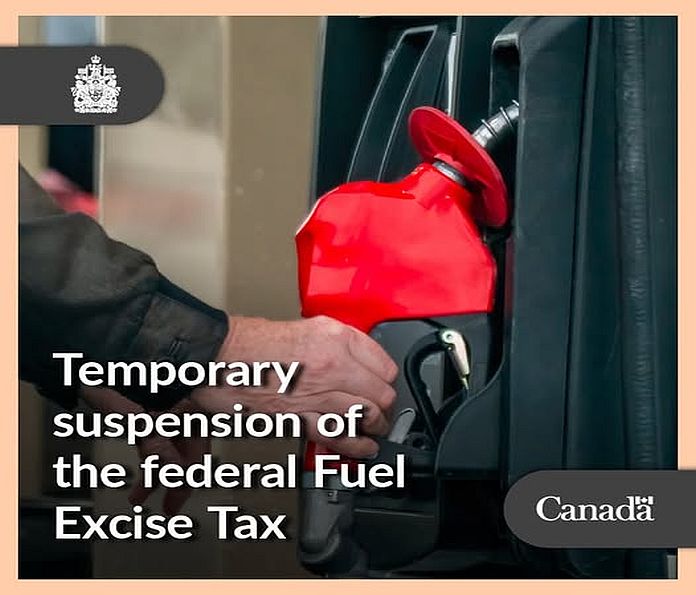
OTTAWA, Canada – Prime Minister, Mark Carney, has announced that the government is temporarily suspending the federal Fuel Excise Tax on gasoline and diesel across Canada. Starting April 20, 2026, Canada’s new government will suspend the full amount of the tax on gasoline and diesel until September 7, 2026. This is expected to reduce Canadians’ bills at the gas station by 10 cents per litre on regular gasoline and 4 cents on diesel. The government is also temporarily suspending the federal Fuel Excise Tax on aviation fuels.
“Cutting the tax on gasoline and diesel until Labour Day is a responsible measure that will reduce operating costs for truckers and businesses in the food, agriculture, housing, construction, and delivery sectors. With lower costs and greater financial strength, businesses can hire more workers, confidently build, and export more products to global markets. Canada’s new government was elected to build a more resilient economy – an economy that creates good careers, strengthens our sovereignty, and empowers all Canadians with a lower cost of living. We’re moving with speed and ambition to build a country where all Canadians have greater certainty, security, and prosperity,” the prime minister’s office – communications said.
“We’re building a stronger, more resilient, and more independent Canadian economy. As we build, we’re cutting your taxes, reducing the costs of your homes, and providing you relief at the pump. We cannot control what other nations do. We’re focused on what we can control – building Canada strong for all,” said prime minister of Canada,” PMO added.
Global conflict and ongoing supply disruptions in the Middle East are driving up fuel prices around the world. To make Canada more energy secure and less reliant on external factors, our government is advancing major projects to realise Canada’s full potential in clean and conventional energy.
“We’re building big in electricity, LNG, and nuclear to provide all Canadians with clean, reliable, and affordable power. As we build for the long term, we are providing immediate relief to bring down costs for Canadians right now – including cutting taxes for 22 million Canadians, cancelling the consumer carbon tax, and protecting and expanding vital social programs,” said PMO.
Quick facts
- Today’s announcement builds on major initiatives to lower costs for Canadians, including:
- Cutting taxes for 22 million middle-class Canadians by lowering the first marginal personal income tax rate from 15 percent to 14 percent as of July 1, 2025, providing tax relief of up to $420 a year per person, or up to $840 a year for two-income families.
- Eliminating the Goods and Services Tax (GST) for first-time homebuyers on new homes up to $1 million and reducing the GST for first-time home buyers on new homes between $1 million and $1.5 million, to immediately make the goal of home ownership a reality for more Canadians, especially young families.
- Cancelling the federal consumer carbon tax effective April 1, 2025, directly helping Canadians save money at the pump. The government also removed the requirement for provinces and territories to have a consumer-facing carbon price as of that date. This has helped reduce gas prices in most provinces and territories by up to 18 cents per litre in comparison to 2024-25, lowering headline inflation.
- Launching the new Canada Groceries and Essentials Benefit, which provides a family of four up to $1,890 this year, and about $1,400 a year for the next four years; and a single person up to $950 this year, and about $700 a year for the next four years. The benefit will provide additional, significant support for more than 12 million Canadians.
- Budget 2025 also outlined concrete action to ensure Canadians receive the support they deserve, including targeted measures to strengthen food security and household affordability:
- Making the National School Food Program permanent, providing school meals for up to 400,000 children each year, saving participating families with two children in school an estimated $800 annually on groceries.
- Introducing Automatic Federal Benefits, starting in the 2026 tax year, to ensure up to 5.5 million low-income Canadians automatically receive the benefits they qualify for by the 2028 tax year, including the Canada Groceries and Essentials Benefit and the Canada Child Benefit.
- Lowering costs and strengthening competition in essential services, including ambitious pro-competition measures in the telecom and financial sectors to reduce prices, make it easier for Canadians to switch providers, and lower banking and service fees.
- More information on budget 2025 measures to tackle affordability is available here.