



By BDC
MONTREAL, Canada – The Bank of Canada’s July decision confirmed a new reality for borrowers: the policy rate may be stable, but broader financing conditions are not. The bank held its policy rate at 2.25 percent, weighing signs of improving growth against a recent pickup in inflation driven largely by energy prices. For businesses and households making borrowing decisions, the key question is no longer just when the bank’s next move will come. It is how bond yields, risk premiums and credit conditions will shape the rates they actually pay.
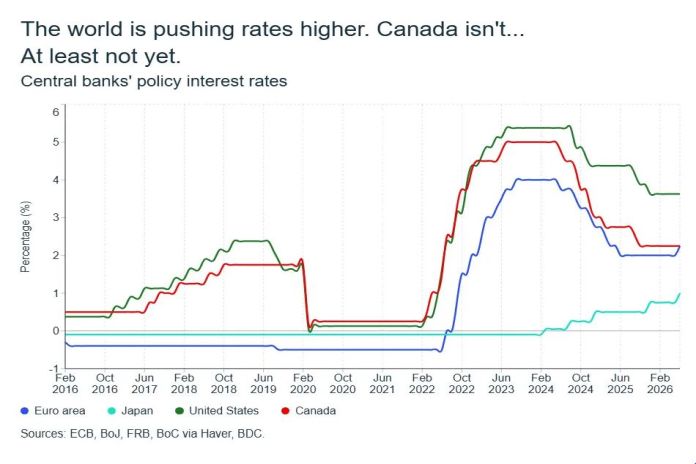
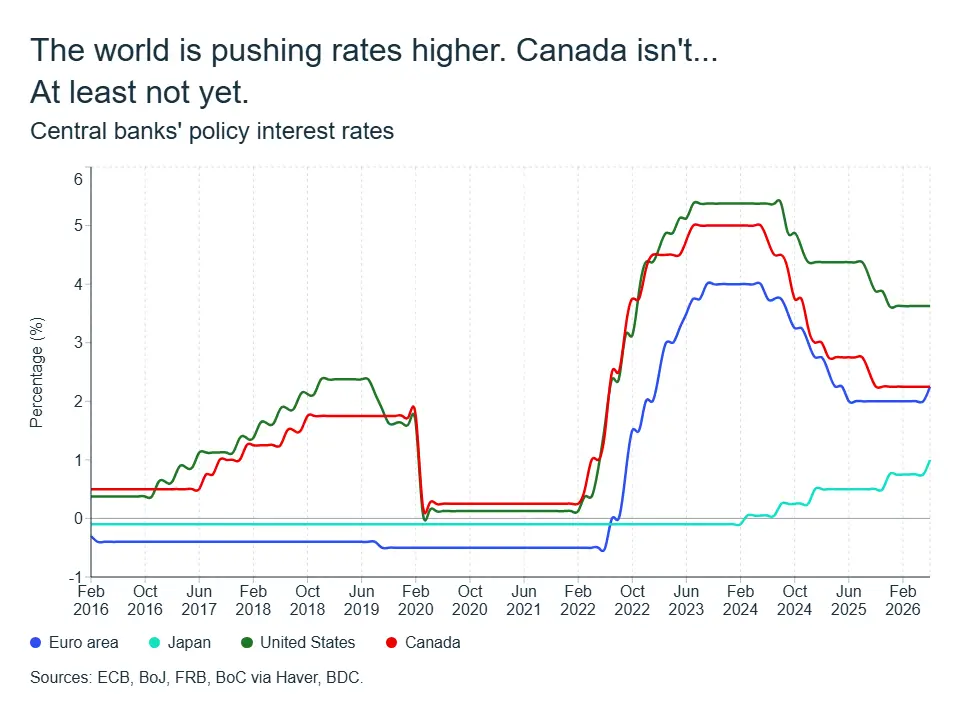
Globally, the situation is also less aligned. The United States remains in a holding pattern, with policy rates still in restrictive territory as inflation has yet to return durably to target. As a result, markets have become increasingly sensitive to any sign that rates could remain higher for longer.
In other regions, inflation pressures linked to energy markets have made central banks more cautious. The European Central Bank (ECB) and the Bank of Japan (BoJ), for example, both raised their policy rates in June. It marks the ECB’s first increase since September 2023 and brings the BoJ’s policy rate to its highest level in more than 30 years. This divergence reflects differences in domestic conditions but also the growing importance of global shocks, which increasingly spill over into Canadian bond yields and therefore, financing costs.
So what will happen here, at home?
Energy prices remain central to the story. Oil prices have been volatile, rising above levels seen earlier in the year before easing from their peak. Compared with the pre-conflict environment, prices remain elevated and unstable. This matters because energy is currently one of the main sources of renewed inflation pressure. The longer geopolitical tensions persist, the greater the risk that these pressures spread beyond energy into broader price dynamics.
Canada’s domestic economy, however, is not overheating. Growth has been soft, demand remains limited and the economy is still operating with some excess supply. BDC Economics continues to expect real GDP growth of about 1.0 percent in 2026, below the economy’s potential. That weak growth backdrop is important: it limits the ability of businesses to pass higher costs on to consumers and reduces the risk of a broad inflation spiral.
Recent data have improved, but they do not point to a boom. GDP rebounded in April and early estimates suggest another modest gain in May, putting the second quarter on track for a clear improvement after a weak start to the year. At the same time, labour market conditions have cooled. The unemployment rate has moved closer to 6.5 -7 percent, compared with roughly 5 percent during the tight labour market conditions of 2022. This increase signals the presence of excess supply in the economy.
Demographics are also reshaping the outlook. Canada’s population has declined for three consecutive quarters, an unprecedented shift in modern records. In the near term, this reduces demand for housing, consumption and some services, helping to contain broad-based inflationary pressures despite ongoing increases in some sectors. Over time, it also lowers the economy’s potential growth rate, limiting how quickly activity can expand without creating new pressures.
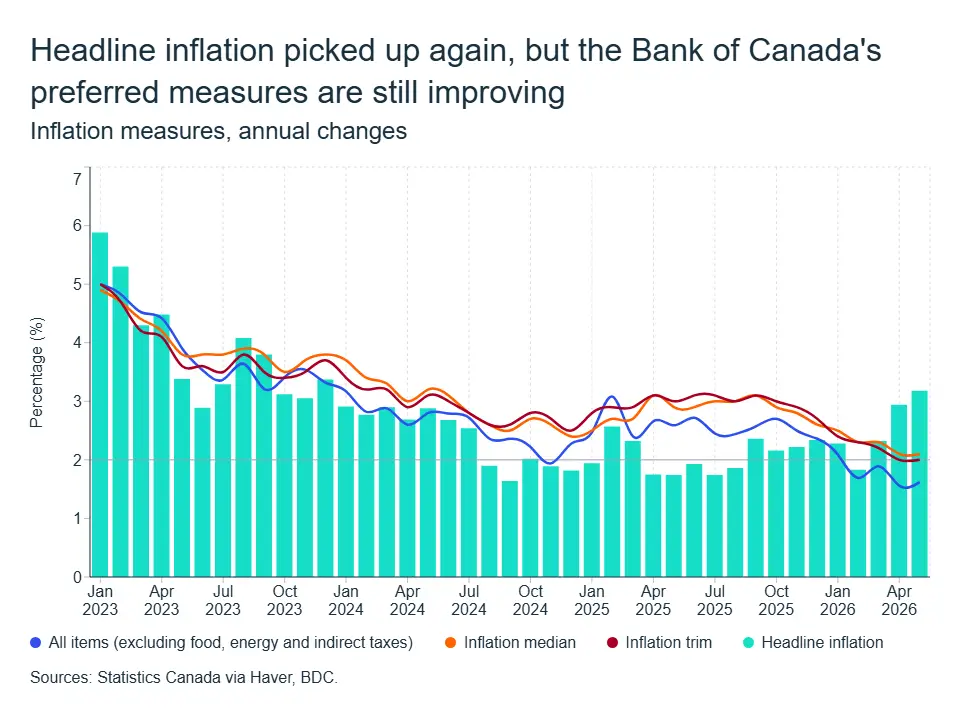
Inflation reflects this balancing act. Headline inflation has moved above 3 percent, driven largely by gasoline and energy-related costs. But the Bank of Canada’s preferred core measures remain close to 2 percent, suggesting limited evidence so far of broad-based inflation pressure. This is why the bank can remain patient, even as it stays alert to the risk that energy costs could spill over into other prices.
The disconnect between policy rates and borrowing costs
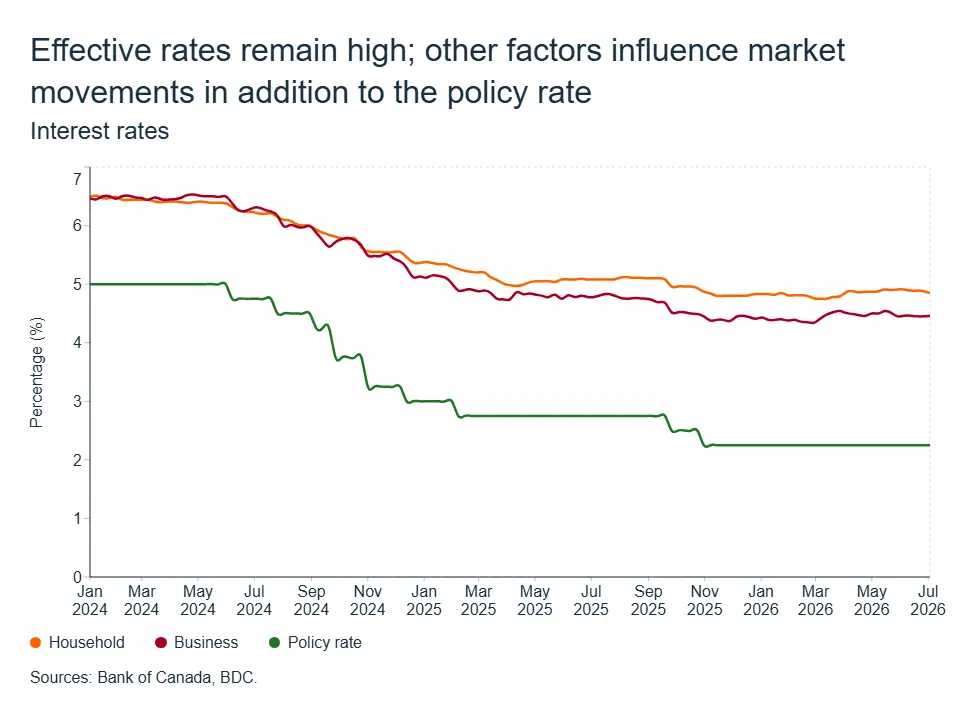
For entrepreneurs and households, the most important development is not simply the level of the policy rate, but the behaviour of effective borrowing rates.
The policy rate is a benchmark for short-term borrowing costs, but it does not directly determine the rates faced by borrowers. Effective rates depend on a broader set of factors, including bank funding costs, competition, credit conditions, bond yields and financial market sentiment.
Those factors still matter. Government bond yields remain elevated in a context of high global uncertainty and heightened volatility. While yields are below the peaks reached during the tightening cycle, they are still high enough to keep borrowing costs restrictive by historical standards.
For businesses, this translates into financing costs that remain sensitive to market conditions. For households, the effect is particularly visible in mortgage rates, which are even more closely linked to bond yields.
What to watch in the second half of the year
Three forces will shape the path of interest rates and borrowing conditions in the coming months:
- Energy prices. Oil remains the main upside risk to inflation. Persistent increases would raise the risk of broader price pressures, while a decline would reinforce the return toward target.
- Domestic demand. Canada’s excess supply is helping to contain inflation. A stronger rebound in consumption, housing or investment could reduce that buffer and influence future policy decisions.
- Financial markets and expectations. Bond yields and risk premiums are becoming increasingly important in the transmission of monetary policy. Their evolution will determine how much relief households and businesses actually see in Canada.
What it means for entrepreneurs and households
With second-quarter GDP tracking stronger than the first quarter, inflation firming because of energy prices and unemployment edging lower, there is little urgency for the Bank of Canada to move away from its 2.25 percent policy rate. Financing decisions, whether for new borrowing or upcoming renewals, should be planned around a stable, not falling, policy rate through the summer.
Behind the bank’s steady hand, however, the environment is anything but stable. Central bank decisions remain a key driver of borrowing costs, but even with the policy rate on hold, effective borrowing rates can keep moving as markets react to inflation data, geopolitical developments and shifts in growth expectations. When uncertainty rises, investors demand more compensation for risk, pushing bond yields, and therefore borrowing costs, higher, even without any action from the Bank of Canada.
Bottom line
Stability in policy rates no longer guarantees stability in borrowing costs. The range of plausible outcomes has narrowed, but global volatility and shifting market expectations mean borrowing costs will continue to evolve even when the headline policy rate does not.
The challenge is that uncertainty can easily lead to a wait-and-see mindset. While caution is understandable, putting growth plans on hold for too long can leave businesses less prepared for future opportunities.
Waiting for perfect clarity on interest rates, trade policy or the economic outlook may prove costly. The most resilient firms are often those that keep moving forward, investing selectively and strategically to strengthen their competitiveness and position themselves for the future.
Related: Bank of Canada maintains the policy rate at 2¼ percent