

-
- Commodities can drive growth, but over-reliance leaves economies vulnerable to shocks.
- Next step: Move beyond raw material exports by adding value and strengthening productive capacity.
- UNCTAD’s new dashboard helps countries turn data into informed policy decisions.
GENEVA, Switzerland – On 14 July, UN Trade and Development (UNCTAD) unveils its new Commodity Dependence Dashboard. The new interactive dashboard provides direct, user-friendly access to regularly updated data, helping policymakers formulate strategies for more diversified, resilient and sustainable economies. Explore regularly updated data covering 195 member states.
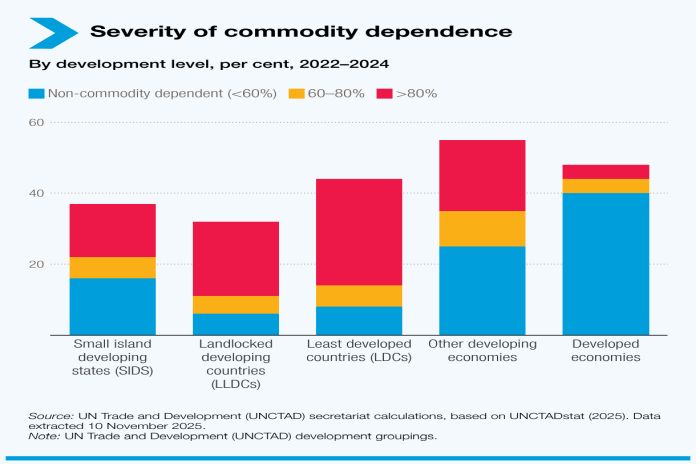
UNCTAD’s new dashboard shows that between 2022 and 2024, 94 of 143 developing economies remained commodity-dependent, including about 80 percent of least developed countries and landlocked developing countries.
This dependence is often rooted in structural factors, including natural resource endowments, historical trade patterns, limited productive capacities, infrastructure gaps, as well as constrained access to finance and technology.
Over time, these factors can reinforce specialisation in primary commodities and make economic diversification more difficult. Many developing countries continue to rely on a narrow range of commodity exports, from fuels and minerals to agricultural products.
While these exports generate growth, government revenue and foreign exchange earnings, heavy dependence leaves economies exposed to price volatility and shifts in global demand.
Turning resource wealth into structural transformation
To translate commodity wealth into long-term development, countries need to move up value chains through processing, industrialisation, stronger domestic linkages, technology transfer and skills development.
Equally important is strengthening the productive capacities needed to build more diversified and resilient economies. For many countries, this is the difference between simply exporting raw materials and using natural resources to drive structural transformation.
Lasting gains often come from strengthening backward, forward and lateral linkages across the economy.
These linkages can support local suppliers, service providers, technology development and skills upgrading, enabling commodity sectors to contribute to broader economic diversification and resilience.
About the Author