



By Robin Middelanis and Yasuhiro Kawasoe
In the days that follow a disaster – a flood, a cyclone, an earthquake – governments and aid agencies face an agonising challenge: with limited resources and millions in need, who gets help, and how much? Get it wrong, and cash transfers reach many people but don’t take into consideration their economic needs and are too small to make a difference. Get it right, and the same budget can prevent millions from falling into poverty.
Adaptive social protection programs which combine social protection, disaster risk management, and climate adaptation, are well designed to navigate exactly this trade-off. A new paper offers the first global, systematic analysis of their effectiveness. Its key finding: when the primary goal is to prevent households from falling deeper into poverty, programs that prioritise meaningful support to the poorest tend to perform better than spreading the same budget thin and giving everyone a little.
The scale of the problem
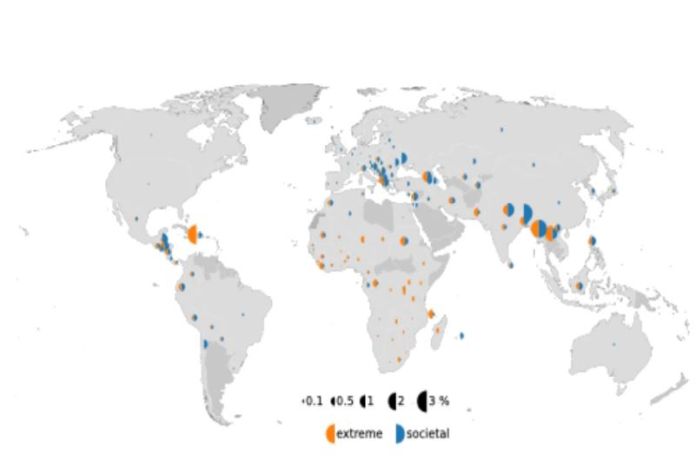
The numbers in the study are striking. Simulations across 131 countries suggest that 12.7 million people live in extreme poverty due to disasters throughout an average year, with an additional 12.9 million living below country-specific thresholds that reflect the local cost of meeting basic needs. But annual averages can be misleading. For example, a single catastrophic 100-year flood in Pakistan alone could push 9.6 million people into extreme poverty in one stroke. Beyond poverty headcounts, disasters destroy consumption and well-being for millions more who never cross a poverty line, but whose lives deteriorate sharply. Because each dollar of consumption is worth more to those who have less, a given loss takes a far greater toll on the well-being of poor households, making the global well-being impact of disaster-related damages equivalent to a GDP decline of $1.14 trillion per year. The damage is enormous and unevenly distributed.
Depth before breadth — but it’s not that simple
The study takes a systematic, global approach to understanding how adaptive social protection can best address these risks by simulating the effect of four types of interventions: post-disaster cash transfers delivered either as a uniform lump-sum payment or proportional to experienced damages, reductions in disaster vulnerability and exposure, and income diversification strategies.
The central finding is clear: depth before breadth. In terms of well-being benefits, programs that deliver meaningful levels of support to fewer, lower-income households outperform programs that spread thin coverage across a larger population. A transfer too small to cover basic needs after a disaster generates limited protective effect despite reaching many people. Evidence from the real world reinforces this: doubling cash transfer amounts in Pakistan, rather than simply expanding enrollment, significantly improved child and maternal nutrition outcomes. By contrast, cash transfers to Syrian refugees in Jordan between 2015 and 2018 were set too low to generate broader livelihood improvements, illustrating the cost of under-resourcing.
The research makes it clear that protection cannot be the exclusive preserve of the poorest. Non-poor households also face meaningful disaster risks, and adaptive social protection can generate gains across all income groups when well designed. The study underscores that disaster response measures and preventive action before harm strikes should be integrated to yield greater and more sustainable results. Income diversification, stronger housing, and protective infrastructure all reduce the number of people who fall into poverty in the first place, while insurance and post-disaster support programs can help those affected recover from a disaster.
Three insights for policymakers
The implications for policymakers, particularly in lower-income countries, are both actionable and urgent.
- Transfer amounts matter as much as coverage rates. Expanding a program’s reach while holding the transfer level constant is not a neutral trade-off; it may mean that fewer receive enough support to recover. Policymakers should set transfer levels relative to what households actually need to sustain basic consumption after a shock and resist the political temptation to spread resources too thin. Prioritizing low-income households is not just equitable; it is also where the largest poverty-reduction gains are found.
- Lower-income countries face a distinctive challenge: a larger share of their populations is vulnerable to disasters, yet a smaller share is covered by any formal safety net. This means expanding coverage is genuinely more urgent in these contexts than in higher-income countries, even as intensity of support remains critical.
- Prevention and response must work together. Programs built solely around post-disaster transfers leave untapped the potential of ex ante investment in vulnerability reduction. The Philippines offers a practical example: following Typhoon Yolanda, integrating “build back better” principles into the disaster response delivered long-term co-benefits that a purely reactive transfer program would have missed.
Looking ahead
The research underscores that programs aiming to reduce poverty are more successful when giving meaningful support to fewer people rather than spreading too little across too many. They reach the poorest first, where every dollar has the greatest impact. And smart programs take a holistic approach by strengthening resilience against future shocks while responding to a disaster. Disasters already cost the world the equivalent of $1.14 trillion in lost well-being every year, and climate change will make them worse. The evidence is there. Now governments need to act on it.