


- An overall resilient world economy masks significant differences among countries and regions. Energy importers and countries with limited policy space are most vulnerable
By Kristalina Georgieva
More than three months into the war in the Middle East, the global economy appears to be holding up. Commodity prices, inflation and expectations for it, and financial conditions have all been impacted—but not yet in ways that signal a global slowdown. And we have seen strong economic momentum in the world’s biggest economies, the United States and China.
But an overall resilient global picture masks significant disparities. Even among advanced economies, some countries and communities have been harder hit. And in Africa, the negative impacts are more conspicuous. Meanwhile, with the prolonged closure of the Strait of Hormuz and infrastructure in the Middle East damaged by the fighting, uncertainty and risks remain high.
We will provide an updated analysis of this global picture on July 8, in our next World Economic Outlook Update.
Drivers of global resilience so far
At the conflict’s outset, our immediate concern was the impact on energy prices and knock-on effects on inflation. And they have been considerable. Oil prices are 30 percent higher than pre-war levels. Yet that is lower than was seen earlier in the conflict, despite the straits’ prolonged closure.
Some countries, such as China, have been able—for now—to cushion the disruption by tapping deep oil reserves. This has also helped with demand pressures in otherwise hard-hit Asia. Increased production and refinery utilization outside the Gulf, although not sufficient to offset the shock, have also contained the increase in oil prices. In addition, actions to dampen demand or limit the price passthrough have mitigated the impact so far. But, here too, there are limits to how long countries can manage the higher budgetary costs and higher external financing requirements.
In many economies, higher oil prices are nonetheless contributing to a pickup in headline inflation. That is concerning—but not the full story. It is also important to consider whether people and businesses expect a more persistent erosion of their purchasing power. And these medium-term expectations generally remain well anchored. That’s an encouraging sign of confidence in central banks’ commitment to price stability.
Financial markets have also proven resilient. Government bond yields have climbed significantly since the war began, but risk assets have rallied on strong earnings, and we see little evidence of a broader flight to safety. By historical standards, financial conditions remain accommodative.
Technology is another bright spot. Strong technology-related investment—particularly in artificial intelligence and data centers—has been a driving force in the countries where economic momentum is holding up. The United States is benefiting from this global technology cycle, as are economies in Asia that have seen stronger technology exports. Most countries, however, are yet to feel the productivity and growth impact of technology, leading to concerns about further economic divergence.
To sum up, the combination of economic resilience and technological advancements have helped to cushion the impact of the energy supply shock on growth at the global level and there have been bright spots within regions. But there are countries that are harder hit, largely depending on geography, degree of energy dependence, and available policy space.
Hardest hit
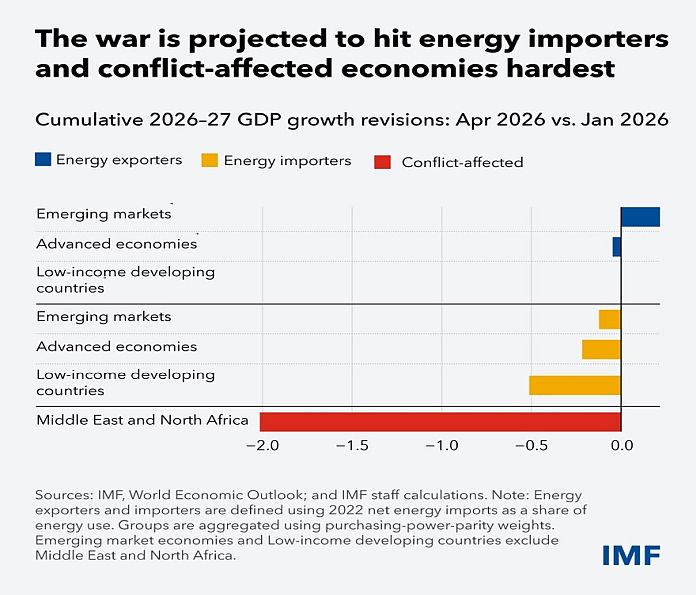
For war impacts, proximity matters. Oil exporters around the Gulf that are directly affected by the war face steep downward revisions to growth this year, with five out of eight countries seeing outright contractions.
For Europe, which is heavily dependent on imported oil and gas, higher energy prices are weighing on growth and putting upward pressure on inflation, with the ECB recently raising interest rates.
Emerging market economies in Asia are also bearing the brunt—with the relatively higher oil and gas intensity of the economies in the region. They face retail gasoline prices that have increased 40 percent since the war began, while rising government bond yields and currency depreciation and capital outflow pressures have amplified the costs of the shock.
Yet, it is the countries that combine heavy reliance on energy imports with limited policy space that are especially hard-hit.
The strain is especially visible in Africa, where many of these factors are at play. For countries in the region that rely heavily on imports, rising costs are worsening external balances and increasing budgetary pressures—and financing needs.
Several African countries have been managing fuel shortages—including Ethiopia, Malawi, and Zambia—and most are feeling the pain of sharp fuel price increases. In countries such as Lesotho, Rwanda, and Tanzania, gasoline prices have increased by about half since the onset of the war.
Higher energy prices have also driven up fertilizer and food costs, increasing the risk of food insecurity. If disruptions persist, farmers in many low-income countries may struggle. That in turn may further fuel inflation for months to come.
Needed: policy discipline and agility
As we have said before, much depends on the duration and intensity of the energy supply shock. The sooner it is resolved, the better—especially as supply will take time to recover given the significant infrastructure damage—and Sunday’s ceasefire announcement is welcome. But should the conflict or disruptions intensify, this is a clear risk to global growth.
This continued high uncertainty underscores the need for all policymakers to be agile and disciplined. Maintaining price stability is essential. Already, some central banks have begun to tighten to keep inflation expectations anchored.
With borrowing costs rising, fiscal discipline is equally important. Price caps, subsidies and similar interventions may be popular, but they are costly. Fiscal responses should be targeted, temporary, preserve price signals, and well-sequenced to protect the vulnerable without undermining public finances.
This is even more important given the need to make room for the fiscal costs of ensuring that AI-driven growth translates into shared prosperity. That includes both the fiscal costs to address new vulnerabilities, as well as investing in technology and people to ensure that emerging and developing economies are not left behind.
Supporting affected members
While there is much our members can do to cushion the impact of the war, they shouldn’t have to go it alone. The Fund remains as committed as ever to helping our member countries navigate this period of heightened uncertainty. Just as the effects vary across countries and regions, our support is tailored to meet the differentiated needs of our members.
For now, most member countries are asking for clear, candid policy guidance rather than financial support. And we have duly responded—providing tailored policy advice and capacity development. While the risks have not yet receded, embracing the right policies will help provide some relief.
For those countries that need financial support, we are stepping up. We are working with several countries and will soon present to our Executive Board proposals to adjust existing programs in response to the shock. The Gambia has requested an augmentation and program extension. Burkina Faso has reached staff-level agreement on a funding increase to address higher external financing needs. In Ethiopia, we aim to bring forward financing to this year, while we have initiated discussions on a new program with Malawi. Bangladesh also has requested a new program.
That the global economy is so far weathering the shock is cause for reassurance—but not complacency. The IMF remains on high alert. We are also deeply mindful of the economic damage some of our members are already suffering. We will work with them to manage the shock and limit its negative impacts, especially on the vulnerable. Our commitment to our membership is unwavering.