

-
- From diving in Brazil as a teenager to leading marine pollution research, Vanessa Hatje’s career spans five continents and has brought her to the IAEA Marine Environment Laboratories in Monaco.
By Ellie McDonald, IAEA Department of Nuclear Sciences and Applications
Vanessa Hatje’s love of the ocean began with diving as a teenager growing up in Brazil – she loved seeing the brilliant colours of the creatures underwater. When she was 17, a visit to the Institute of Oceanography in São Paulo and a chance meeting with a pioneering organic chemist set her on the path to become a marine pollutants expert. That path has taken her from Brazil to France, Spain, Australia, the United States of America, Antarctica and, most recently, to the IAEA Marine Environment Laboratories in Monaco.
Despite some hurdles along the way, Hatje’s professional journey has stayed true to her passion to protect the ocean.
Nuclear techniques for the ocean
Hatje knew little about nuclear techniques when she began studying oceanography, but that changed when she moved from Brazil to Sydney, Australia, to pursue a PhD. She conducted most of her experimental work at the Australian Nuclear Science and Technology Organization (ANTSO). “It was my first experience using nuclear techniques to study processes that control the levels of trace metals – such as zinc, iron and chromium – in water. I applied these techniques while conducting marine pollution research in Sydney Harbour.”
Later, she used nuclear techniques to determine the chronology of environmental contamination of several marine ecosystems in Bahia, Brazil. She extracted cores of sediment from the coastal and ocean floor, a method that preserves the integrity of sediment layers. “I used dated sediment cores to examine the historical record of pollution,” she said, “and I correlated the data to the diverse human activities and how they changed over time.”
Hatje’s educational journey prepared her for a new challenge to establish labs and projects focused on the marine environment at the Federal University of Bahia in a chemistry department that had never before supported ocean research. Around this time, Hatje began to work with a scientist who helped her navigate the Brazilian academic system. “I had the opportunity to work with a highly esteemed Brazilian scientist. Together, we managed two large projects,” she said. “I learned a great deal from my colleague – how to run a research group, how to successfully secure large grants and the importance of having a strong network.”
One of Hatje’s greatest professional achievements is one that led to practical change. In 2013, while on a sabbatical at the University of California at Santa Cruz in the USA, Hatje had the chance to apply a method she had developed to evaluate rare earth elements in seawater to 20 years of water samples from San Francisco Bay. She found evidence of increasing levels of gadolinium, a naturally occurring element that is used as a contrast agent to increase the resolution of magnetic resonance imaging. “At the end of the day, this research had a very practical outcome that changed the monitoring programme of the area, with gadolinium now included in routine measurements of water quality in the Bay.”
Both sides of sustainable science
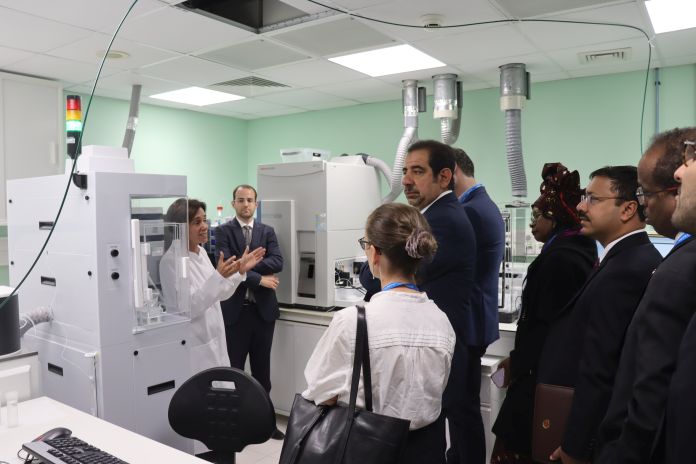
Today, as a research scientist at the IAEA, Hatje’s work centres on two main areas: Blue Carbon, an emerging field in marine carbon dioxide removal; and investigation of marine pollutants, including rare earth elements and their environmental impact. Blue Carbon refers to organic carbon that is sequestered from the atmosphere and stored in the marine sediments of coastal and marine ecosystems, such as mangroves, seagrasses meadows and salt marshes. The IAEA’s work on Blue Carbon supports member states to assess the amount of organic carbon stored in their marine environments, allowing for more effective ocean management.
Coming from a Latin American country that receives IAEA support, Hatje understands the challenges scientists face, particularly in developing countries. “It’s super exciting to be in the position to facilitate capacity building and the transfer of technology to these countries,” she said. “If I can be part of the smallest change, that would be amazing. I think that’s what brought me here.”
Hatje’s work at the IAEA, among others, involves training early-career scientists through the IAEA’s technical cooperation programme. When asked what advice she would give to students, she said, “Stay focused and keep pushing forward, because it is going to be hard. In our field, especially with publications and grant applications, we face a lot of rejections, particularly early in one’s career. Take the positive feedback from scientific reviewers and move on. It’s part of the job. Build your network, explore different experience and institutions. Don’t be afraid to take risks.”
The IAEA’s commitment to gender equality
The IAEA is committed to gender equality and to supporting the ability of all individuals, regardless of gender, to equally contribute to and benefit from its programmes and activities.
The IAEA’s Marie Sklodowska-Curie Fellowship Programme supports the next generation of women nuclear professionals by offering scholarships for master’s degrees in nuclear-related fields. The IAEA’s Lise Meitner Programme offers early- and mid-career women multi-week training visits to nuclear facilities.