

-
- Narco-trafficking, international law, the oil industry, Caribbean and Latin American governments are in sharp focus.
- Regional governments will have to function differently in 2026.
- More US action expected.
By CNG Insight
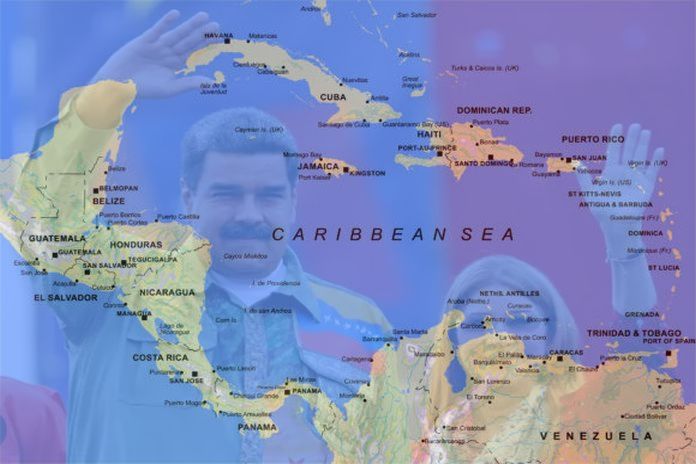
The United States military, in the execution of military operation ‘Absolute resolve” on 3 January 2026, extracted president of Venezuela Nicolás Maduro and his wife Cilia Flores, into the confines of US justice and indicted them on Narco-Terrorism Conspiracy, Cocaine Importation Conspiracy, Possession of Machineguns and Destructive Devices, and Conspiracy to Possess Machine guns and Destructive Devices. The US action in Venezuela hitherto puts narco-trafficking, the oil markets and industry, and the Caribbean into sharp focus.
The Trump administration, in furtherance of tariffs, new visa restrictions, Caribbean CIP/CBI, and the declaration “this is our hemisphere,” has relatively sanctioned a reset in the Caribbean and Latin America.
The Commonwealth Lawyers Association open letter to members regarding USA military action in Venezuela, wrote:
“The recent military actions taken by the United States of America (“USA”) in relation to Venezuela are abhorrent to the rule of law and must be condemned. The basic principles of sovereignty of nations are enshrined in the United Nations Charter. Specifically, Article 2(4) of the Charter prohibits the threat or use of force against the territorial integrity or political independence of any state. The Inter-American Democratic Charter also underscores the importance of respecting sovereignty and adhering to democratic principles.”
Ron Paul, in his weekly column, stated that, “Regime change and nation-building are back!”
He reasoned that, “Overwhelming US military power – and likely some bribed Venezuelan officials – ensured that the operation was swift and dramatic. This was not a war, we were told. It was just a surgical operation to remove a criminal dictator and restore democracy to the country. American oil companies would soon get even richer, exploiting the country’s vast oil reserves. This time it will be different! If all of this sounds familiar, that’s because it is the same narrative used each time the US has launched a “regime change” operation this century.”
Sir Ronald Sanders, Op-Ed titled ‘CARICOM at the crossroads of pressure,’ advised:
“The Caribbean Community stands at a moment that calls for less rhetoric and more realism. CARICOM is experiencing a period in which external pressure is intensifying, new norms are hardening among powerful states, and the need for small states to navigate emerging demands is growing.”
A January 3, 2026, statement from The Bureau of the Conference of heads of government of the Caribbean Community (Jamaica, Saint Kitts and Nevis, and Saint Lucia) reads:
“The Caribbean Community (CARICOM) is firmly committed to the fundamental principles of international law and multilateralism enshrined in the UN Charter, including sovereignty and territorial integrity of states and respect for human dignity. The region reiterates its call for peaceful dialogue through diplomatic channels to ensure Venezuela’s stability, good governance, democracy and prosperity for the people of Venezuela.
“CARICOM remains ready to support all such efforts, in a spirit of cooperation and mutual respect. The Bureau of heads of government assures that every effort is being taken to ensure the safety and security of citizens of the region. The Bureau will continue to monitor the multifaceted impact of this evolving situation and the implications for economic activity within the Community, particularly air travel.”
Caribbean and Latin America reset
Implications of the “Donroe Doctrine,” international law and the UN Charter; aspects of trade, communication, commerce, and diplomacy with a new Venezuela/USA underscores the multiple dimensions the region faces.
Amid the antipathy to the Caribbean and Latin America reset, CARICOM charters and agreements, ALBA, PertroCarib, financial institutions, military and political operations, trade and commerce are inevitable in a prescribed reset.
CARICOM and Latin America leaders have the task to retool not merely in aspects of dialogue and commonplace diplomacy, but with a regional integrated plan.
More US action expected
The current course of economic growth and development, security and external relations is significantly altered, based on the variable degree of exposure to Venezuela’s ideology and governance model. And amid the “Hue and cry” of weird mixed metaphors and non-sequiturs directed at certain Caribbean leaders, their silence and presumptive inaction should not be perceived in abstract terms.
The undercurrent is directed to more US action that is likely to precipitate geopolitical concerns in the Caribbean and Latin America. These actions are likely to carry more intense changes. In a worst-case scenario, caution demands the avoidance of Haiti in the northern Caribbean and a replica [Venezuela] in the south. Managing concerns and structural changes will become vital to life in the Caribbean.
Former St Vincent and the Grenadines, and current leader of the opposition, Ralph Gonsalves, noted that the regional community is already feeling the “multifaceted impact” of the Venezuela situation unfolding daily.
Gonsalves warns Caribbean leaders not to conflate “military or political operations” with simple law enforcement, noting historical examples like King Jaja of Opobo and Toussaint Louverture, who were lured into “dialogue” only to be abducted or faced with “trumped-up charges.”
With the US “in charge of Venezuela,” a remodelling of the status quo and Caribbean geopolitics is in motion, as more US action manifests – work in progress – carving spheres of influence.
CARICOM continues to reaffirm the principle of maintaining the Caribbean region as a zone of peace; fighting narco-trafficking and the illegal trade in small arms and light weapons; unequivocal support for the sovereignty and territorial integrity of countries in the region, and the safety and livelihoods of the people of the region. The Venezuelan crisis conveys US dominance directed at China, Russia, and Iran that could last for decades, if history is a guide. Only time will tell!
- Related: Caribbean countries should diversify their trade relations and strengthen regional integration
Oil markets are adjusting
“Saudi Arabia, Russia, Iraq, UAE, Kuwait, Kazakhstan, Algeria, and Oman reaffirm commitment to market stability on a steady global economic outlook and current healthy oil market fundamentals as reflected in low inventories.” ~ OPEC
Thus far, the unfolding Venezuelan crisis (military, geopolitical and the oil industry) has tabled another opportunity for CARICOM and regional integration to channel dialogue, encourage cooperation and transparency, and coordinate response as a substantial unified block.
Investment capital cares about margins. Economic power can reshape markets. Acknowledging and understanding the many possible future challenges and opportunities that lie ahead can help gain unprecedented access on the horizon.
CARICOM must rethink affordable energy solutions. Member states that are most exposed to the Venezuelan oil market, with debt of up to USD 1 billion, must recalibrate energy dependence, energy charity, and financial obligations. CARICOM must rethink its economic and geopolitical spheres with coordinated action as an integrated bloc.
US Senator Tom Cotton (R-Ark.) notes: “What we want is a future Venezuelan government that will be pro-American, that will contribute to stability, order and prosperity, not only in Venezuela, but in our own backyard.”