

PORT OF SPAIN, Trinidad – Efforts to modernise the Caribbean Community’s (CARICOM) financial sector are accelerating as regional Central Banks, regulators, stock exchanges, private-sector stakeholders, and development partners work to align the Region’s financial architecture with global standards.
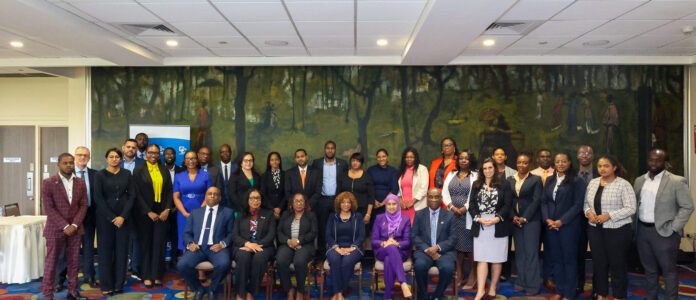
Regional financial leaders and experts are in Port of Spain, Trinidad and Tobago, for a two-day forum aimed at strengthening CARICOM’s financial foundation and making it more inclusive, coherent, and digitally advanced. The meeting to Advance Cross-border Payment and Settlement Innovation in CARICOM is convened by the CARICOM Secretariat’s Economic Policy and Development Programme with support from the 11th European Development Fund (EDF).
In opening remarks on Thursday, 4 December, Dr Wendell Samuel, CARICOM assistant secretary-general (Ag), economic integration, innovation and development, underscored the pivotal context of the meeting. He noted that the discussions are essential to supporting economic growth and deepening the CARICOM Single Market and Economy (CSME).
He stressed that the meeting is “more than a technical undertaking”, describing it as a deliberate choice about the kind of region member states aim to build. Dr Samuel acknowledged the “tremendous effort” being invested in modernising domestic payment systems, but highlighted persistent gaps, differences, and challenges in the wider financial architecture.
He cautioned that national progress alone, cannot deliver the level of regional efficiency and competitiveness required in today’s global environment and noted that the two-day forum provides an opportunity to design a financial infrastructure that adds coherence to what remains a highly fragmented landscape.
“Modern commerce, requires that cross-border payments move with speed and reliability; that regional investment is supported by strong, predictable settlement arrangements; that liquidity can move safely across jurisdictions; and that our financial architecture enables regional opportunities rather than constrains them,” he stated
He also emphasised that the region has already laid meaningful groundwork: several Central Banks have launched or piloted digital currencies; payment providers are innovating; stock exchanges and regulators are open to new cooperative models; and development partners continue to support experimentation with secure cross-border financial infrastructures.
Listen to the remarks by assistant secretary-general (Ag) Dr Wendell Samuel here
Also addressing the opening of the meeting, Dr Dorian Noel, deputy governor of the Central Bank of Trinidad and Tobago, described the discussions as critical to strengthening financial market infrastructure and improving inclusiveness in the regional financial space.
He stressed the importance of aligning regional efforts with international conventions and standards, and of addressing key concerns around financial integrity, cybersecurity, stability, and consumer protection. He said that independent national initiatives should converge into a single regional strategic framework to save resources and achieve a unified, interoperable digital financial infrastructure.
Dr Noel also said he was encouraged by the emerging opportunities for innovation and collaboration.
“The future of payments in the region is not just about technology; it is about trust, inclusion, and opportunities,” he said.
Presentations and discussions during the forum will focus on governance models for cross-border payment systems; digital public infrastructure for Central Banks; a CARICOM public-private pilot for real-time, inclusive cross-border payments and securities settlement; and remote brokerage and digital settlement solutions.
The outcomes of the meeting are expected to enhance the region’s ongoing efforts to modernise its financial architecture and advance a more integrated, digital, and resilient CARICOM financial ecosystem.