


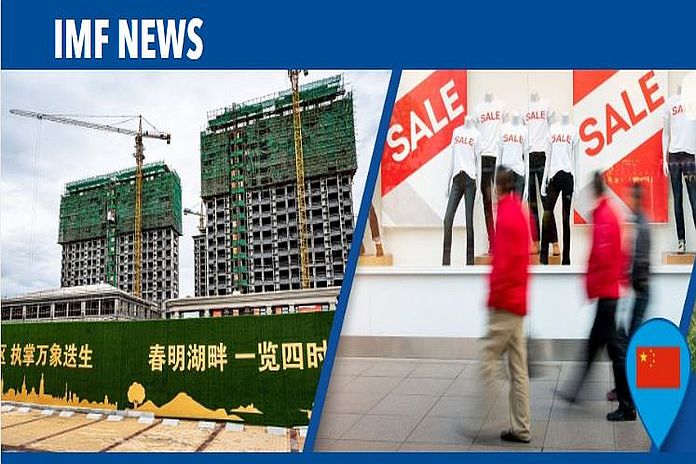
- More forceful macroeconomic stimulus, stronger social protection, and fiscal support for the property sector can help boost domestic demand, especially consumption
By Daniel Garcia-Macia, Sonali Jain-Chandra, Siddharth Kothari, and Yizhi Xu
China’s economy has proved resilient in the face of multiple shocks, boosted by robust exports and fiscal stimulus, and it remains a major driver of global growth.
The economy expanded by 5 percent in 2025, and we project 4.5 percent growth this year, up 0.3 percentage points from our October forecast.
Despite this resilience, the growth model of the world’s second-largest economy faces increasing challenges. Domestic demand has been subdued, in part because the protracted property slump, combined with a weak social safety net, hurt consumers’ willingness to spend.
This has resulted in deflationary pressures and has made growth increasingly dependent on external demand. Yet China cannot count on ever higher exports to drive durable growth in the coming years. That makes pivoting to consumption-led growth the overarching policy priority.
China’s policymakers recognise these challenges and are taking steps in the right direction. They adopted a more expansionary fiscal policy stance in 2025 that involved targeted social subsidies, and reduced over-investment in some industries, while easing monetary policy. Looking ahead, the 15th Five-Year Plan (2026-30) prioritises increasing consumption as a driver of economic growth. In addition, a gradually increasing retirement age, building on the 2024 reform, will help reduce the drag from a contracting labor force and boost economic prospects.
These are helpful measures, but China can do more to increase consumption and domestic demand for years to come. A more forceful macroeconomic expansion will be critical. So, too, will be efforts to strengthen social safety nets and support the recovery of the property sector.
Fiscal stimulus
We recommend a comprehensive macroeconomic policy package focused on additional fiscal stimulus, supported by further monetary policy easing and greater exchange rate flexibility. This combination of measures would help lift inflation to a healthy level and raise domestic demand, making the economy less dependent on exports.
At the same time, policymakers will need to change the composition of fiscal spending. This means paring back public investment and industrial policies that support specific industries. Doing so, in turn, would increase productivity by better allocating resources and letting market forces play a bigger role. It would also free up budgetary resources to lift social spending and address the property sector contraction, including by supporting buyers of unfinished housing.
Improved social protection
Fiscal policy should prioritise strengthening social protection to give people confidence to spend more. Think of healthcare, pensions, unemployment benefits, and social assistance. In all these areas, we see scope for increased benefits and broader coverage. This would reduce the need for vulnerable people to save excessively to protect against unexpected shocks or life events. A recent IMF working paper shows that doubling social spending in rural areas can lead to a cumulative increase in consumption over a five-year horizon, reaching 2.4 percentage points of gross domestic product.
Easing household registration requirements will also help. The hukou system classifies residents as urban or rural, effectively excluding migrant workers from rural areas from fully accessing social benefits in large cities. Relaxing hukou requirements can significantly lower saving rates. We estimate that granting urban status to 200 million rural migrants could raise the consumption-to-GDP ratio by an additional 0.6 percentage points.
Finally, making taxes on labor more progressive and strengthening taxes on capital can reduce inequality and increase disposable income for lower-income people who tend to spend more of their income. That would encourage additional consumption.
Taken together, the IMF’s policy recommendations would significantly rebalance the economy toward consumption. They could boost the consumption-to-GDP ratio by about 4 percentage points over five years. Unlocking the potential of the vast domestic market would make growth less dependent on external demand and therefore more resilient.
And let’s not forget: with China contributing about 30 percent to global growth, a better-balanced economy also means a stronger and healthier world economy.
- Sonali Jain-Chandra is the IMF mission chief for China. Siddharth Kothari is deputy chief. Daniel Garcia-Macia is a senior economist in the Asia and Pacific Department, where Yizhi Xu is an economist.