

By Benito Wheatley
As international relations become more unpredictable in an increasingly uncertain world, diplomacy will be even more critical to advancing the national interests of the British Virgin Islands (BVI). It is the best means by which to exert some influence on the external decisions that ultimately affect our daily lives, the functioning of our society, and the long-term trajectory of our national development.
The BVI currently faces a number of external pressures and risks that are being addressed through diplomatic channels. These include infringement on our autonomy, higher tariffs internationally, greater scrutiny on the financial services industry, limited access to financing for development, regional threats to local security, more extreme weather, and other negative impacts of climate change, such as the unprecedented groundswell of sargassum seaweed. All of these things impact our economy and way of life, but their effects cannot be mitigated without international engagement.
This is why BVI diplomacy has been carefully calibrated to support our self-governance and self-determination, strengthen development cooperation for sustainable development and climate resilience, promote and protect our position as an international finance centre (IFC), diversify our international trade, and facilitate our cooperation with regional and international partners on security issues.
We are diplomatically meeting these national objectives in a number of ways.
To support self-governance and self-determination, we are engaging bilaterally with the United Kingdom (UK), and multilaterally with both the United Nations (UN) Special Committee on Decolonization (C-24) and the UN General Assembly’s Fourth Committee that is responsible for special political and decolonization issues. Diplomatic and political engagement with these key stakeholders is the most effective way of safeguarding our social, political, economic and human rights as a people in our own right under international law.
In the environmental space, we are advocating collectively with other Small Island Developing States (SIDS) for international assistance based on our climate vulnerability and the urgent need for climate finance to build more resilient societies. Our climate diplomacy is being conducted through our Associate Memberships in regional organisations, including the Caribbean Community (CARICOM), Organisation of Eastern Caribbean States (OECS) and Association of Caribbean States (ACS). Our primary objective is to qualify for concessional financing and grants to build and upgrade roads, drains and other climate-resilient infrastructure that can withstand more extreme weather, which is forecast to get worse in the years ahead.
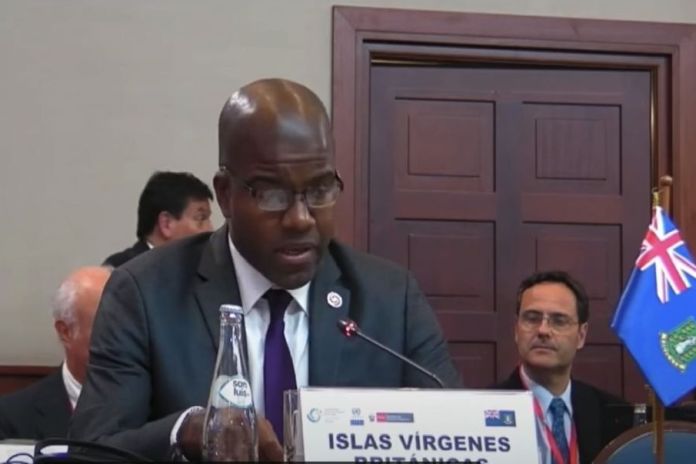
To secure international support for our sustainable development, we are engaging the UN system on development cooperation to help achieve the Sustainable Development Goals (SDGs). We are doing so through multilateral diplomacy in our capacity as both a member of the UN Multi-Country Office (MCO) for Barbados and the Eastern Caribbean, and as an associate member of the United Nations Economic Commission for Latin America and the Caribbean (ECLAC). The BVI currently sits as a vice chair of UN ECLAC, as well as two of its subsidiary bodies, including the Regional Conference on South-South Cooperation in Latin America and the Caribbean and the Caribbean Development and Cooperation Committee (CDCC). We also serve as chair of the ECLAC associate members working group.
In the financial services arena, we are engaging with key international partners and stakeholders to protect our economic and commercial interests. This involves:
- Engaging with the UK government, UK parliament, British Overseas Territories (OTs) and Crown Dependencies on accessible registers of beneficial ownership;
- Cooperating with the Financial Action Task Force (FATF), Organisation of Economic Cooperation and Development (OECD), and European Union (EU) on financial services regulation and international taxation; and,
- Undertaking trade missions and industry engagements in China, India, Latin America, and Member Countries of the Association of Southeast Asian Nations (ASEAN), such as Malaysia.
This economic diplomacy is helping to ensure the continued buoyancy of our financial services industry, that is critical to sustaining the government’s main revenue earner, which accounts for two-thirds of the government budget.
In terms of the United States’ (US) application of higher tariffs on trade partners around the world, we are engaging in trade diplomacy with the Dominican Republic and the countries and territories of the Eastern Caribbean to help our wholesalers and retailers directly tap their markets in an effort to get more affordable goods into local stores and quality food onto supermarket shelves at lower prices for consumers.
Finally, while external security does not directly fall under the BVI’s remit, regional security plays an important role in BVI diplomacy as we respond to drug trafficking, human trafficking, and organised crime more generally, as well as irregular migration and the securing of Haitian refugees. To help mitigate the effects of these regional issues on local security, we are participating in regional security arrangements and initiatives with regional and international partners, including CARICOM IMPACS, the Regional Security System (RSS), Office of the United Nations High Commissioner for Refugees (UNHCR), and the United States Virgin Islands (USVI).
Despite the unfolding global uncertainty and the challenges it poses for small jurisdictions, the people of the BVI and its stakeholders can be assured that BVI diplomacy is being fully employed to secure the national interest of our islands.
- Special Envoy Benito Wheatley is the BVI’s CARICOM Ambassador, OECS Commissioner, Association of Caribbean States Ambassador and UN Representative; and serves as Vice Chair of UN ECLAC, Vice Chair of the ECLAC Regional Conference on South-South Cooperation in Latin America and the Caribbean, Vice Chair of the ECLAC Caribbean Development and Cooperation Committee, and Chair of the ECLAC Associate Members Working Group.