

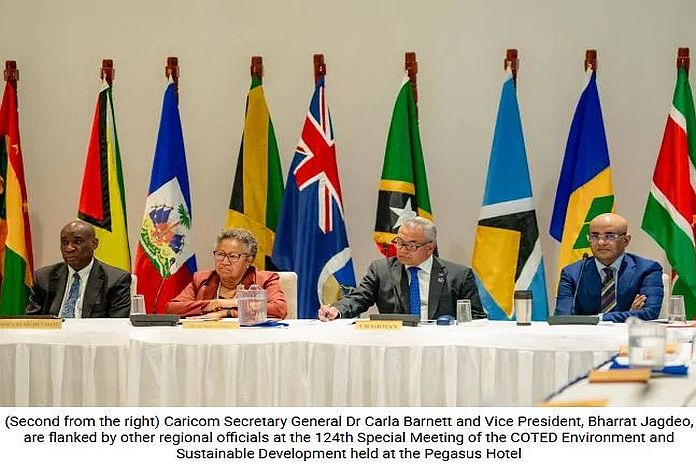
 GEORGETOWN, Guyana, (DPI) – Vice President Dr Bharrat Jagdeo is calling on Caribbean leaders to rethink their approach to climate policy, warning that rigid positions and slow-moving global systems are hindering real progress.
Speaking at the 124th Special Meeting of the COTED Environment and Sustainable Development meeting in Georgetown on Thursday, Dr Jagdeo said recent geopolitical tensions, including conflict involving Iran, Israel and the United States, have exposed how dependent the world remains on fossil fuels.
“In spite of all of the changes and the advances in renewable energy, we’re still so reliant on fossil fuel,” he said, noting that the fallout has already included rising costs, economic instability and disruptions to key sectors. The central message was that the climate conversation must shift. “We need to reframe that debate for us to make progress,” Dr Jagdeo said, urging leaders to move beyond what he described as a binary framing of fossil fuels versus renewables; called for a more pragmatic approach that treats net-zero emissions as a balance of multiple solutions.
Dr Jagdeo warned that without such a shift, Caribbean representatives risk repeating the same arguments at global forums such as the Conference of the Parties (COP) without advancing outcomes.
“There’ll be a temptation to give all these very lofty speeches,” he said, stating, “But your quest has to be a search for solutions.”
Four areas of action
The vice president outlined four areas he said should guide a more practical regional strategy — beginning with energy.
“The first is, he said, dictated out of necessity,” adding, “When you look at …the cost of energy for this region, many of us are using more than 10% of gross domestic product to import fuel energy.”
Dr Jagdeo, an economist by profession, contrasted that with larger economies that spend a smaller share of their output on energy, recalling that Caribbean countries once spent the equivalent of 25 percent of GDP on fuel.
“How could you really craft a development policy in the medium long term with that leakage… it’s impossible,” he said, positing that even if we don’t have a climate challenge, it is a problem that must be addressed.
Second area of action, he emphasised, is the Caribbean’s extreme vulnerability to disasters, citing data from the International Monetary Fund (IMF).
“Since 1950, a total of 511 disasters have hit small developing countries… and of those, 324 were in our region,” he said.
Such events, he noted, can erase decades of economic progress overnight.
“How could you accumulate wealth and build up social and economic infrastructure when overnight it could disappear,” Dr Jagdeo said, pointing to the need for concrete planning to climate-proof infrastructure. “So whether there was a climate crisis or not, we need to foolproof our region against disasters.”
The third area of priority, he said, is biodiversity.
“We’re losing corals. We’re using a lot of the biodiversity which would have a societal impact.”
According to Dr Jagdeo, even climate skeptics, particularly in the United States, are likely to support environmental conservation efforts. As such, he argued, framing policies around biodiversity could broaden political support.
Dr Jagdeo called for reforms to global climate finance systems to ensure faster and larger flows of funding to vulnerable countries.
“And the fourth, let’s reform the institutions to get the money flowing faster,” he said, urging leaders to move beyond rhetoric.
The vice president said: “You can pay attention and go through these fancy speeches and stuff, but be deliberate. The deliberate action on the part of countries’ ownership leads to success.”
Dr Jagdeo also voiced frustration with the pace and complexity of international climate financing, including mechanisms such as the Green Climate Fund.
“We’ve been waiting for climate funds, etc, forever,” he said. “It seems as though, if we don’t break this cycle, then you’re going to get tired, as I am now.” He pointed to Guyana’s own efforts, including raising nearly $1 billion through forest carbon credits, as evidence that countries can act independently when global systems fall short.
Act deliberately
Throughout his presentation, Dr Jagdeo returned to a consistent theme – urgency paired with realism. Global conditions, he argued, are unlikely to change quickly, particularly with major emitters playing a reduced role in climate negotiations, and Caribbean nations must adapt their strategies accordingly.
His appeal, especially to younger policymakers, was to focus less on rhetoric and more on implementation.
“If we don’t break this cycle,” he said, “you’re going to get tired… listening to the same thing over and over again.”
The vice president stressed that the path forward is clear – rethink the debate, act deliberately and pursue solutions grounded in reality.