

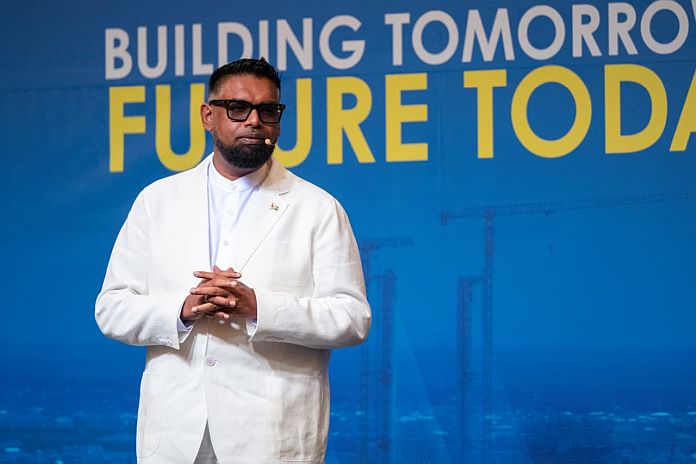
 GEORGETOWN, Guyana, (DPI) – Guyana is not “sleepwalking into the future” but boldly engineering a model of development that converts energy wealth into sustainable prosperity, president Dr Mohamed Irfaan Ali declared, delivering the feature address on Tuesday at the Guyana Energy Conference and Supply Chain Expo at the Guyana Marriott Hotel, Georgetown.
The president painted a sweeping vision of a modern, connected and technology-driven Guyana, to which artificial intelligence strengthens healthcare, every child has access to digital learning, government services operate at the “touch of a button,” and infrastructure links coast and hinterland seamlessly.
“Energy is the capacity to do work,” the head of state said. “And in a national context, that energy is people, technology, capital, partnership, but importantly, ideas. Ideas are what create the momentum to move this country forward.”
Referencing a real-time survey conducted among participants, president Ali noted that while 65 percent of respondents believe the world is not heading in the right direction, more than 90 per cent believe Guyana is moving forward positively.
“We cannot be satisfied when nearly 10 percent still believe we are not heading in the right direction,” he said. “That means we must continue working to ensure every citizen is part of this journey.”
President Ali emphasised that development must translate into measurable economic value and improved human development indicators, including life expectancy, education attainment and income per capita, all of which have shown improvement.
The president outlined five strategic pillars through which Guyana is leveraging its rapidly expanding oil and gas sector:
- Strengthening national and regional energy security;
- Building resilient food production systems;
- Driving economic diversification;
- Creating sustainable high-value jobs;
- Expanding infrastructure through strategic financing.
President Ali stressed that prosperity is not achieved through spending alone but through“spending plus strategic alliances, integration and partnership.”
Guyana, he said, is building a model that does not postpone development.
“Yes, we have a Natural Resource Fund. But simultaneously, we are moving at lightning speed with infrastructure development. We are developing a global model, one that adopts developmental prosperity with an eye on sustainability.”
President Ali highlighted ongoing and planned investments in Wales, including the Gas-to-Energy Project, gas processing facilities, fertiliser and industrial development, and plans for a scalable data centre to position Guyana as a regional technology hub. He also underscored the importance of transport and logistics integration, including deep-water port development, enhanced connectivity with northern Brazil, and proposals for new municipal airports in Lethem and Region Six, as part of positioning Guyana as a gateway between South America and the Caribbean.
“Our neighbours are not here by accident,” he said, pointing to Brazil’s massive agricultural output and the opportunities for integration. “Our long-term sustainability requires integration with the region’s economy.”
Human capital development remains central to the government’s strategy. The president noted that Guyana has already graduated its first cohort of locally trained offshore deep water drilling specialists and is expanding technical institutes in oil and gas, agriculture, construction, and hospitality.
From coding programmes in primary schools to AI-driven public services and cybersecurity investments, he said the country is building a citizen-centric digital ecosystem.
“We have to make the investments for tomorrow today,” he emphasised.
President Ali reaffirmed that Guyana’s transformation is grounded not only in infrastructure and energy, but in people, culture, technology and faith.
“Our investments will secure energy independence, strengthen food production, propel industrialisation, create thousands of sustainable jobs, and build a safe and secure country,” he said. “But most importantly, all of this is rooted in our people.”
The three-day conference runs from February 17 to 20, bringing together global energy leaders, investors and policymakers to explore opportunities in one of the world’s fastest-growing economies.
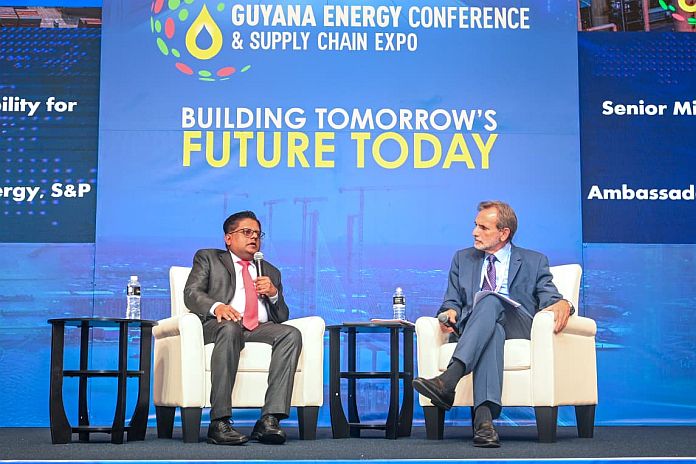
Meanwhile, senior minister in the office of the president with responsibility for finance, Ashni Singh, said Guyana’s economic transformation is the result of decades of policy reform, institutional strengthening and strategic investment.
“We’ve been able to accumulate, in the sovereign wealth fund, enough savings now to pay off the total external debt of the country, all within the space of just about five years.”
“We moved from one FPSO producing about 120,000 barrels of oil per day in December 2019 to four FPSOs producing about 900,000 barrels per day today,” minister Singh explained. “With the deployment of the next FPSO, we will exceed one million barrels of oil per day, and by the end of the decade, we expect production capacity of about 1.7 million barrels per day. By any standard, these are extraordinary numbers.”
“At the turn of the 1990s, Guyana was essentially bankrupt. We were spending more than 100 percent of government revenue on servicing debt, and the stock of debt was more than 600 percent of GDP,” he said. “It took decades of effort to rebuild institutions, liberalise the economy and establish Guyana as a credible destination for investment.”
“Saving for future generations will manifest itself not only in monetary savings, but also in investment in public infrastructure that will generate returns over the long term,” adding, “for generations, Guyana has struggled to generate adequate electricity reliably and at a competitive price,” he said. “That has limited our ability to process our resources and develop manufacturing.”
“With cheaper and more reliable electricity, we anticipate the emergence of an industrial and manufacturing sector that has long been constrained by high energy costs. We’re witnessing a transformation at a speed that we have never seen anywhere else,” he said. “If anyone feels dizzy from the last five years, the next five years will be even more extraordinary.”