
BRIDGETOWN, Barbados – The effect of good policies, planning, gender-sensitive data collection, strengthened community participation in support of law enforcement, collaboration of stakeholders, and opportunities for education, training, employment, income-generation, crime diversion, improving citizen security and socio-economic development, are lessons learned by the Caribbean Development Bank (CDB) through programmes it has financed across the region.
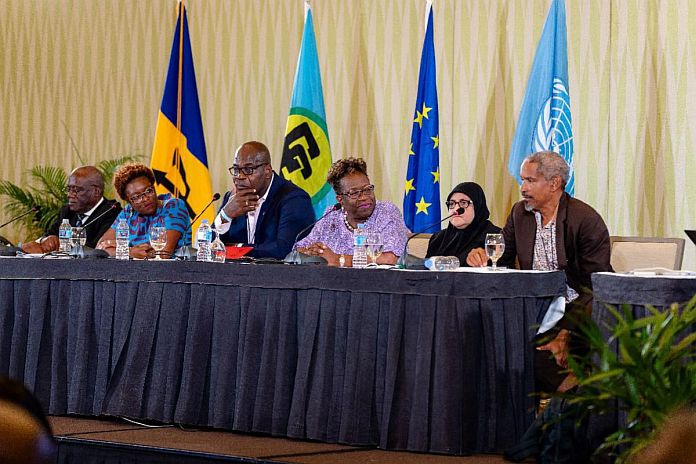
Senior operations officer, social analyst in the CDB projects department, Elbert Ellis, made the observations during his presentation on Crime, Citizen Security and Socio-Economic Development at the 7th Biennial Law Conference of the Caribbean Court of Justice (CCJ) Academy for Law, held at the Hilton Hotel in Barbados from October 18-20, where he noted the connection between citizen security, socio-economic development and poverty reduction.
The CDB, recognising the harm to citizen security, economic and human capital growth in the region and its potential to impede the achievement of its mandate, has financed several programmes that focus on preventative factors for crime and violence, strengthening the role of the school, home and community as primary agents of socialisation enhancing cohesiveness and resilience, and increasing resilience of at-risk youth.
It is estimated that reducing crime in the region could improve Gross Domestic Product by as much as 5 percent.
“This comes against the sobering reality that virtually all Caribbean countries are experiencing an alarming state of affairs regarding criminal activity. Even more glaring are the opportunity costs, and as such, the reform of the criminal justice system and a significant reduction of crime would, without doubt, set this region on an upward trajectory of economic growth and development,” Ellis said.
Risk factors for citizen security include erosion of social cohesion and social capital, unmet basic needs, increased psycho-social issues, gender inequality and notions of masculinity, low economic growth rates, poverty, and high rates of social and economic inequality.
“The reform agenda provides an opportunity to establish systems to address the emerging issues that will challenge decision-makers in the justice system and appreciate the changing norms and values that are influenced by intersecting variables such as class, gender, age, and geographic inequality across society and their impact on the types of cases addressed in the criminal justice system,” said Ellis.
The CCJ Academy for Law’s Biennial Law Conference offers thought leaders in the legal profession a platform to present their ideas to attorneys, law and sociology students, and civil society on various themes concerning the reform and modernisation of Caribbean legal systems and wider society. The CDB provided a USD50,000 grant toward staging this year’s Conference.
About the Author