

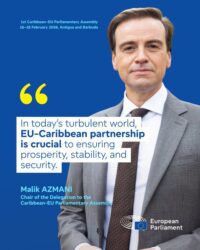
 ST JOHN’S, Antigua – At the conclusion of the first Plenary Session of the Caribbean–EU Parliamentary Assembly, held in Antigua and Barbuda from 16 to 18 February, co-president Malik Azmani highlighted the historic importance of this meeting as it launches the parliamentary dimension of the Samoa Agreement.
This first plenary session reflects a shared political will to deepen dialogue and enhance partnership between like-minded partners who are united by strong historical ties, common values, and a shared commitment to democracy, multilateralism and international law.
The session took place in a challenging international context, characterised by rising geopolitical tensions, increasing pressure on the rules-based international order, and global crises affecting societies, economies and security worldwide. In this environment, cooperation between the European Union and the Caribbean is more important than ever.
Over the course of three days, European and Caribbean parliamentarians engaged in substantive and constructive discussions on five strategic priorities: climate resilience and the energy transition; trade and investment; transnational organised crime; territorial integrity and multilateralism; and the situation in Haiti.
Members addressed the dire situation in Haiti and renewed their strong support for a Haitian-led political solution, while emphasising the urgent need to tackle insecurity and alleviate the pressing humanitarian crisis.
Parliamentarians converged on the need to develop, under the Global Gateway initiative, a Caribbean–EU Climate Resilience and Renewable Energy Compact, as well as a coordinated mechanism to tackle Sargassum, including additional funding for research and development on alternative uses. Members also discussed trade opportunities and market access, cooperation in the digital economy, investments, and the strengthening of trade regulation capacity.
The Assembly was further enriched by an inspiring and interactive Youth Forum, underscoring the essential role young people must play in climate resilience, including through the development of green skills. The Women’s Forum provided valuable perspectives on women’s economic empowerment, including improved access to finance, and reaffirmed the key role of women in shaping the future of the Caribbean–EU partnership.
The Assembly concluded its work with the adoption of concrete recommendations addressed to the Caribbean–EU Council of Ministers. These recommendations aim to guide future joint action.
The co-president underlined that the European Parliament delegation leaves Antigua and Barbuda reinforced in its conviction that continued engagement and closer political dialogue are essential to promoting shared prosperity and defending a multilateral, rules-based international order.