


By Caribbean News Global 
CASTRIES, St Lucia – Saint Lucia has become politically polarised to reveal uniformity in its learning and education system. Aside from legislators and political parties trading arguments and policy positions on avenues to higher learning, Prime Minister Philip J. Pierre is focused and committed to building and transforming opportunities towards a more competitive country.
The nucleus of this agenda actively pursued by the government embodies – a people-centred strategy – “investing in our people, building a stronger, smarter, and more competitive Saint Lucia.”
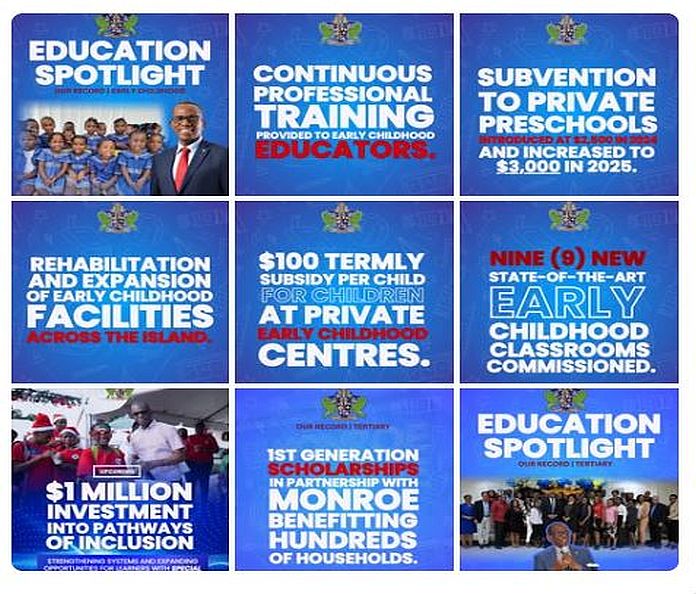
“Our government has achieved Universal Primary and Secondary Education, and in our new term, we will deliver Universal Early Childhood Education. Through the One University Graduate per Household Programme, First Generation Scholarship and continued investment in nurse training, we’re expanding access to higher learning and transforming opportunities for every family,” Prime Minister Pierre explained, placing all Saint Lucians on notice. “ We’re investing in our people, building a stronger, smarter, and more competitive Saint Lucia.”
Prime Minister Pierre and his administration recently reinforced their education platform and announced additional policies to be implemented “after we’ve won the next election,” as conveyed, September 21, 2025.
In contrast, the United Workers Party (UWP) says that they are committed to making education free at Sir Arthur Lewis Community College (SALCC) at approximately $6.0 million annually. This is apparently premised on the central argument of ensuring equitable access to higher education by investing in human capital.
Protecting Saint Lucians, regardless of their background, to have access to higher learning and the opportunity to build a brighter future is commendable. However, the ensuing proposition is via what avenue and/or module?
The future of education
The article, “Inclusive Education Must Be a Central Pillar for Development,” is characteristic of one such module.
“Education continues to be a significant freedom to the development of our people, our growth, our development and our prospects as a region. But as we pursue the full ambition to ensure that we educate our young people, we must do so in full cognisance that we can leave no one behind. The future of education … is inclusive, fair, just and transparent. It is one that has now to be underscored by its resilience, and an attitude of ensuring that every single person will play their part as we go forward,” said Minister of Education Transformation of Barbados, Chad Blackman.
Expanded equal access to education
Prime Minister Pierre asserted earlier this week:
“It has always been a labour administration that has expanded equal access to education for the children of Saint Lucia. From achieving Universal Primary and Secondary Education to investing in improved learning environments, labour governments have consistently ensured that no child is left behind. And it will once again be a Labour administration that delivers Universal Early Childhood Education, continuing our proud legacy of opening doors of opportunity for every child, in every community, across our nation.”
Inclusive, accessible and empowering
Partisan affiliations differ; however, education is key to gathering useful information.
“Education remains a top priority for my government,” said Prime Minister Pierre. “One that must be inclusive, accessible, and empowering for every child,” affirming, “ Soon, we will implement Pathways to Inclusion: Strengthening Systems and Expanding Opportunities for Learners with Special Educational Needs.”
“As part of this commitment, the government will also construct two new centres for special education, creating safe and nurturing spaces where every learner can reach their full potential.”
The Prime Minister continued:
“This initiative reflects our unwavering belief that every learner deserves an equal chance to thrive, regardless of ability or circumstance. An initial allocation of $1 million has been set aside to strengthen support systems, improve learning environments, and expand opportunities for our children.”
“ Our goal is to build an education system that produces well-rounded citizens, empowered to contribute meaningfully to our nation’s progress, regardless of their ability.”
Ensuring every potential is nurtured
Health care education corresponds to the pivotal component in a country’s overall development, meaning: it is important to guard against the conceptualised gamesmanship towards National Health Insurance (NHI) – Coverage for all (75,000 coverage) – like a big tent party – and Universal HealthCare (UHC) – incomplete at the chronic stage of a health crisis.
NHI and UHC are descriptive of a variable that must be better framed, not only to the unsuspecting voter in this election cycle, but to the general well-being and the greater good of the public. Not special interests!
“Universal Health Care promises access, but National Health Insurance guarantees it, sustainably,” the UWP said in a social media post. #RightTheWrong! “ With NHI, everyone is guaranteed access when they need care. It’s fair, transparent and built to last, ensuring that every Saint Lucian has access to quality healthcare today, tomorrow and for generations to come,” says the UWP.
Breaking down the UWP NHI scheme with fitting metaphors is definitely too disagreeable. However, moving forward requires crucial health insurance education and better health care systems. This will aid in the provision of pathways out of poverty, disease, and ill-health, and improvement in the quality of life.
A new framework
The reassurance to education, facilities and systems empowers generations to economic freedom, growth and prosperity.
Investing in programs, supporting students inside and outside the classroom, school feeding programs and access to flexible learning environments help to achieve better student outcomes.
High-quality, active recreation programs also help students to develop new skills and reach their full potential in life.
Towards this revival, learning and child wellbeing are the early starting points towards national renewal, as stated by Prime Minister Pierre:
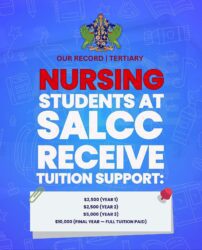
“The drive towards, access, affordability and inclusion, leads to the major policy decision, in the recent tuition support for nursing students, in addition to the yearly stipend is more than financial relief; it’s a strategic investment in our healthcare future, empowering more young Saint Lucians to pursue their calling, strengthen our health workforce, and safeguard the well-being of our nation.”
Pathways to an evolving labour market
Prime Minister Pierre continues to emphasise that his administration has strengthened the foundation of learning and created safer, more nurturing spaces for [our] young children, through significant investments in Early Childhood Development Centres across the island, to achieve the government’s vision of “Universal Early Childhood Education,” and “accessible education from the very start of life.”
In times past, school transformation and health care and systems have remained hardly unchanged. Currently, a concerted effort is paramount to build and maintain resilient schools, hospitals and infrastructure that are inclusive of energy and water efficiency, and waste management.
Building well-equipped green schools are conducive to fostering a learning environment. Equally, building hospitals and new homes that are climate-adaptible and well-equipped helps to create healthy environments.
Equally, the promotion of inclusiveness and accessibility must enable innovation to optimise a well-mapped network of utilities (ICTs, water and sanitation, land use–zoning, and transportation infrastructure, etc). These are essential public policies for sustainable development and adaptation to climate change.
Prime Minister Pierre’s education and learning spotlight for Saint Lucia factors the benchmark to building, both human capital and infrastructure development. Additionally, prioritising readiness and positioning Saint Lucia for the long-term, in view of an evolving labour market and entrepreneurial innovation.
Transparency and informed adjustments are keys to implementation. The immediacy of empowering action, allocating resources and reshaping priorities, remains the great test. In sum, the education spotlight is a virtuous national development policy in action.

