



-
- President Maduro accused the Trump administration of killing civilians and trying to goad Venezuela into a “major war.”
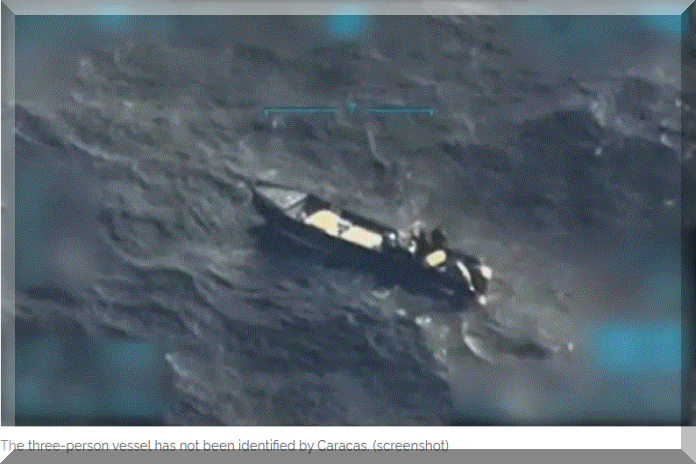
CARACAS, (venezuelanalysis.com) – The United States military killed three men in another strike against a Venezuelan vessel on Monday, claiming it was transporting drugs bound for the US.
President Donald Trump announced the latest strike on his Truth Social platform, saying that the vessel had been “positively identified” as being operated by “narcoterrorists.” His post included a 30-second video clip showing the small boat engulfed in flames. The undated video shows no signs of combat or interception to identify the crew or seize any cargo.
According to Trump, the operation was executed within the US Southern Command’s “area of responsibility” and warned the US would continue “hunting” drug vessels.
When asked by a reporter on Monday in the Oval Office to provide proof that the vessel was carrying narcotics, Trump claimed there were “big bags of cocaine and fentanyl” scattered in the ocean. However, no evidence that the crew was involved in narcotrafficking or that the boat was US-bound has been provided.
Trump likewise boasted that there were “no boats in the ocean anymore,” and admitted that the fishing industry had been “hurt” as a result of the US military action in the Caribbean. He warned that the same approach to the so-called “war on cartels” could be extended to alleged land routes. Last week, Trump signaled he was considering military strikes inside Venezuela.
On Tuesday, before departing for the UK, Trump told reporters that a third Venezuelan boat had also been “knocked off,” but he did not elaborate on what happened.
The Monday attack marks the second lethal military operation by the US against Venezuelan boats in recent weeks. The first took place on September 2, killing 11 people accused of ties to the US-designated “foreign terrorist organisation” Tren de Aragua.
According to anonymous US officials, the 11-person crew attempted to turn around after spotting US aircraft, and some were killed in a follow-up attack after surviving the initial strike. The US has not released details to back up the drug trafficking claims.
Venezuelan officials have stated that investigations found the 11 victims to have no relation to Tren de Aragua or drug trafficking networks, but did not identify them. At a press conference on Monday, president Nicolás Maduro called the attack a “heinous crime” against civilians.
Maduro likewise accused the US of trying to provoke Venezuela into a “major war” for oil-driven regime change ends. He confirmed that communications with the Trump administration were “in shambles,” with only a “basic line” of contact via Colombia-based US Chargé d’Affaires John McNamara aimed at coordinating migrants’ return.
Trump special envoy Richard Grenell, who met with Maduro earlier this year and has promoted dialogue with Venezuela, has been marginalised by Secretary of State Marco Rubio, who has pushed a hardline position vis-à-vis Maduro. On Wednesday, Grenell expressed hope that dialogue would resume at a conference in Paraguay.
The Venezuelan government has not yet commented on the second boat that was struck.
Besides the two bombed vessels, a small nine-person Venezuelan tuna fishing boat was intercepted, boarded and occupied for eight hours on Saturday by soldiers from the US Navy destroyer Jason Dunham in Venezuela’s Exclusive Economic Zone (EEZ). Caracas has complained to the UN’s Food and Agriculture Organization (FAO) that the US is hindering Venezuela’s fishing activity and economic development.
US vice president JD Vance mocked Venezuelan fishermen at a recent public event, suggesting that they were avoiding that part of the ocean due to fears of US strikes.
The two consecutive lethal strikes have prompted domestic and international concern about extrajudicial killings and the potential normalisation of military action in the Caribbean. Last week, Congresswoman Ilhan Omar introduced a war powers resolution in an effort to deter future strikes in the Caribbean, while Senators Adam Schiff and Jack Reed blasted the bombings as “lawless killings” and “outrageous violation of the law.”
China and Latin American governments have also rejected the US’ military escalation.
Since August, Washington has deployed some 4,000 troops, a nuclear-propelled submarine, eight warships, fighter jets and other aircraft in a purported crackdown on drug smugglers.
Washington’s Caribbean military build-up came after the Trump administration raised the bounty for Maduro’s arrest to $50 million, accusing his government of running the so-called “Cartel de los Soles,” which was added to the US terrorist designation list. However, US officials have provided no court-backed evidence to support the charges. Colombian president Gustavo Petro recently said that his country’s intelligence services found that this so-called cartel did not exist.
‘False flag’ DEA operation
On Wednesday, Interior Minister Diosdado Cabello announced that the Bolivarian National Guard (GNB) seized a speedboat carrying 3.6 tons of cocaine, detaining four people, including alleged Drug Enforcement Agency (DEA) agent Levi Enrique López Batis.
According to Cabello, GPS data indicated the boat came from Colombia, and the plan was to stage a “false-flag operation” by staging the drug shipment as having departed from Venezuela.
#Video | Diosdado Cabello, ministro de Relaciones Interiores, Justicia y Paz, informó y presentó el video sobre la detención de Levi Enrique López, agente de la DEA, en el instante en que transportaba 3.680 kilos de cocaína. pic.twitter.com/F4fdhRrfk0
— Globovisión (@globovision) September 17, 2025
On Tuesday, Caracas also dismissed “Hollywood-style falsehoods” in a recent US State Department report which identified Venezuela as a major producer and transit country for drugs. “All of the assertions in the report are unfounded and contradict official data from specialized international organisations,” reads the communique.
The latest UN World Drug Report indicated Venezuela is not a major drug producer or a key US trafficking corridor, and that most shipments reach the US via Washington-allied Central American countries and Pacific routes. Synthetic opioids such as fentanyl are produced in clandestine North American labs, contrary to Trump’s claims about fentanyl production in Venezuela. This data coincides with the most recent DEA report, which found that less than 10 percent of US-bound cocaine flows through Venezuela.