
 ST GEORGE’S, Grenada – The Partnership Initiative for Sustainable Land Management, through its Caribbean Small Island Developing States Sustainable Soil Management for Integrated Landscape Restoration and Sustainable Food Systems (CSIDS-SOILCARE) project is assisting Haiti to advance efforts to map and analyze its soils.
This will be accomplished through SOILCARE, a flagship PISLM project, which is funded by the Global Environment Facility and implemented through support from the Food and Agriculture Organization. The undertaking is expected to help the country make headway in achieving Land Degradation Neutrality.
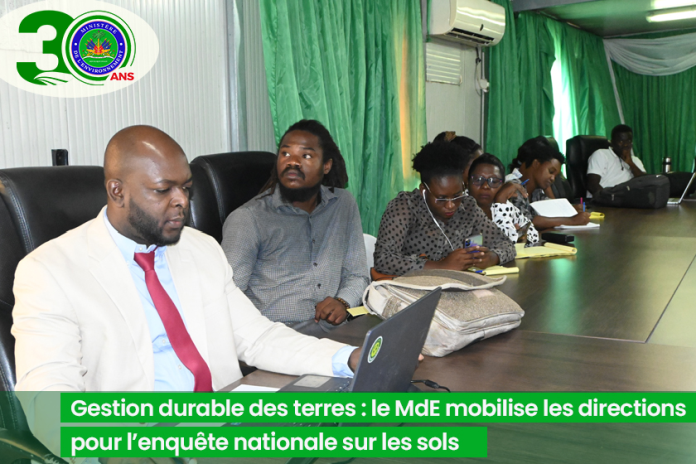
To help Haiti prepare to undertake this national exercise, on Friday, July 25, 2025, the PISLM collaborated with the Directorate of Forests and Renewable Energy (DFER) of the Ministry of the Environment (MdE) to host a hybrid meeting – bringing together departmental, central, and autonomous directorates, to discuss and agree on the standardization of all the field activities during sampling.
Director Eder Audate, head of the DFER and National Focal Point for the United Nations Convention to Combat Desertification (UNCCD), during the meeting, emphasized the need to strengthen field methodology. He stated that FAO standard operating protocols and procedures, adapted to Haitian circumstances, will be used for data collection. According to Audate: “These tools will enable repeated assessment and monitoring of soil properties and quality that will adhere to international standards.”
Agronomist Joseph Constantin, who also serves as the PISLM’s project assistant presented the project and its modalities, explaining that each participating country must analyze and map its soils.
Haiti’s National Soil survey will be led by the Haitian Government, through the Ministry of the Environment (MOE), in collaboration with the Ministry of Agriculture, Natural Resources and Rural Development (MARNDR) and the National Center for Geospatial Information (CNIGS) of the Ministry of Planning and External Cooperation (MPCE).
During the workshop, several concerns were raised, particularly regarding travel difficulties due to insecurity, as well as sample analysis procedures. These concerns were addressed by consultant Joseph Constantin, Dimitry Norris, Lemeuble Jean François, and Donald André, executives at the State University of Haiti (UEH), Limonade campus.
These presenters also provided details on the field survey protocol, with an emphasis on the instruction manual governing campaign management, particularly prior to sample collection.
Project manager for the CSIDS SOILCARE Project- Trevor Thompson, looks forward to the implementation of the project.
“We are hoping that this exercise can help us to improve land use planning, enhance agricultural productivity and increase conservation of lands and soils in Haiti that will result in improved livelihood for its people,” he said.
About the Author