



By Johnny Coomansingh
On February 18, 2012, the Trinidad and Tobago Guardian presented the article titled: ‘Carnival and its implications.’ A quote from the article reads:
“And this carnival, as with every carnival, you and your relationship, if you’re in one, will have to make a choice. How do you and your significant other ‘do’ Carnival? Are you both dedicated to partying till you drop, so you’ll be holding each other up come Carnival Tuesday evening…Can you trust each other out of each other’s eyesight? Make no mistake, Carnival is a time of excess in all things, especially sexual.
Ask the hospital staffs who brace themselves for accidents, drunks, and rapes for the season. Ask the maternity hospital staffs who brace themselves for a significant spike in the birthrate nine months after carnival. How do you react to temptation? How does your partner? When everyone around you is exuding alcohol and willingness, how hard or easy is it for you to be different? Can you stay sober when drinks are free in the band? Can you resist the naked young man who doesn’t mind, won’t stop you and won’t remember? What about when the wining becomes unmistakably something else and you’re caught in the middle of the crowd? How about after Carnival?”
This year 2026, Ash Wednesday is scheduled for February 18. The pre-Lenten carnival culminates with the Las Lap on Tuesday night; a session for the last hurrah. Here’s a snippet of the (1990) calypso Ah come out to play as sung by calypsonian D. Winston McGarland Bailey (Mighty Shadow—deceased). His calypso delivers a relatively good explanation about the behaviour of celebrants during the Las Lap bacchanal just before the aura of Ash Wednesday:
“It was Tuesday night
Las Lap carnival
Mih head feeling right
Ah bounce up this gal
She say ah drink up mih whiskey
And ah smoke up mih tampee
And right now ah searching for ah man to jump up with me.
But boy, yuh dancing like yuh ‘fraid tuh touch me
I come out to play
Hold mih tight around mih belly
I come out to play
Like yuh ‘fraid mih man go beat yuh
I come out to play
Me eh have no man ah tell yuh
Ah only hope yuh eh have no woman in the band.
Because if yuh have ah woman
That go be rel confusion
I’m in search of a man with your description
And ah want yuh play with mih
From now until Ash Wednesday.”
After the Las Lap, when all the excesses of Trinidad’s pre-Lenten carnival comes to a halt, when, despite being still inebriated, stale drunk, or high on some illicit drug, the exhausted and sleepy celebrants, possibly communicants, assumedly return to reality. Somewhere, somehow in the recesses of their minds they think about repentance and sorrow for sins committed, their ribald recklessness, rebelliousness, revelry and bacchanalian debauchery; their extreme freedom of the flesh.
Moreover, they seek to capture a glimpse of the Cathedral of the Immaculate Conception on the Brian Lara Promenade or any other ‘holy’ edifice for that matter. In the sacred ambience of such enclosures, they seek to be absolved of their sins and their unrighteousness. They seek to allow the application of the ashes of last year’s dried-out Palm Sunday palms, marked as crude crosses on their foreheads, symbolic of their mortality and repentance.
Notwithstanding the fact that carnival is a world apart, a license in ritual, and an inversion of social order, there is a stopgap, Ash Wednesday. Here is the entry of the ‘church’ and what we consider as sacred, and the ashes that tells us who we really are when we transition. However, we must remember what a pre-Lenten carnival is all about. Don Mitchell, a cultural geographer, describes carnival as “…the dethronement of the sacred.” Mikhail Bakhtin in his book, Rabelais and his world (1968), interpreted carnival as an activity that is not cognizant of typical spatial boundaries. During carnival time it is possible to live only according to its laws, that is, to the laws of carnivalesque freedom. Does the church understand that particular kind of freedom?
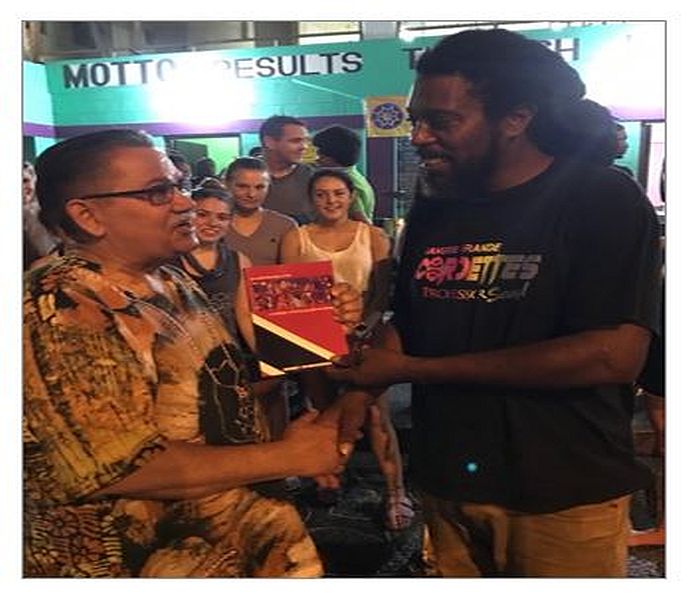
In my book titled: An Understanding of the Trinidad Carnival (2019), it was mentioned that there is an intimate relationship that exists between the Roman Catholic Church and the celebration of carnival in Trinidad and Tobago (T&T). In the chapter, ‘Contextualization of the Trinidad Carnival,’ the book affirms:
“The Roman Catholic Church has supported and defended the Trinidad Carnival throughout its history because the celebration is basically a Roman Catholic tradition. It is clear in the Trinidad Carnival that there is an overt relationship between the sacred and the profane. It is interesting to note that although the Roman Catholic Church in Trinidad observe the ritual of Ash Wednesday, which is included in the annual Roman Catholic Calendar, there is no indication of the carnival days, Carnival Monday (Lundi Gras) and Carnival Tuesday (Mardi Gras) anywhere on the religious calendar.”
In September 2018, Marselle Hasely, a journalist attached to Newsday, spoke of Holy Mas in the launching of a carnival band titled: ‘Through Stained Glass Windows.’ The band designed for the 2019 carnival provided for five sections: i. Love (Amare); ii. Faith (Fidem); iii. Hope (Spero); iv. Light (Lux); v. Joy (Gaudium). It could be that these “positive notions” suggest that we as a people should shoulder our responsibilities to work as a unified front towards a better and peaceful world.
This activity occurred at the All Saints Anglican Church in Port of Spain. To many, this portrayal in the sacred hall of the church may appear blasphemous and incongruous to righteousness. Nevertheless, Hasely cited the words of Canon Richard Jacob, “…we believe God is the source of all that is creative and good. We celebrate what is good and uplifting and give folks an opportunity to rethink how we express that God-given creativity at carnival.” In every sense, the theme of the band was effectively communicated, which in every way, drew from the inspiration of Saint Francis of Assisi in his prayer of peace.
The launching of the carnival band was indeed a potent paradigm concerning the direct intertwining between religion and carnival. However, in my opinion, everything amounts to theatrics. As we all know, marketing is not selling. The organisers of the band had to find ways and means of marketing its product. Use of the ‘church’ was just another cog in the marketing wheel; place.
Whether we agree or not, it’s the same ‘church’ that will house the weary celebrants and or communicants on Ash Wednesday to receive ashes; to revitalize their spirituality. It’s the same church that revers the ‘sacredness’ of the creativity of carnival but how does the church relate to what they perceive to be profane? Anais Nin said: “We do not see things as they are. We see things as we are.”
C.A, Chaitoo-Bernard in the article ‘Thongs down’ published on the InternetExpress (2001), stated:
“Father Clyde Harvey (Roman Catholic), reacted very strongly to certain behaviours exhibited during carnival time. Harvey called on women not to play mas in thongs. The report states that he was saddened that many of the people, who indulge their exhibitionist desires often consider themselves Catholic. Harvey quipped: “When such behaviour is premeditated, it is clearly sinful and cannot be excused. Ash Wednesday and Lent do not wipe out such sin, especially when one intends to do it next year.”
It could be that Father Harvey doesn’t know that carnival epitomises the creation of another world, maybe a nether world.
Back in 1998, in another statement found in the book authored by Peter Mason, Bacchanal: The Carnival Culture of Trinidad, Chandralekha Kasmally, a devout Hindu resident in Trinidad) mentioned the tenor of the Hindu attitude to Trinidad Carnival:
“Too many people only wait for when carnival reach. It doesn’t make sense to me. People go on carnival day and they do all the wrong things, and then on Ash Wednesday they ask forgiveness. But they knew it was wrong in the first place, so God will not forgive them. You know how many rapes and killings take place at carnival? At carnival there are police on the street, but not many—and at carnival people take their revenge.”
On a more jocular take, Tony Deyal in his 2001 article titled: ‘The gift of thongs’ stated:
“The gift of thongs descended on our carnival bands. Many of the female participants went to tong in thongs. Whatever Paradise was lost, seems to have been regained. In the early days, those of us who played ‘mas’ or joined carnival bands, paid our money and got our costumes with no strings attached. Now, for the female players, there are strings and other enthonglements…The enjoinment, customary at home, to hold your tongue, would have given way to the enjoyment of holding your, or some other person’s, thong. Having a tie-thong would not be a handicap, more a wisp than a lisp. Given the nature of the object, it was impossible for the ladies so bedecked to keep a civil thong. One irate, straight-laced lady, watching the spectacle on television, felt that thongs should be outlawed.
As a man about thong myself, I totally disagreed. I saw no need for prior approval by the ‘Thong and Country Planning Authority.’ However, I playfully suggested, thong-in-cheek, so to speak, that maybe we should seek to sample public opinion on this very important issue, and persuade our television station, or even the government, to hold a thong meeting. *Tony Deyal was last seen in a carnival band giving one of his female friends a thong-lashing. He explained it was merely a figure of speech or a ‘diphthong.’”
Apart from the fact that the price of fish for the Lenten season may increase, here’s what I communicated in my book:
“Is it that these pre-Lenten days possessed and infused with gustatory excesses, sexual overtures, inebriation, debauchery, revelry and rebellion are accepted as part of the lifestyle of the communicants? The period of Lent (40 days of fasting, and prayer) begins on Ash Wednesday and there is the mentality or sign of ‘repentance,’ at least until carnival comes again. Carnival will come again, but does the typical celebrant/communicant erase the idea of carnival until two days before Ash Wednesday? Could it be that Ash Wednesday is intimately tied to carnival? It is well-known that the preparation for the next carnival takes place long before the moment arrives. Carnival appears to be in the minds, in the actual soul of a people; this is what the pre-Lenten carnival celebrant lives for.”