



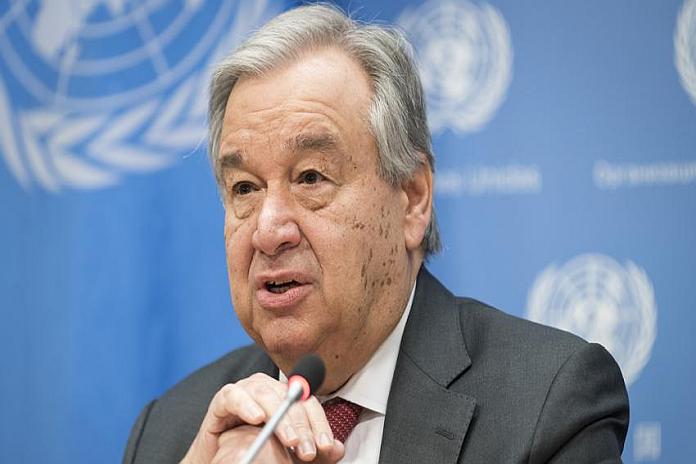
 WASHINGTON, USA – This is an especially meaningful moment for me since it’s my final opportunity for our customary exchange at the beginning of the year. These are early days – but 2026 is already shaping up to be a year of constant surprises and chaos, António Guterres, Secretary-General said Thursday at press conference on his 2026 priorities.
The following is the text of his comments:
Before I entered public life, I trained as a physicist. And in times of profound flux, I return to some of the fixed principles that explain how forces act upon the world. One stands out — Newton’s Third Law of Motion: for every action, there is an equal and opposite reaction.
In physics, this law is a stabilising principle. In geopolitics today, it is a destabilising factor. We are living in a world where actions – especially reckless ones – are provoking dangerous reactions. And unlike in physics, these reactions are not symmetrical or predictable. They are being multiplied by geopolitical divisions and magnified by an epidemic of impunity.
The law of power is prevailing over the power of law. International law is trampled. Cooperation is eroding. And multilateral institutions are under assault on many fronts.
When perilous actions do not meet the adequate reaction, the system destabilises. Impunity is driving today’s conflicts – fueling escalation, widening mistrust, and kicking the doors open for powerful spoilers to enter from every direction.
Meanwhile, the slashing of humanitarian aid is generating its own chain reactions of despair, displacement, and death. At the same time, inequalities are deepening and roiling societies.
Climate change is the most literal and devastating illustration of Newton’s principle. Every action that heats the planet triggers a ferocious reaction — storms, wildfires, hurricanes, droughts, rising seas. And then there is technology.
We are witnessing perhaps the greatest transfer of power of our times – not from governments to people, but from governments to private technology companies. When technologies that shape behaviour, elections, markets, and even conflicts operate without guardrails, the reaction is not innovation; it is instability.
As I look across the spectrum of global challenges, one truth becomes unmistakably clear: our systems of global problem-solving face a reckoning. Those systems are out of time. They still reflect the economic and power structures of 80 years ago. But the world is moving on.
Every day, the share of global economic activity by the traditional group of developed economies recedes – quietly, gradually, but undeniably. Every day, emerging economies expand in scale, in influence, and in confidence. Every day, the dynamism of South-South trade further outpaces traditional North-North flows.
Yet our structures, our institutions, our assumptions, our habits of cooperation, remain tethered to another time.
This must change.
Our structures and institutions must reflect the complexity – and the opportunity – of these new times and realities.
Global problems will not be solved by one power calling the shots. Nor will they be solved by two powers carving the world into rival spheres of influence.
It is important to accelerate, deliberately and with determination, multipolarity — one that is networked, inclusive by design, and capable of creating balance through partnerships.
Partnerships in trade, in technology and in international cooperation. But multipolarity, by itself, does not guarantee stability or peace.
Europe before the first World War was multipolar. But in the absence of effective multilateral institutions, the result was confrontation and war.
For multipolarity to generate equilibrium, prosperity and peace, we need strong multilateral institutions where legitimacy is rooted in shared responsibility and shared values. And let’s be clear about something else as we strongly pursue reform:
Structures may be out of date – but values are not. Leadership today is not a choice about being principled or pragmatic. It’s the recognition that principles are pragmatic.
The Charter of the United Nations was written by people bloodied and bruised by war. They understood that the values enshrined in our founding documents were not lofty abstractions or idealistic hopes. Those values are the sine qua non of lasting peace and enduring justice.
Values matter – and people are risking everything to make those values real. That is on full display around the world – whether it is a protestor standing up to repression …a journalist standing up for press freedom … or an everyday citizen standing up for their neighbour.
Despite all the hurdles, the United Nations is acting to give life to our shared values. And we won’t give up. We are pushing for peace – just and sustainable peace rooted in international law.
Peace that addresses root causes. Peace that endures beyond the signing of an agreement. We are pressing to reform and strengthen the Security Council – the one and only body with the Charter-mandated authority to act on peace and security on behalf of every country. But there is no lasting peace without development.
We are acting to accelerate progress on the Sustainable Development Goals and insisting on reform of the global financial architecture. That includes ending the crushing cycle of debt, tripling the lending capacity of multilateral development banks, and ensuring developing countries just participation and real influence in global financial institutions.
On climate, we recognise the overshoot of global temperatures above the 1.5-degree threshold and that it now requires an overshoot of ambition – starting with deep emissions cuts this decade and a just, orderly and equitable transition from fossil fuels to renewables.
We are demanding far greater support for countries already confronting climate catastrophe, expanded early warning systems, opportunities for nations rich in critical minerals to climb global value chains.
And on technology, we are working urgently to help craft a framework for governance – through a global dialogue here at the United Nations, the new International Scientific Panel on AI and enhanced capacity support for developing countries.
I will soon submit to the General Assembly a list of 40 names of proposed panel members. I am also calling for the creation of a Global Fund on AI Capacity Development for developing countries – with a target of $3 billion.
As we begin this year, we are determined to choose actions that generate concrete and positive reactions – as called for in the Pact for the Future. Reactions of peace, of justice, of responsibility, and of progress in our troubled times.