



 Uncertainty defined 2025. In Latin America and the Caribbean (LAC), economic, social and political uncertainty reached historic highs. This will continue in 2026, driven by shifting geopolitical alliances, changing trade rules, and a dense calendar of elections.
These forces are reshaping development prospects unevenly. Some countries are benefiting from higher commodity prices and renewed investor interest, while others remain stuck in low growth or face rising vulnerability. Climate shocks are becoming more frequent and costly, just as populations are ageing faster than care systems can adapt.
This #GraphForThought highlights trends to watch in the development space in LAC in 2026, revealing not only the risks ahead, but also where new opportunities may emerge in a more fragmented and uncertain world.
- Expect the unexpected: Uncertainty continues on the rise as global and domestic pressures converge
Uncertainty in LAC has been rising since the pandemic, but 2025 marked a clear break from the past. Levels reached a historic high—more than 2.5 times higher than in 2024—driven largely by external forces.
A shifting geopolitical landscape, led by policy changes in the United States, has been a central factor. As the US climbed to the top of the global uncertainty ranking, the effects spilled over to LAC through trade, investment, migration flows, remittances, financial flows, and democratic governance. Changes in U.S. migration policy prompted migrants returns or internal reshuffling within the region, with economic, social, and security implications. This trend is likely to intensify in 2026, with antimigratory policies gaining traction around parts of the world.
Domestic dynamics are also amplifying this volatility. In 2026, seven countries, representing more than half of the region’s population (52%), will undergo presidential transitions, at a time when LAC is the most politically polarized region in the world. The overlap between global uncertainty and domestic political change increases the risk of policy reversals, delayed investment, and short-term instability.
- Eyes on LAC: A pivotal region at the center of a global realignment around trade, security and power.
2026 began with the region situated at the center of geopolitical attention. Its significant endowment of strategic resources—including lithium, copper, rare earth minerals, and nearly 19% of the world’s proven oil reserves—has increased international interest in its role within global supply chains. At the same time, the expansion of organised criminal networks, including those seeking influence over high-value natural assets, has added complexity to the regional security environment. These dynamics have heightened uncertainty and insecurity at both the domestic and international levels. In response, questions related to security, governance, and economic sovereignty have gained prominence, particularly in countries where resource wealth, criminal activity, and external commercial interests intersect.
Trade patterns are also shifting in ways that suggest uncertainty will persist. Over the past two decades, LAC deepened its economic ties with China, now the region’s second-largest export destination, representing 12.3 percent of goods exports in 2024. While the United States remains the region’s top partner at 14.9 percent (excluding Mexico), the tariffs introduced in 2025 may accelerate LAC’s pivot toward alternative markets.
At the same time, a trade agreement between Mercosur and the European Union (still pending ratification in a shifting geopolitical context) could further reshape the region’s trade landscape. Together, these shifts position LAC not just as a bystander in global fragmentation, but as a region increasingly navigating competing economic spheres.
- An uptick in growth, but uneven and uncertain
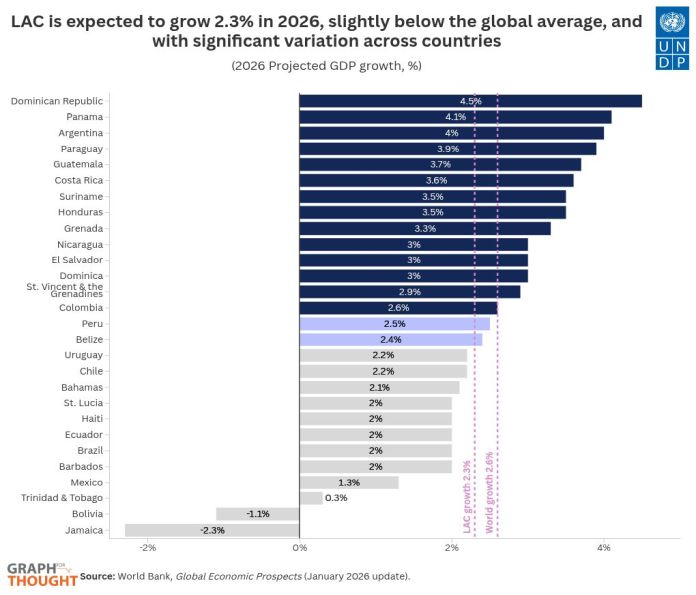
LAC is expected to see a modest acceleration in growth in 2026, but growth remains fragile and highly uneven. The region is projected to grow by 2.3% in 2026, following 2.2% in 2025— and below global growth rates of 2.6% and 2.7%, respectively. On average, LAC continues to lag behind other emerging regions.
Beyond averages, however, outcomes diverge sharply. A subset of countries is benefiting from higher commodity prices and stronger external demand, with growth rates approaching 4 percent, levels comparable to those seen in East Asia and the Pacific. For these economies, favourable terms of trade and renewed investment have provided short-term momentum. Others face a more challenging outlook. Exposure to newly imposed tariffs, coupled with broader geopolitical tensions, is weighing on exports and investment. Several countries are expected to experience minimal growth, or even contraction, highlighting how external shocks continue to shape uneven development paths across the region.
Still, the region’s outlook is not fixed. Commodity prices are expected to soften in 2026 as global growth remains low and oil supplies above demand, limiting the sustainability of recent gains. Yet rising interest in the region’s minerals and oil reserves could spur new foreign investment that boosts growth. At the same time, analysts warn about potential asset-price corrections linked to an artificial intelligence bubble, which could disrupt global financial markets and spill over into the region.
- Poverty continues to decline, but gains are fragile and concentrated
Poverty in LAC is expected to fall to 25.2% in 2025, the lowest rate on record and roughly half its level in 2000. A slight decline from 25.5 percent in 2024, and 27.9 percent in 2023. The recovery from the pandemic shock has continued, but its benefits have not been evenly shared. Recent progress has been driven largely by Brazil and Mexico, where expanded cash-transfer programs and strong labor market performance have accelerated poverty reduction. When these two countries are excluded, the regional poverty rate is nearly three percentage points higher, and the pace of recovery appears far slower.
- Climate pressures intensify, but clean energy gains momentum
LAC remains one of the regions most exposed to climate-related shocks. After Asia, it ranks second globally in exposure to extreme weather, with nearly three-quarters of its countries highly vulnerable to droughts, floods, and storms. These risks are no longer episodic: they are structural.
The frequency of extreme weather events has increased steadily over time, rising from an annual average of 11.7 events between 2000 and 2010 to 12.9 between 2011 and 2025. The human impact has intensified even more sharply: the number of people affected each year has doubled, from 4.9 million to more than 10 million. Caribbean countries are particularly exposed, with climate shocks placing sustained pressure on public finances, infrastructure, and livelihoods.
Nevertheless, the region holds significant potential to contribute to global climate solutions. Renewable sources already account for 62.5 percent of electricity generation in LAC, far exceeding the OECD (35.1%) and global averages (31.8%). The region also possesses vast solar, wind, and hydropower capacity, along with 23% of the world’s forests and unparalleled biodiversity.
With targeted investment and innovation, 2026 could mark a turning point, one in which LAC begins to translate its natural advantages into large-scale climate and development gains. The region’s challenge is not a lack of potential, but the ability to mobilise capital, policy coordination, and technology at speed.
- At the tipping point: Population ageing is reshaping care needs
LAC has entered a new demographic phase. In 2024 and 2025, the region reached a historic turning point; for the first time, older adults (65+) required relatively more care than young children (ages 0-4). This shift reflects decades of falling fertility rates and rising life expectancy.
As populations age, demand for long-term care is set to increase rapidly. The number of older adults in LAC requiring assistance with daily activities is projected to nearly triple by 2050, driven by longer lifespans and the growing prevalence of chronic conditions. Yet care systems across the region remain underdeveloped and uneven.
The implications extend beyond health. Ageing populations place increasing pressure on social protection systems, public health services, and pension schemes. Without adequate preparation, the burden of care is likely to fall disproportionately on working-age adults, particularly women, who continue to shoulder most unpaid caregiving responsibilities for both children and the elderly. Addressing population ageing will require rethinking care as a core pillar of development policy, rather than a peripheral social issue.
Advancing development in LAC amid turbulence
The shifts observed in 2025 set the stage for a complex 2026. Although LAC has made substantial development gains, progress remains unequal, and disparities in growth and poverty rates continue to underscore structural gaps. These matters are compounded by climate risks and a fast-aging population that requires a rethink in terms of care and social protection. Meeting today’s challenges will require a renewed approach to human development, one that recognizes their interconnected nature.
A new development playbook is needed. Reducing poverty and vulnerability requires expanding social protection, improving labor market opportunities, ensuring quality education, and widening access to financial tools that help households withstand adversity. Climate adaptation, through better early-warning systems, risk-informed planning, stronger coordination, and resilient infrastructure, is essential, particularly for countries most affected by extreme events. At the same time, fast demographic change underscores the need to expand long-term care systems, reinforce public health services, and redistribute unpaid care work to narrow gender gaps. Advancing and sustaining these reforms in a highly polarised environment will require stronger governance: effective institutions, rule-based decision making, and trust in public action become essential to safeguard democratic stability and keep development progress on track.
The path ahead may continue to be turbulent at moments, but integrating economic, social, and climate priorities, anchored in building resilience –as highlighted by UNDPs Regional Programme Document for LAC, approved by consensus by its executive board- can provide the stability the region needs to navigate uncertainty while sustaining development progress.