



By João Ricardo Vasconcelos and Cem Dener
Governments worldwide are embracing technology to modernise the public sector and deliver better services to their citizens. The World Bank’s GovTech approach plays a key role in supporting this transformation by helping countries build strong digital foundations and turning them into tangible results. One of the main tools in this effort is the GovTech Maturity Index (GTMI), which we use to track progress—and to understand where gaps remain in the global digital government landscape.
Across the globe, governments are working to build modern digital infrastructure to enhance their services to meet the growing expectations of citizens for seamless online interactions with public administration. However, the latest GTMI 2025 shows that progress is ongoing but remains uneven. The most significant difficulties arise where technology meets people—especially in encouraging service adoption, fostering inclusion, maintaining engagement, and ensuring accountability.
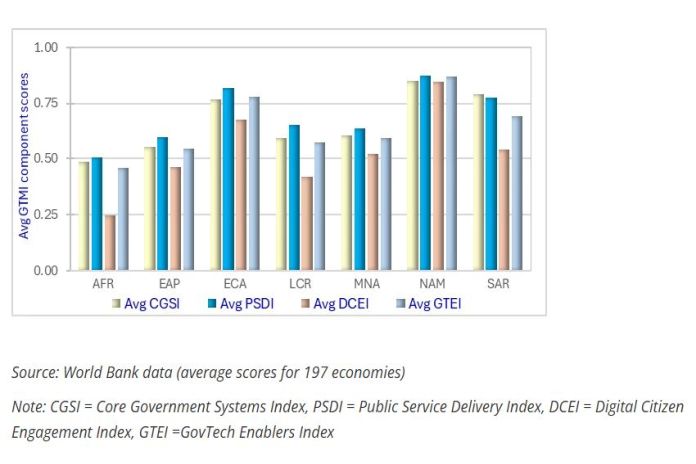
The GTMI provides a snapshot of public sector digital transformation across four areas: Core Government Systems, Online Public Service Delivery, Digital Citizen Engagement, and GovTech Enablers, as shown in the graph below. It groups economies by normalized maturity scores (A–D), helping practitioners identify gaps and prioritize reforms.
What GTMI measures—and why it matters
The publicly available GTMI dataset, GTMI Dashboard, and the newly released GTMI Brief, provide a global view on how countries and regions are building digital government foundations, and where global patterns and trends continue to emerge.
The 2025 GTMI picture at a glance:
- Top performers are growing: Group A grew from roughly 35 percent (2022) to 41percent of economies in 2025.
- Middle groups narrowed: Groups B and C dropped to roughly 21percent and 24 percent, respectively; Group D declined to around 14 percent.
- The digital divide widened: The gap between the highest- and lowest-performing groups expanded, underscoring the need for targeted support.
- Regional contrasts persist: Europe and Central Asia is strong leading with about 70 percent in Group A, while Africa lags at 13 percent, a pattern consistent across GTMI editions and regional briefs.
What’s improving—and what still falls short
Since 2022, many economies have adopted government cloud solutions, enterprise architecture, interoperability frameworks, and updated digital strategies. Stronger data governance and expanded digital skills and innovation programs are on the rise.
However, persistent bottlenecks remain. Nearly half of economies still lack fully implemented cloud and interoperability backbones, and some have experienced setbacks in modernising human resources and payroll systems—foundational for integrity, transparency, and workforce performance.
Digital services continue to expand, with most economies now offering digital tax, customs and e-payments services, and a majority uses digital ID to enable transactions. Yet about four in ten economies still lack an operational one-stop service portal, and many existing portals struggle with usability, accessibility, and maintenance.
Digital citizen engagement remains the least mature GTMI component in most regions. Several open government portals were discontinued, and open data platforms face maintenance challenges—undercutting transparency and trust.
Why does this matter and what’s next?
Service quality and inclusion matter. Well-designed, accessible digital services save time and reduce costs for citizens and businesses. Poorly designed portals, however, deepen exclusion and limit access to essential services. Trust and accountability also rely on transparency: engagement platforms, open data, and performance dashboards help citizens see what their governments are delivering, supporting legitimacy and course correction.
Shared cloud, interoperability, and enterprise architecture improve efficiency by reducing duplication and secure scaling. Yet, lack of realistic financing – often relying heavily on external grants- remains a major obstacle to sustained digital reforms.
To close the digital maturity gap, Governments should build strong foundations first with adequate financial resources, then scale services. Prioritise shared platforms and reusable components before proliferating portals. Data governance should be institutionalised: clarifying ownership, ensuring quality, and protecting privacy. Services should be designed and co-created with users, accessibility built in, and maintenance funded. Usage and outcomes should be monitored to build trust and enable course correction.
By focusing on these fundamentals, we aim to support governments in using tools like the GTMI not just to measure progress, but to turn digital systems into better and more inclusive services for citizens.