
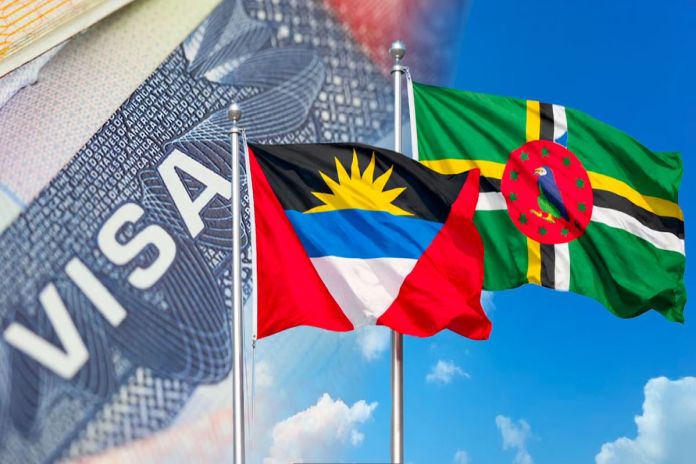


GUYANA / ST LUICA – The below are statements by the Bureau of the Conference of Heads of Government of CARICOM and the Organisation of Eastern Caribbean States (OECS) Commission, on the revocation of United States visas for citizens of Antigua and Barbuda and the Commonwealth of Dominica.
The Bureau of the Conference of Heads of Government of the Caribbean Community (CARICOM) has noted with concern the proclamation issued by the government of the United States on 16 December 2025, imposing partial entry restrictions on nationals of Antigua and Barbuda and the Commonwealth of Dominica.
The Bureau recognises the right of countries to implement policies regulating entry to their borders. Nevertheless, the Bureau expresses concern that this decision was taken without prior consultation, especially in circumstances of its potential adverse effects on legitimate travel, people-to-people exchanges, and the social and economic well-being of these small states. CARICOM is also concerned about the lack of clarity regarding the status of existing visas after 1 January 2026.
The Bureau urges an early engagement by the United States with the governments of Antigua and Barbuda and Dominica to clarify the proclamation and address outstanding concerns, consistent with the strong and longstanding partnership between the United States of America and CARICOM.
CARICOM remains committed to dialogue and cooperation based on mutual respect, shared interests and the rule of law as we seek to secure the prosperity of the region and its citizens.
The OECS acknowledges, with respect, the sovereign right of all states to determine and enforce their immigration and border security policies in accordance with their national laws and security assessments. At the same time, the Commission believes it is important that such measures be considered within the context of the historically close, cooperative, and mutually beneficial relationship between the Caribbean and the United States – a relationship grounded in shared democratic values, people-to-people ties, and long-standing economic, cultural, and security cooperation.
For decades, Caribbean nationals – including those from Antigua and Barbuda and Dominica – have formed an integral part of the social and economic fabric of the United States. The Caribbean diaspora has consistently demonstrated itself to be law-abiding, productive, and civically engaged, contributing meaningfully across critical sectors such as healthcare, education, construction, entrepreneurship, the creative industries, and public service. These contributions have strengthened local communities and reinforced the enduring bonds between our societies.
The OECS further underscores the depth of economic interdependence between the United States and the Eastern Caribbean. The United States remains a principal trading partner, investor, tourism source market, and development partner for OECS member states. These ties are reinforced through continuous diplomatic engagement, private-sector collaboration, and structured dialogue on matters of shared concern, including financial integrity, border security, and transnational risk management.
With specific regard to Citizenship by Investment Programmes (CIPs), the OECS notes that its member states have been actively and constructively engaged in ongoing dialogue with relevant agencies of the United States government and other international partners. These engagements have been frank, technical, and solutions-oriented. Importantly, OECS member states have made demonstrable progress in strengthening due diligence systems, enhancing information-sharing, tightening eligibility standards, and – most significantly – advancing the establishment of a regional, independent regulatory authority to ensure consistent oversight, transparency, and compliance with international best practices.
For small island developing states in the Caribbean, CIPs represent one of a very limited set of lawful, non-debt-creating policy instruments available to finance resilience-building, disaster adaptation/recovery, and sustainable development. These programmes have been deployed responsibly to support critical public investments in infrastructure, education, health systems, renewable energy, and social resilience – areas that directly enhance regional and hemispheric stability.
In this regard, the OECS respectfully urges that consideration be given to the unique vulnerabilities, constrained fiscal space, and limited economic diversification options available to small states in the western hemisphere. A collaborative, consultative approach – grounded in dialogue, proportionality, and shared responsibility – offers the most effective pathway to addressing legitimate concerns while preserving long-standing partnerships.
The OECS Commission reaffirms its commitment to continued engagement with the government of the United States, including under the current administration, in a spirit of mutual respect, transparency, and cooperation. We remain confident that through sustained dialogue and evidence-based collaboration, solutions can be advanced that uphold security objectives while recognising the developmental realities of small, open economies.
The OECS stands firmly with Antigua and Barbuda and Dominica and reiterates its collective resolve to work with all partners to ensure that the Eastern Caribbean remains a region defined by good governance, international cooperation, and constructive engagement within the Americas.
Related Links:
- President Donald J. Trump Further Restricts and Limits the Entry of Foreign Nationals to Protect the Security of the United States
- Restricting and limiting the entry of Foreign Nationals to protect the security of the United States
About the Author