



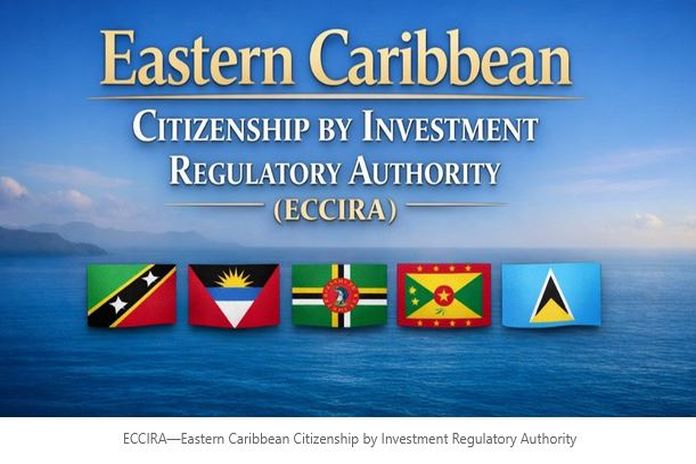
In October 2025, St Kitts and Nevis became the first Eastern Caribbean state to give domestic legal force to a new regional authority regulating citizenship-by-investment (CBI) programmes. Dominica and Grenada followed within days. Antigua and Barbuda advanced similar legislation through Parliament shortly thereafter, while Saint Lucia publicly confirmed that its own bill would be adopted before the end of the year.
Each of these legislative steps may appear technical. Taken together, they amount to the most significant restructuring of the Caribbean CBI landscape since its creation more than thirty years ago.
For the first time, five Eastern Caribbean states—Antigua and Barbuda, Dominica, Grenada, St Kitts and Nevis, and Saint Lucia—have agreed not merely to align standards or cooperate informally, but to pool regulatory authority over citizenship itself through a single regional body: the Eastern Caribbean Citizenship by Investment Regulatory Authority (ECCIRA).
This is not symbolism. Once all national laws are in force and the final instruments of ratification are deposited, ECCIRA will exercise binding oversight across the region’s economic citizenship programmes. Decisions that were once made entirely at the national level will now operate within a shared regional framework.
Citizenship, long regarded as the clearest expression of state sovereignty, has entered a new phase, one shaped as much by external mobility regimes as by domestic policy.
From competition to coordination
Caribbean CBI programmes were born in a very different international environment. When St Kitts and Nevis launched the first programme in 1984, the idea that citizenship could be used as an economic development tool attracted little attention outside the region. Over time, other states followed, relying on CBI revenues to finance reconstruction after natural disasters, fund infrastructure, and support public services.
For many years, regulation remained almost entirely national. Programmes competed on speed, flexibility, and price. That model proved commercially successful, but it also left small states increasingly exposed.
Over the past decade, CBI has moved from the margins of economic policy to the center of international scrutiny. The United States, the European Union, and the United Kingdom have progressively reframed economic citizenship through the lenses of security, sanctions enforcement, and migration control. Visa-free access, once assumed to be durable, has become conditional—and revocable.
For small states negotiating mobility arrangements with far larger partners, the imbalance is structural. No single Caribbean country, acting alone, can meaningfully influence global screening standards or absorb unilateral travel restrictions without consequence. Fragmentation became a vulnerability. The response that emerged was not confrontation, but coordination.
Agreement under pressure
The road to ECCIRA was shaped by sustained diplomatic engagement under growing external pressure. Beginning in 2023, a series of US–Caribbean roundtables articulated principles on due diligence, information sharing, and programme governance. Parallel discussions took place with European and British counterparts, often framed less as negotiation than expectation-setting.
By mid-2025, the strategic choice had narrowed. Caribbean governments faced a clear alternative: accept externally imposed outcomes—including visa suspensions or entry restrictions—or design a regional framework capable of addressing international concerns on their own terms.
Against this backdrop, the Memorandum of Agreement signed in 2024 by all five Eastern Caribbean states with CBI programmes provided a foundation for collective action.
On 1 July 2025, draft legislation establishing ECCIRA was published for public consultation. In September, the five heads of government formally committed to a joint regulator and common standards, with each state undertaking to enact enabling legislation domestically.
St Kitts and Nevis moved first. Act No. 24 of 2025 gave the ECCIRA framework binding legal effect, including regulatory supremacy in defined areas. Dominica and Grenada followed. Antigua and Barbuda advanced its own bill, while Saint Lucia confirmed that its legislation would complete the process. Grenada was designated host of the ECCIRA headquarters, with branch offices in each participating state.
The agreement is designed to enter into force following ratification by all five countries, with a transition period expected to run into early 2026.
What ECCIRA changes and what it does not
Despite the subject’s political sensitivity, the substance of the ECCIRA framework is notably restrained. It does not rewrite citizenship law wholesale. Instead, it creates a regulatory layer above national programmes, establishing minimum standards and ensuring uniform application.
ECCIRA will oversee due diligence processes, agent and developer licensing, information-sharing mechanisms, and compliance reporting. It introduces region-wide requirements for biometric data collection, mandatory interviews, and stronger “genuine link” expectations, including a minimum 30-day residency obligation to be fulfilled within five years of naturalization. A standard minimum investment threshold of US$200,000 effectively ends price-based competition between programmes.
ECCIRA does not abolish national citizenship laws or eliminate sovereign decision-making. Citizenship will continue to be granted under domestic statutes. Revenues will remain national. Political accountability will stay local. The shift is not the elimination of sovereignty but its recalibration within a binding regional system.
The most consequential changes lie not in the agreement itself, but in the national laws that give it effect. The St Kitts and Nevis legislation, for example, adds enforcement mechanisms absent from earlier drafts: inspections, administrative penalties, transitional provisions, and recognition of ECCIRA authority before domestic courts. In practical terms, ECCIRA won’t be advisory but rather an enforcement body.
Shared sovereignty as strategy
Pooling authority over citizenship inevitably raises questions of sovereignty. Some critics have characterised ECCIRA as a concession extracted under external pressure. That reading is incomplete.
Sovereignty in today’s interconnected world is rarely absolute. It is exercised within systems—financial, security, and mobility-related—controlled mainly by others. For small states, insisting on formal autonomy while losing visa-free access or financial credibility offers little practical benefit.
ECCIRA signifies a strategic compromise. By sharing regulatory authority regionally, Caribbean states enhance their collective global influence. They replace fragmented national systems with a unified, credible framework that external partners can trust and work with. This is not the loss of sovereignty, but its strategic adaptation.
Market consequences
For investors and intermediaries, the implications are clear. Processing will be slower. Scrutiny will be deeper. Volumes may decline.
At the same time, the long-term value proposition of Caribbean citizenship may improve. Programmes that survive under a unified regulatory regime will be more defensible politically and diplomatically. Visa-free access, once lost, is difficult to restore. Preserving it requires credibility.
In that sense, ECCIRA is not designed to expand the market but to stabilise it.
However, recent extensions of the US travel ban and restrictions, this time partially targeting Antigua and Barbuda and Dominica, illustrate the tangible risks investors face. Notably, similar programmes elsewhere were not affected, raising questions of consistency and fairness in international oversight. Under ECCIRA, Caribbean states aim to create a framework that preserves credibility and mitigates such unilateral measures.
A new phase for economic citizenship
The significance of ECCIRA may extend beyond the Caribbean. It reflects a strategic choice by small states to respond collectively to external pressure rather than absorb standards set entirely elsewhere. The framework does not reject international scrutiny; it internalises it through regional governance.
Success will depend less on the law than on its execution. Enforcement, transparency, and political discipline will decide if ECCIRA emerges as a durable model or remains a transitional compromise.
What is already clear is that citizenship by investment has entered a more constrained and politicised phase. It is no longer treated solely as a national economic instrument, but as part of a wider system of security, mobility, and international trust.
The question is no longer whether these programmes will be regulated, but who shapes the rules, and on what terms.