


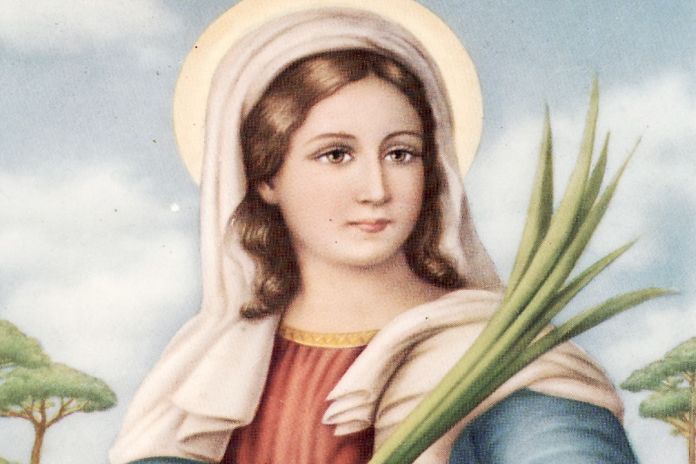

St Lucy’s Day, also known as Lucia Day, is a traditional Swedish celebration filled with children in costumes, elaborate processions, and Swedish treats — all honouring the beloved saint.
St Lucy, whose feast day is celebrated by the Catholic Church on December 13, was a virgin and martyr from Syracuse, Sicily, born in the year 283. The young woman, whose name means “light,” devoted herself to God and to serving the poor.
Legend has it that when Lucy was taking food and supplies to Christians hiding in the catacombs during the reign of the Roman Emperor Diocletian, in order to bring as much as possible in both hands, she wore a candle-lit wreath on her head to light her way.
That story has inspired a long-standing annual tradition of Swedish candle-lit processions honouring St. Lucy on her feast day. Girls dress in long white robes with red sashes. A young girl selected to be “Lucia” — the Italian name for Lucy — wearing a wreath with lit candles in addition to the white robe, leads the “Luciatåg” procession. She is followed by her handmaidens, who also carry a candle; star boys, who carry stars on sticks and have tall paper cones on their heads; and gingerbread men, who carry lit lanterns.
In previous years, the country held a competition on national television to select a woman to be Lucia in the procession. These days, schools and local churches simply choose a girl to be Lucia by random draw. These processions take place across the country in churches, schools, offices, town halls, care homes, and even restaurants.
Swedish treats called “Lussekatt,” which are S-shaped saffron buns similar to cinnamon rolls, also make an appearance in this popular custom. Lucia carries a tray filled with these buns and gingerbread cookies.
The main song people sing is “Sankta Lucia,” which is a Swedish translation of the Neapolitan song “Santa Lucia.” The lyrics highlight the cold, dark winter nights and the light being brought into homes by the saint.
Historically, before reforms to the calendar, the feast of St Lucy landed on the shortest day of the year on the Julian calendar. This made it the longest night of the year. According to Swedish folklore, “Lucia Night” was a dangerous night when dark spirits would come out in full force. By morning, livestock would need extra feed, and people were encouraged to eat seven to nine breakfasts.
In agrarian Sweden, individuals would dress up as Lucia figures and wander from house to house singing songs and scrounging for food. This custom disappeared with urban migration, and the white-dressed Lucia became a more acceptable form of celebration.
The first recorded appearance of the white-dressed Lucia was in a country house in 1764. The custom became a universal Swedish tradition in the 1900s.