



By Lisandro Martin, Juan Jose Leguia Alegria, and Ze Han
In Homer’s Odyssey, Odysseus does not reach home by following a flawless plan. His journey is defined by detours, storms, and course corrections. What matters is not the elegance of his original route, but his ability to adapt as conditions change.
Development projects rarely unfold as planned. Political transitions, economic shocks, and shifting priorities can pull a project off course. By the time problems surface in formal reviews, teams may already be operating with assumptions that no longer hold. The question, then, is not whether plans will diverge from reality — they almost always do — but whether institutions can recognise drift early and respond in time.
In World Bank operations, restructuring is the formal tool to adjust a project’s objectives, scope, or design during implementation.
A new paper examines three questions: Do restructurings improve project performance? Does timing matter? And does the depth of restructuring shape the size and durability of improvements?
Studying restructuring at scale
To answer these questions, we examined more than a decade of World Bank projects, tracking changes in Implementation Status and Results (ISR) ratings – the metrics that reflect how projects are performing during implementation, when decisions can still influence outcomes.
A key challenge is that restructuring is not random. Projects that restructure may already be struggling, making it difficult to separate the effect of restructuring itself from the problems that triggered it.
To address this, we used a matching-based approach that compares restructured projects to otherwise similar projects that had not yet restructured. This allows us to trace how performance evolves after restructuring, rather than simply comparing averages.
What the paper finds: Restructuring is associated with sustained improvement
The results are striking. On average, projects show clear and persistent improvements in ISR ratings after restructuring, both for implementation progress (IP) and project development objectives (PDO). These gains are not fleeting; they persist across multiple reporting cycles (see Figure 1).
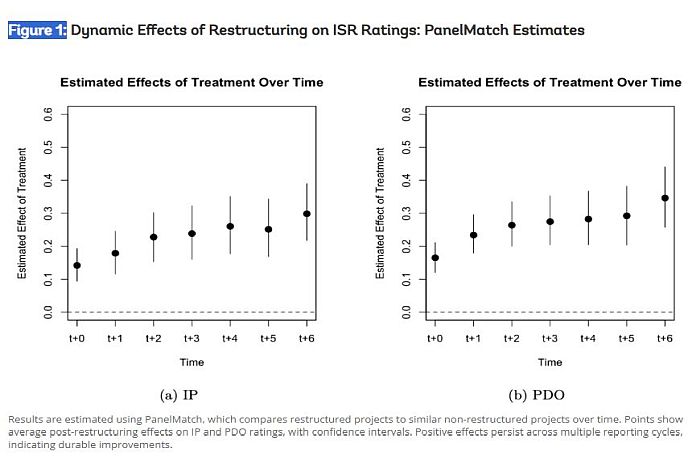
Restructuring is not a cosmetic reset; it is associated with real improvements in delivery.
Timing and depth matter most
Earlier restructurings are associated with more durable gains because teams have sufficient time to internalize lessons, revise course, and still deliver results. Late restructurings can still help, but time constraints limit how much improvement can take hold. This finding echoes a broader lesson from adaptive systems: feedback is most valuable when it arrives early enough to change behaviour.
Depth also shapes impact. Comprehensive restructurings — those that meaningfully change objectives, components, or results frameworks — produce larger and more sustained improvements than minor adjustments. Incremental changes can help stabilise implementation, but they rarely alter a project’s trajectory in the same way that substantive redesign can.
Why restructuring works: A behavioural explanation
These effects are not purely technical. Restructuring forces attention by bringing managers, specialists, and government counterparts back to the table, disrupting inertia, and creating institutional permission to challenge outdated assumptions.
It resets credibility. Clarifying objectives and rescoping activities helps reset beliefs about what is feasible and worth investing in. This process mitigates common behavioural frictions, such as sunk-cost bias and coordination failures, which can otherwise keep teams locked into ineffective plans. By restoring confidence that the revised plan is achievable, restructuring increases the likelihood that managers, teams, and counterparts will re-commit attention, effort, and political capital going forward.
Implications for practice: Normalise timely, substantive adaptation
An emerging idea in development practice is what we have called an “outcome reflex”: not a rule in a manual, but a standing instinct to continually ask whether actions are delivering results that matter for people. It treats plans as hypotheses — constantly tested against evidence rather than assumed to succeed by design.
This points to a practical lesson for development institutions: the goal is not “more restructurings,” but smarter adaptation embedded in routine management.
Create earlier checkpoints with clear decision rules so that evidence prompts timely action before problems become entrenched. Match the response to the diagnosis by distinguishing issues that need lighter adjustments from those that require deeper changes; align the depth of change with the root cause. Strengthen feedback loops by improving the frequency and quality of data on outputs and intermediate outcomes; use implementation trajectories and beneficiary feedback to inform whether to tweak, redesign, or stay the course. Apply data analytics and AI to surface weak signals earlier and highlight where deeper versus lighter adjustments are most likely to matter. These tools do not replace judgment; they reduce the cost of paying attention, and of acting in time.
Finally, avoid counterproductive behaviours. Don’t treat restructuring as failure, rather as a tool for disciplined adaptation. Don’t rely on incrementalism when fundamentals have shifted. And don’t wait for the next formal review when evidence warrants earlier action. In implementation, time is the scarcest resource.